Determining the cost of your data recovery starts with a diagnostic.
In order for us to provide you with a firm quote and no surprises on the cost of recovering your damaged storage device, we must first perform a thorough diagnostic in our certified ISO CLASS 4 clean room (if necessary). And with industry leading hardware designed to work on failing drives, unlock the service area, access and repair firmware modules, build head maps, target user data etc..
Because the diagnosis takes time to complete we do charge a diagnostic fee that applies toward the total recovery cost, if successful. You can view the various diagnostic options below.
Standard Diagnostic Fee (Per Drive)
$106
tax inc.
24-48 hour diagnostics turnaround
Includes a thorough cleanroom examination (if necessary) on all types of hard drives and flash drives including SSD
A firm quote will be provided within 24-48 hours upon starting the case. Gets applied toward a successful data recovery.
Expedited Diagnostic Fee (Per Drive)
$212
tax inc.
6-12 hour diagnostics turnaround
Includes a thorough cleanroom examination (if necessary) on all types of hard drives and flash drives including SSD
A firm quote will be provided within 12 hours upon receipt of drive. Gets applied toward a successful data recovery.
Standard RAID Drive Diagnostic Fee (Per Drive)
$106
tax inc.
48 hour diagnostics turnaround
Includes IDE, SATA, SCSI, SSD and SAS drives
A firm quote will be provided within 48 hours upon receipt of drive. Gets applied toward a successful data recovery.
Expedited RAID Drive Diagnostic Fee (Per Drive)
$212
tax inc.
24 hour diagnostics turnaround
Includes IDE, SATA, SCSI, SSD and SAS drive
A firm quote will be provided within 24 hours upon receipt of drive. Gets applied toward a successful data recovery.
Once the diagnostic has been completed, then we can provide you with a no obligation firm quote based off the complexity of the problems, cost of parts, and time involved. If you agree to the quote, then the work will proceed and you will be responsible for payment upon a successful recovery of your requested (noted on agreement form) data. If the data cannot be recovered for any reason, then no further charges other than the diagnostic fee and cost of parts (if agreed upon) will be due and your drive can be picked up at our office if you’d like it back.
STANDARD TURNAROUND TIME
Most cases are completed within a week without expediting and without additional cost… Where a client wants us working around the clock on a case, there is an expedited fee, quoted for that case and depending on its complexity… The difference is what the default is: a week as standard, with speed available on request, rather than weeks as standard with speed for sale.
What can I expect the recovery to cost?
Professional data recovery is broken down into three levels of complexity for a single hard drive depending on the extent of damages. A description and rough price range is described below to help you understand the potential costs.
USB Flash Sticks
$400+
Advanced “Chip off” or PCB rework
i.e.-NAND degradation, physically damaged or bent boards
Payments made using a credit card carry a 3.5% processing fee. There is no fee if payment is made by check.
SOME CASES CARRY A DEPOSIT FOR THE ATTEMPT
Where a recovery depends on parts bought for your drive specifically, or on helium gas, a non-refundable deposit is required before the attempt begins. That covers what has to be purchased for your case and consumed in the work, whether or not the data comes back.
It is determined once the diagnostic is complete and before any work begins, so you know the figure and what it covers before you commit to anything. It is quoted for your drive by the engineer who examined it: not a percentage of a price tier, and not a position in a queue.
A NOTE ABOUT HELIUM DRIVES
If you have a helium drive that needs data recovery contact us with the exact model and description of the problem, and we’ll let you know if this is a case we can accept before charging you anything or taking up your time.
WHAT A HELIUM DRIVE ACTUALLY REQUIRES
Helium-sealed drives are not ordinary drives with a different label. The enclosure is hermetically sealed at the factory because helium is about one seventh the density of air, and the entire mechanical design depends on it. The heads fly closer. The platters are thinner, so more of them fit. Turbulence that would be unacceptable in air is manageable in helium. Remove the helium and you have not opened a hard drive. You have changed the physics the drive was engineered around.
The moment the seal is broken, helium leaves and air replaces it. Fly height, damping and turbulence all shift at once, on a stack that may carry a dozen or more heads. The drive may still spin and may still read, and that is the trap, because it will not do so reliably or for long. A helium drive opened and run in air is a single attempt, not a process. Whatever imaging you are going to get, you get once.
There are two ways to work with that, and they are the only two. The drive is refilled with helium after the work is done, purging the air out through the release port as the helium goes in and resealing the enclosure. Or the drive is opened and operated inside a sealed enclosure flooded with helium, so the atmosphere is never lost in the first place. Neither is a small piece of equipment and neither is something a repair counter owns. We have performed research and development on different approaches here, because there is no supplier you can buy this from the way you buy a laminar flow hood.
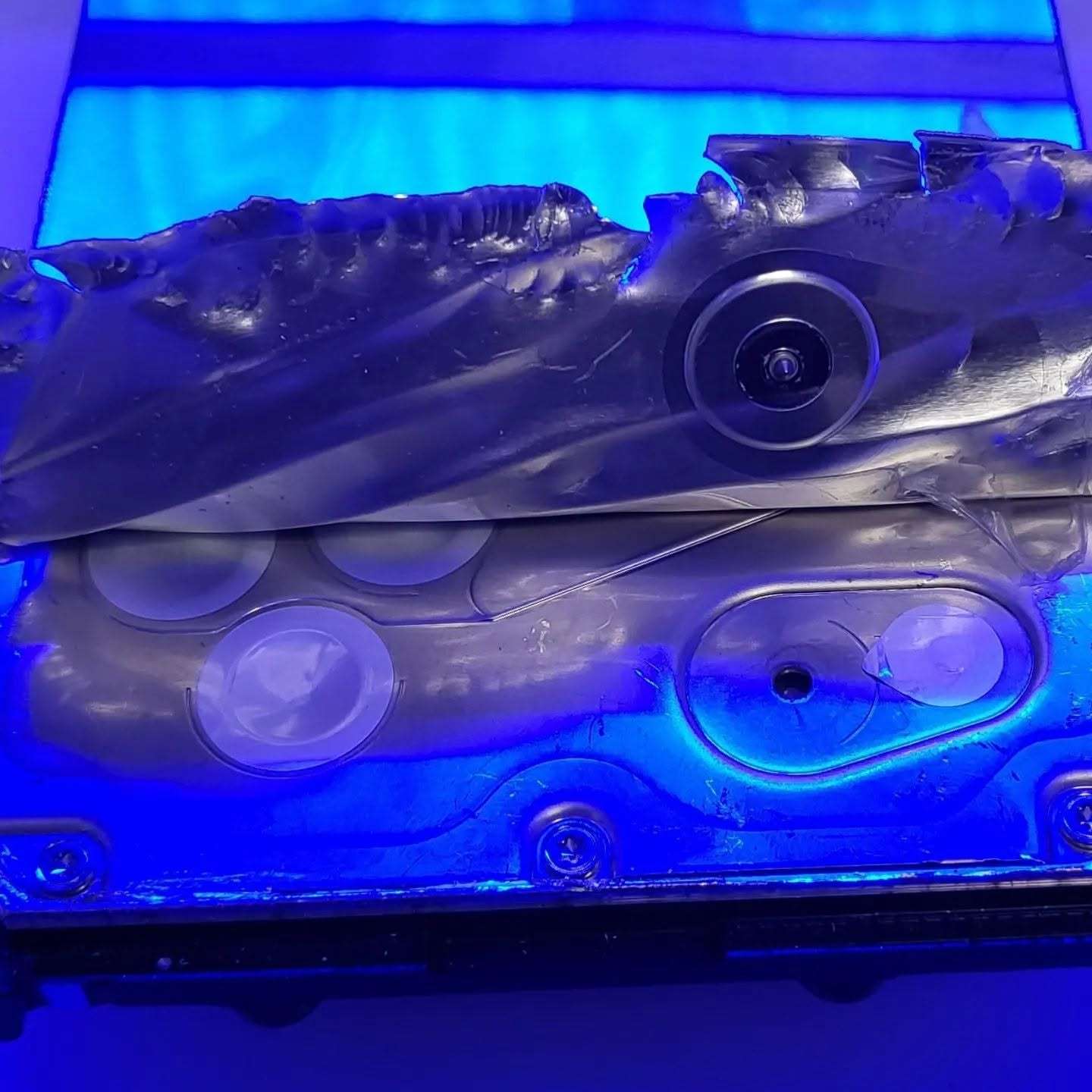
The factory hermetic seal, lifted. This foil is the only thing holding the helium in, and the port beneath it is where a refill has to go back in. Disturb this and the drive is no longer the machine its engineers designed.
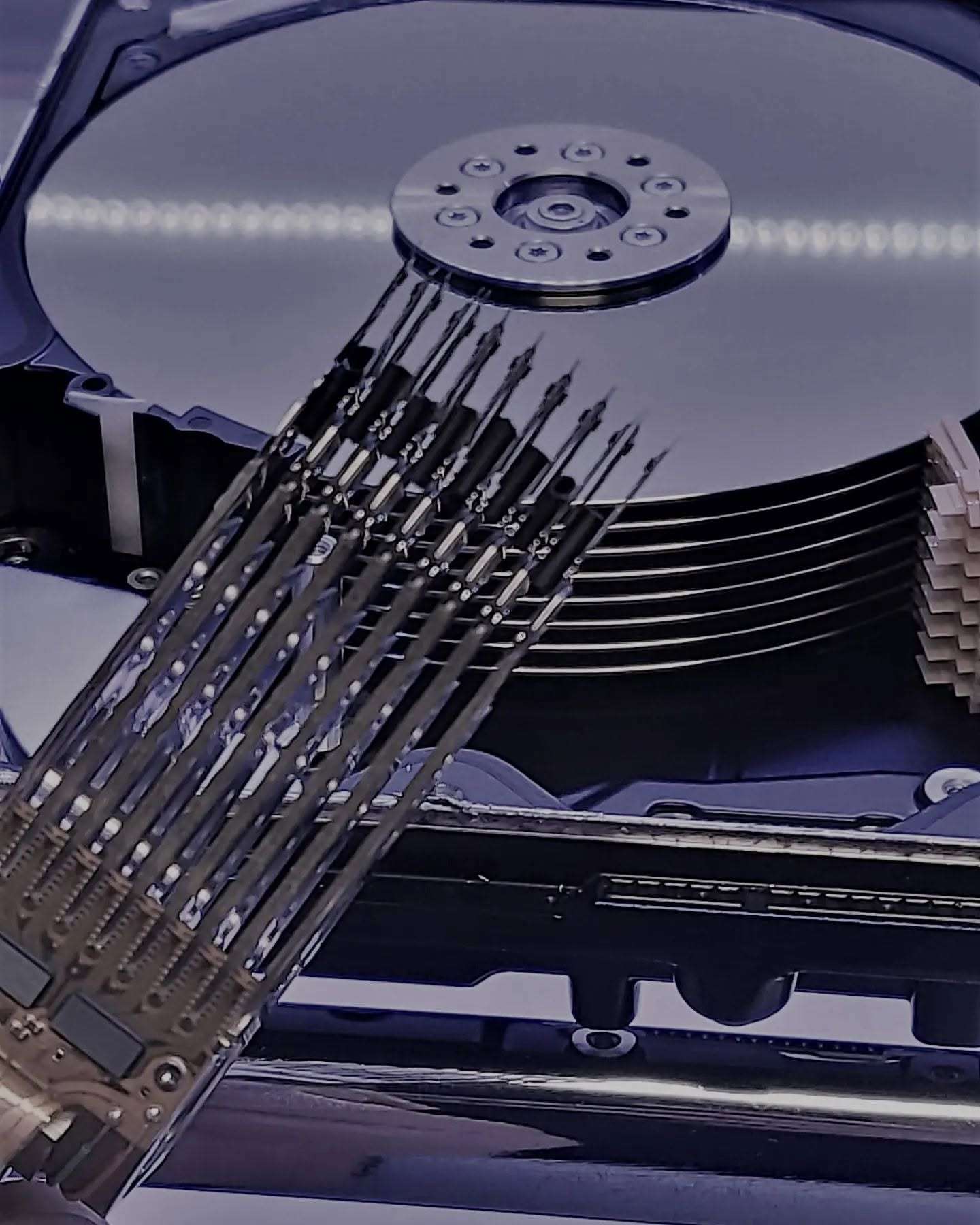
A 12TB helium-sealed drive, sixteen heads, opened in our clean room during development work. The moment the seal is broken the helium is gone and every head on that stack is flying in air.
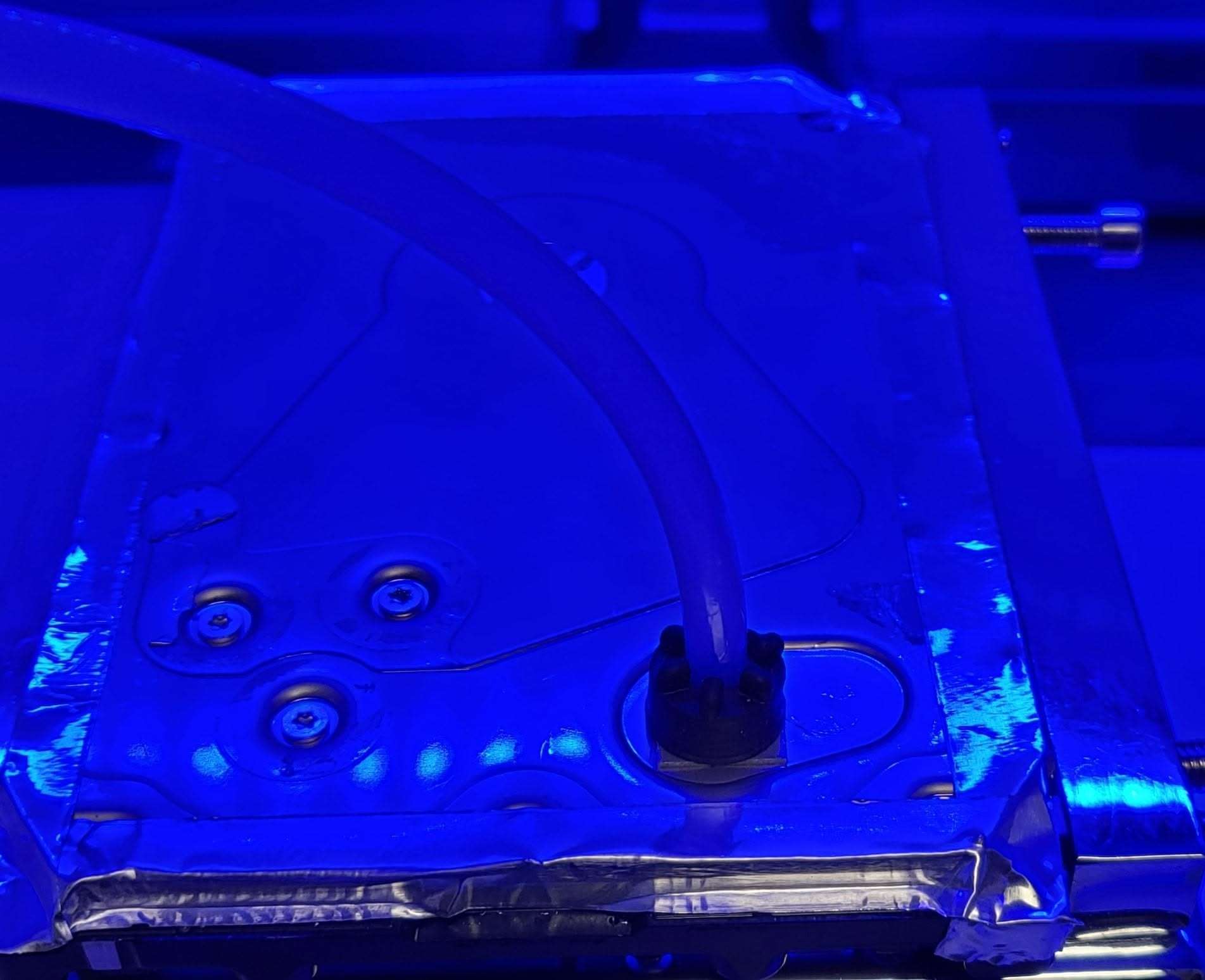
Refilling the enclosure through the release port, purging the air back out as the helium goes in through a bleeder hole. This is development work in our own laboratory, not a photograph of equipment anyone sells.
A point that gets missed: a helium enclosure and a clean room are not alternatives. The enclosure controls the atmosphere. The clean room controls the particles. Opening a helium drive inside a sealed helium box that nobody has ever particle-tested means you have solved the gas and left the platters exposed to whatever is in that box. Both problems are real, and only one of them has a number you can ask for.
Then there is the part no enclosure solves. Modern drives carry adaptive data unique to that specific drive in firmware, and getting to it means unlocking the service area. Without service area access there is very little to be done, whatever the gas is. Support for that is model by model and family by family. Helium drives are not one thing: different manufacturers, different generations, different architectures, and firmware access that exists for some and does not exist for others. A drive that is fully supported and a drive that is not can sit on the same shelf at the same capacity.
Which is why “we do helium recovery” is not an answer to anything. The honest answer names your drive. If you have a helium-sealed drive and a laboratory has quoted you, ask three things. Is this specific model and firmware family supported for service area access, or is that being assumed? What is the drive opened inside, and what is the measured class of that air, certified by which firm and on what date? And is the helium replaced before imaging, or is the drive being run in air as a one-time extraction?
A laboratory that has actually done this work will answer all three in a couple of sentences, because these are the questions it asks itself before it accepts the case. If you have a helium drive that needs data recovery contact us with the exact model and description of the problem, and we’ll let you know if this is a case we can accept before charging you anything or taking up your time.
We offer a permanent 20% discount off of the recovery cost for military, veterans, first responders, seniors, teachers and students with valid ID
My drive is functioning – How much is the data transfer service?
Required before any transfer. Evaluates source & destination devices for safest transfer option. Applies toward total transfer cost. ($106 minimum transfer cost on transfers under 1 hour).
SERVICE
DATA TRANSFER
RATE
$60/hr
NOTES
The total copying time would depend on the size of data, and time involved in parsing, compiling file records, and transfer verifications. Some small transfers stay within the hour while safely transferring terabytes of data can take several hours.
$60 / hr
Professionally Transferred Data
Copy videos, images, and documents from your old devices to a USB flash drive, SSD, RAID box, laptop, or any other non-cloud-based media storage device.
Professionally transferred data starting at $106 (inc. tax) — the most affordable way to ensure your memories and files aren’t lost in the process.
Diagnostic to start – pay one fee for both drives
Diagnostic fee applies toward total transfer cost ($106 minimum cost for transfers up to 1 hour)
$60/hr transfer rate + tax
Work performed by a digital forensics expert
All pricing subject to applicable sales tax
No hidden fees — quote approved before work begins
Destination media must be blank or have adequate free space
We can supply new destination drives at cost upon request
⚠ If Data Recovery Is Needed
If the diagnostic reveals your source device has physical or logical damage and requires data recovery rather than a simple transfer, you will be notified before any further work is authorized.
In that case, the diagnostic fee applies toward your data recovery case. You pay nothing additional unless you approve the recovery quote.
Tri-State Data Recovery proudly offers a permanent 20% discount on all data recovery services for active military and veterans with valid military ID. We understand your sacrifice and are honored to serve those who served us.
Start Your Recovery
Your Data Deserves aReal Laboratory. Not a Middleman.
If your hard drive, SSD, NVMe, RAID, or external drive has failed — stop. Do not power it on again. Do not hand it to a big box store. Call Tri-State Data Recovery and speak directly to engineer Don Anderson at our King of Prussia headquarters today.
We may request cookies to be set on your device. We use cookies to let us know when you visit our websites, how you interact with us, to enrich your user experience, and to customize your relationship with our website.
Click on the different category headings to find out more. You can also change some of your preferences. Note that blocking some types of cookies may impact your experience on our websites and the services we are able to offer.
Essential Website Cookies
These cookies are strictly necessary to provide you with services available through our website and to use some of its features.
Because these cookies are strictly necessary to deliver the website, refusing them will have impact how our site functions. You always can block or delete cookies by changing your browser settings and force blocking all cookies on this website. But this will always prompt you to accept/refuse cookies when revisiting our site.
We fully respect if you want to refuse cookies but to avoid asking you again and again kindly allow us to store a cookie for that. You are free to opt out any time or opt in for other cookies to get a better experience. If you refuse cookies we will remove all set cookies in our domain.
We provide you with a list of stored cookies on your computer in our domain so you can check what we stored. Due to security reasons we are not able to show or modify cookies from other domains. You can check these in your browser security settings.
Google Analytics Cookies
These cookies collect information that is used either in aggregate form to help us understand how our website is being used or how effective our marketing campaigns are, or to help us customize our website and application for you in order to enhance your experience.
If you do not want that we track your visit to our site you can disable tracking in your browser here:
Other external services
We also use different external services like Google Webfonts, Google Maps, and external Video providers. Since these providers may collect personal data like your IP address we allow you to block them here. Please be aware that this might heavily reduce the functionality and appearance of our site. Changes will take effect once you reload the page.
Google Webfont Settings:
Google Map Settings:
Google reCaptcha Settings:
Vimeo and Youtube video embeds:
Other cookies
The following cookies are also needed - You can choose if you want to allow them: