Data recovery costs $400 to $2,500 for most single-drive cases. Logical recoveries start at $400, Level 2 work at $800, and clean room work runs $1,500 to $2,500, with a $106 diagnostic per drive, tax included, applied toward a successful recovery. RAID, NAS, server and forensic work is quoted per case after diagnosis.
There is no charge beyond the diagnostic if we can’t recover it, and you receive a phone call with a firm quote after the drive has been examined, never before.
⚠️ TWO QUOTES FOR ONE DRIVE CAN DIFFER BY THOUSANDS, AND IT ISN’T THE ENGINEERING
Four things explain almost all of the gap. Whether the case is logical or physical, the biggest variable of the four and the one most often left vague. Whether the price contains a second company’s fee. Whether you are paying for speed rather than skill. And whether the quote came before or after anyone examined the drive.
None of that is visible in a number on a screen. Data recovery is an unregulated industry in America, and anyone can advertise the service. This page sets out how the pricing actually works, including ours, so you can compare quotes before you part with an only copy rather than afterward.
HOW MUCH DOES DATA RECOVERY COST?
$106
DIAGNOSTIC PER DRIVE, TAX INCLUDED
OUR NUMBERS, IN FULL
WHAT IT COSTS HERE
Published because you can’t compare what isn’t published, and because a published price cannot quietly contain another company’s fee.
| Work | What it means | Price |
|---|---|---|
| Diagnostic | Per drive, tax included, applied toward a successful recovery. Tells you what failed, the odds of success and what it will cost. | $106 |
| Logical | Deleted files, a corrupted file system, a formatted volume, or a healthy drive inside a machine that won’t start. | From $400 |
| Level 2 | Many bad sectors, firmware corruption or weak heads. The drive is failing rather than failed. | From $800 |
| Clean room | Head replacement, platter damage, seized motor. Donor parts and labor included in the quoted figure. | $1,500–$2,500 |
| Helium HDD | Physical damage. Media, firmware, platter damage or head issues. Cost determined by time, parts, and whether gas is required. | From $1,500 |
| SSD & NVMe | Controller failure, corrupted firmware, degraded NAND, drives that vanish from BIOS. Chip replacement and reflow where the NAND is soldered. | From $500 |
| RAID, NAS, server | Every member repaired and imaged individually before we attempt to reconstruct the copies. | Quoted per case |
| Forensic & legal | Write-blocked imaging, court-ready reports on findings, expert testimony. | Quoted per case |
SOME CASES CARRY A DEPOSIT FOR THE ATTEMPT
Where a recovery depends on parts bought for your drive specifically, or on helium gas, a non-refundable deposit is required before the attempt begins. That covers what has to be purchased for your case and consumed in the work, whether or not the data comes back.
It is determined once the diagnostic is complete and before any work begins, so you know the figure and what it covers before you commit to anything. It is quoted for your drive by the engineer who examined it: not a percentage of a price tier, and not a position in a queue.
Most cases are completed within one week without paying for expedited services. Rush services are offered on emergency cases at an additional expense based on the case and before the case is accepted, so you know the cost and what is possible before you commit.
Active military, veterans, first responders, seniors, teachers and students receive a permanent 20% discount with valid ID. Full pricing is published on our pricing page.
VARIABLE ONE
LOGICAL OR PHYSICAL: THE QUESTION THAT SETS THE PRICE
Before any number means anything, work out which kind of failure you have, because they aren’t the same trade and they aren’t in the same price bracket.
LOGICAL FAILURES
are files deleted, a corrupted file system, a formatted volume, or a healthy drive inside a machine that won’t start. The drive works; the arrangement of the data doesn’t. This is the cheaper half of the trade, it’s often within reach of a repair shop, and if the files were simply deleted and the data is not critical you could purchase consumer recovery software yourself before paying anyone. Stop using the drive first, so nothing overwrites them.
WARNING: Many consumers and repair shops assume a drive is healthy because it is still recognized, when it has actually begun failing through developing bad sectors. Running recovery software on a drive with bad sectors can result in corrupted files, partial recoveries, or complete data loss. Local shops have been known to still charge a hefty price for returning only corrupted data. In professional data recovery the problem files are separated out, so you know exactly what you are paying for.
PHYSICAL FAILURES
are drives that lock up the system, error out, or click, grind, beep, were dropped, went through water, or are no longer detected at all. The mechanism, the electronics or the firmware has failed. That needs a trained engineer, certified clean rooms, precision-matched donor parts, firmware and service-area tooling, and imaging hardware built for the purpose. None of that equipment is something a repair shop owns.
Physical failures are not $400 work. Level 2, where there are many bad sectors, firmware corruption or weak heads, starts at $800. Clean room work on major physical damage runs $1,500 to $2,500. RAID, server and forensic work is quoted per case after diagnosis.
WHAT THE LABORATORY DOES THAT SOFTWARE CANNOT
A laboratory uses professional hardware like the PC-3000 to test the drive, unlock its service area, back up and repair its firmware, create a head map and target the sectors relevant to your data. The file table is read first so the imaging is aimed at the sectors the files actually occupy, weakest areas left for last, while also separating any damaged files so you know exactly what you are paying for.
A counter diagnoses a failing drive by reading it, because that is the only instrument on the counter. The software assumes a healthy drive with a logical fault, so it starts at the beginning and works through to the end, hammering the damaged areas hardest, on the one copy you have. A failing drive has a finite number of reads left in it, and that is how they get spent. Every minute of the attempt is spent out of the drive’s remaining life resulting in creating more bad sectors, a head crash or complete destruction of the drive.
Modern hard drives add a further requirement. The circuit board carries a serial flash ROM holding adaptive data unique to that drive that needs modification to allow access to the service area, so modern data recovery means advanced micro soldering, chip replacement and reflow, and ROM programming and SED unlocking. It takes expert-level training to do any of that without destroying the board or the chip.
It costs more than the shop’s entire tool inventory and it takes years to use properly. What costs you the data is not the diagnosis, it is the attempt. If your drive has already been through it, say so on the first call. It changes the approach, and what can be done.
VARIABLE TWO
Whether the Price Contains Somebody Else’s Fee
A great deal of advertised data recovery is collected in one place and performed in another. The chain usually runs three deep with the most critical gap through several shipping factories and handling: you, the shop or provider that took the drive, and a laboratory nobody named. Each handoff adds a fee, and the invoice shows one number. The price you were quoted then contains somebody else’s fee, a margin you were not shown, shipping risks, possible data theft or a broken chain of custody.
STATED OPENLY
Some arrangements are stated openly. Micro Center publishes its data recovery service as powered by Gillware, a laboratory in Wisconsin; the store is the intake point. Best Buy’s Geek Squad handles software-level cases at the counter and sends physically failed drives to a partner laboratory, which prices them after it has the drive. Knowing that, you can decide whether the convenience is worth the margin and the shipping risks.
Read a brand line literally. Powered by. In partnership with. An authorized location. Cases routed to our partner laboratory. All of those are accurate, and all mean the same thing: the name on the door takes the drive in, and a different company opens it. Disclosure is better than silence, and a brand that names its partner is ahead of one that names nobody. But the disclosure only helps if you act on it, because every question that matters now applies to the second company. Which state and county is the drive opened in. Which ISO class, certified by which firm, on what date. And what is the split between the counter’s fee and the laboratory’s.
HIDDEN PARTNER LAB
Staples publishes prices without naming a laboratory. Its tech services pages list in-store data backup at around $70 and in-store hard drive and flash media recovery at roughly $260, with a no-data-no-charge guarantee and recovered files returned on a new drive or discs. A physically failed drive needs a clean room, and no office-supply store has one, so those cases go somewhere else, but the pages don’t say where. A published price is genuinely useful. A published price with no named laboratory tells you what it will cost and not who will have your data, and a flat figure quoted before anyone has examined the drive is a starting point rather than a quote.
COMPUTER SHOP FRONTS
And some arrangements are not disclosed at all. A national company sometimes uses a repair shop to host its listing on Google Maps, and a page can be generated for a town name without anyone being in the town. Put the street address into a search by itself and see who else is listed there, then put it into Street View and read the sign on the building. Comparing the opening hours of two listings at one address, or asking for the clean room certification, will usually expose the truth.
At 1165 York Road in Warminster, Pennsylvania, two names are listed at the same address: Technoid Computer Repairs, in Suite B, and SALVAGEDATA Recovery Services. Both carry their own listing and their own phone number, so they appear as two separate laboratories a customer could choose between. The building is a small storefront it shares with an unrelated kitchen and bath showroom, and a banner outside advertises a data recovery lab.
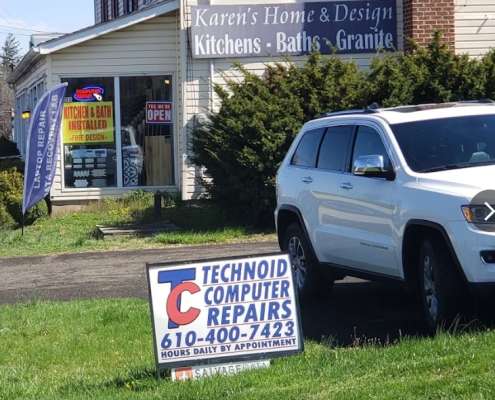
1165 York Road, Warminster. Two data recovery listings, one storefront
Check where the local ones actually are:
- 3663 Hulmeville Rd, Bensalem — a computer and phone repair shop trading under its own name (see image below)
- 106 E Maple Ave, Langhorne — a computer repair business (see image below)
- 50 W Powhattan Ave, Essington — a single-tenant building occupied by an IT services company whose name is on the signage and the parking (see image below)
- 260 W DeKalb Pike, King of Prussia — a computer retailer, name on the pylon sign at the street (see image below)
- 11 N Eagle Rd, Havertown — a cell phone repair shop (see image below)
- 1165 York Rd, Warminster — a computer repair shop (see image below)
- 7827 Old York Rd, Elkins Park · 1192 W Main St, Stroudsburg · 430 Fairmount Ave, Philadelphia — the same pattern (see images below)
The Bensalem and Langhorne addresses are five miles apart and appear as separate local labs. Don’t take our word for any of it. Open Google Maps, search the company name, and look at the addresses yourself. Then drop any one of them into Street View and read the sign over the door.
-
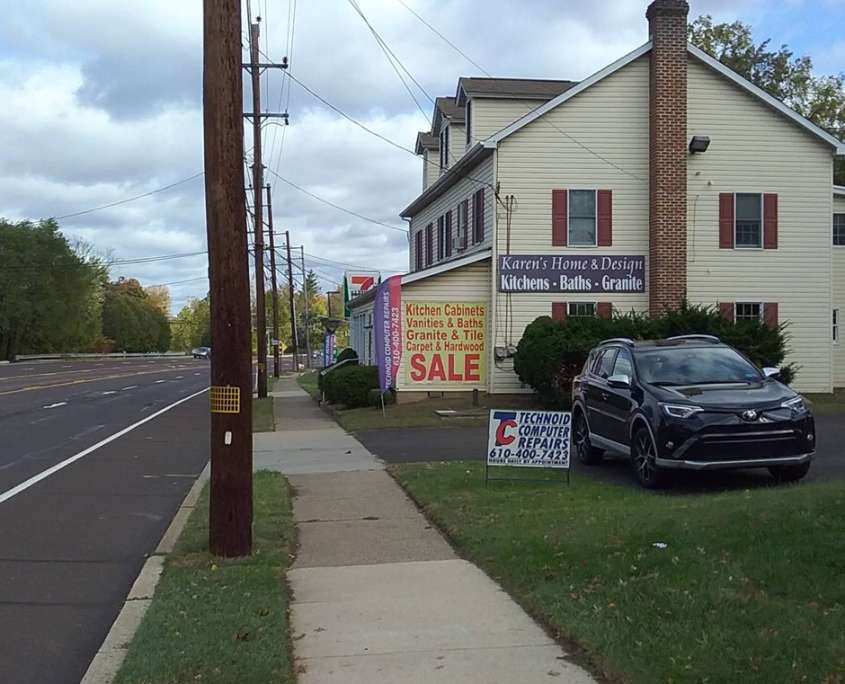
- SALVAGEDATA FRONT 1165 York Rd, Warminster, PA 18974
-
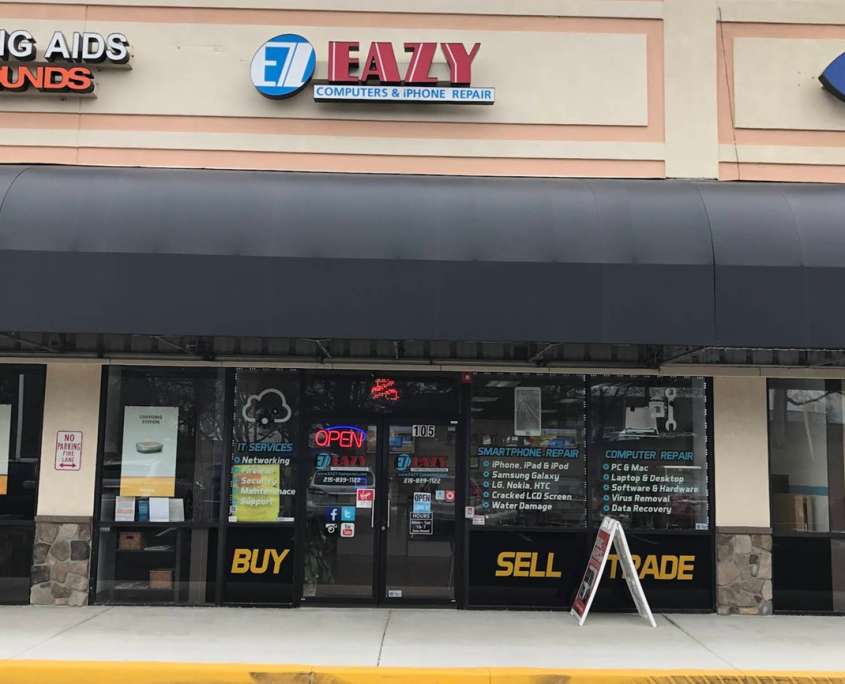
- SALVAGEDATA FRONT 3663 Hulmeville Rd Bensalem
-
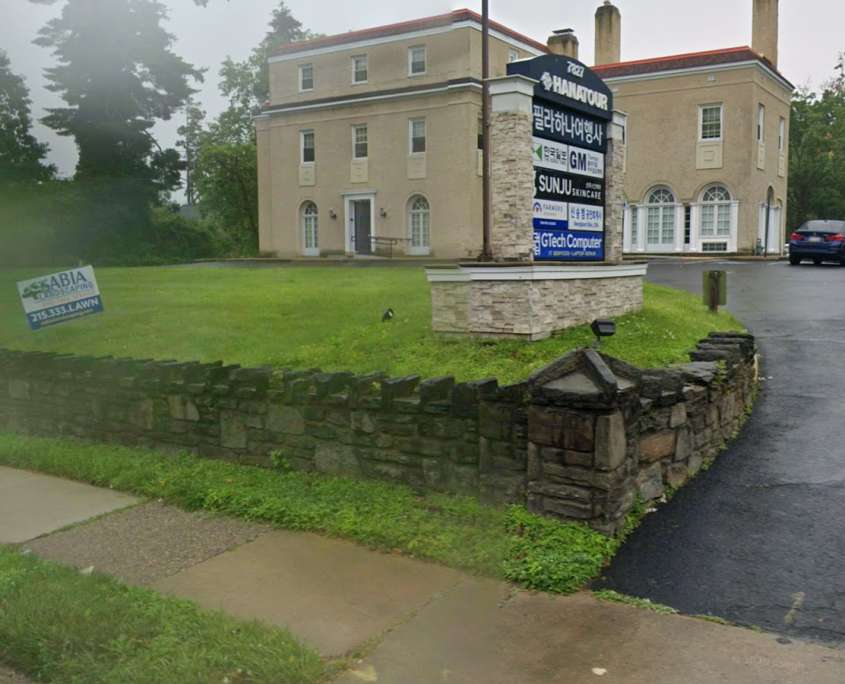
- SALVAGEDATA FRONT 7827 Old York Road – Elkins Park
-
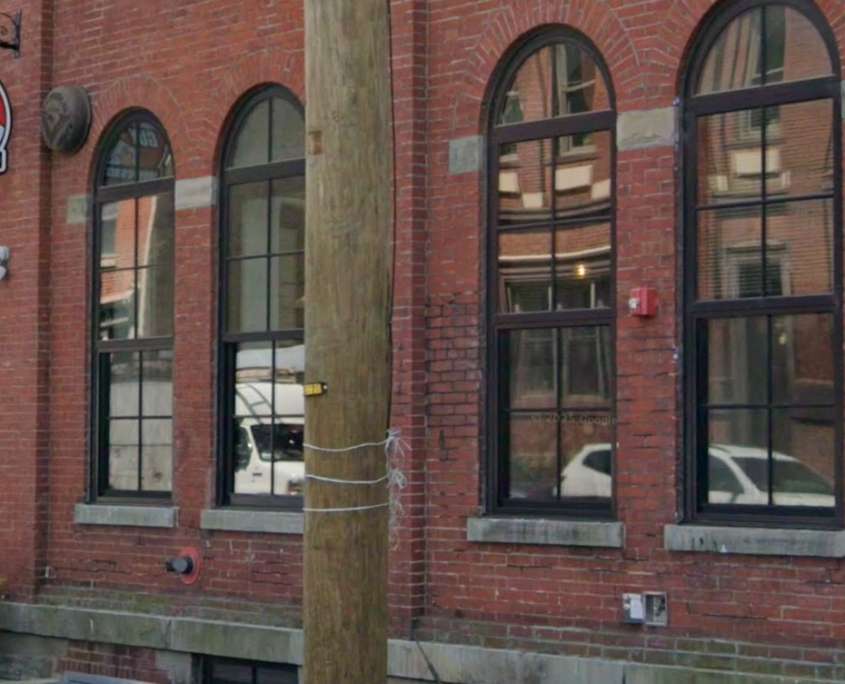
- SALVAGEDATA FRONT 430 Fairmount Ave Philadelphia PA
-
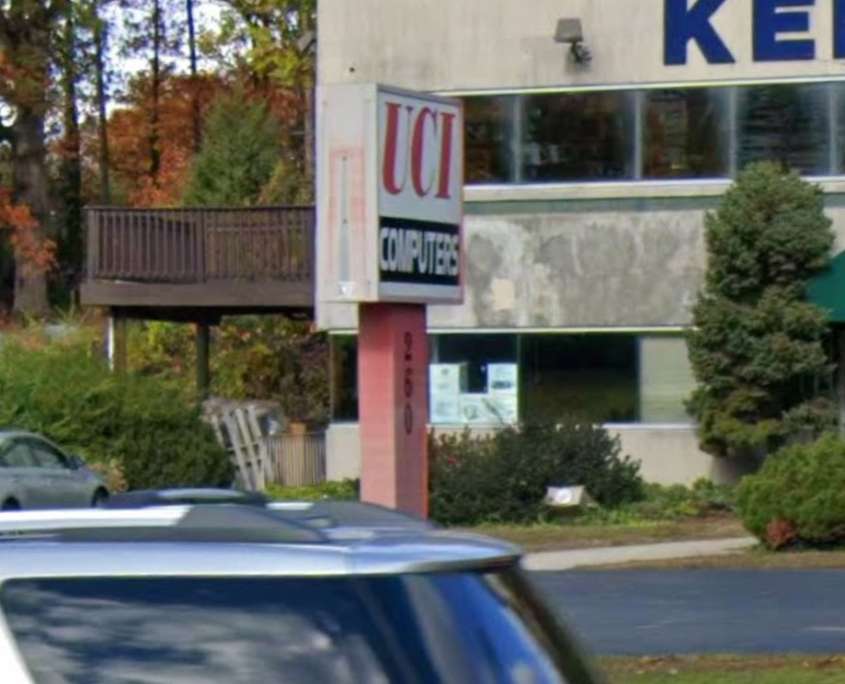
- SALVAGEDATA FRONT 260 W Dekalb Pike King of Prussia
-
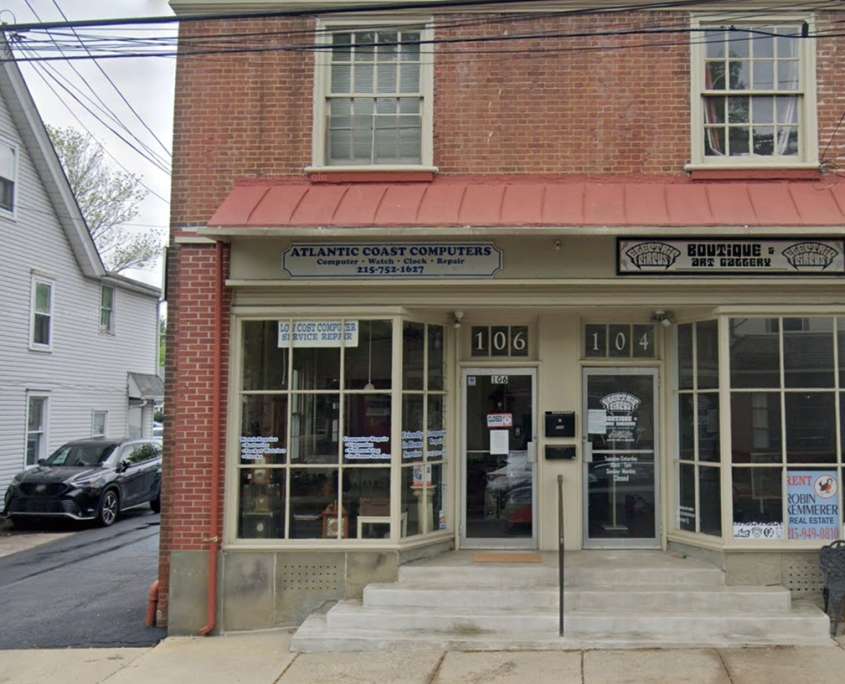
- SALVAGEDATA FRONT 106 E Maple Ave, Langhorne, PA 19047
-
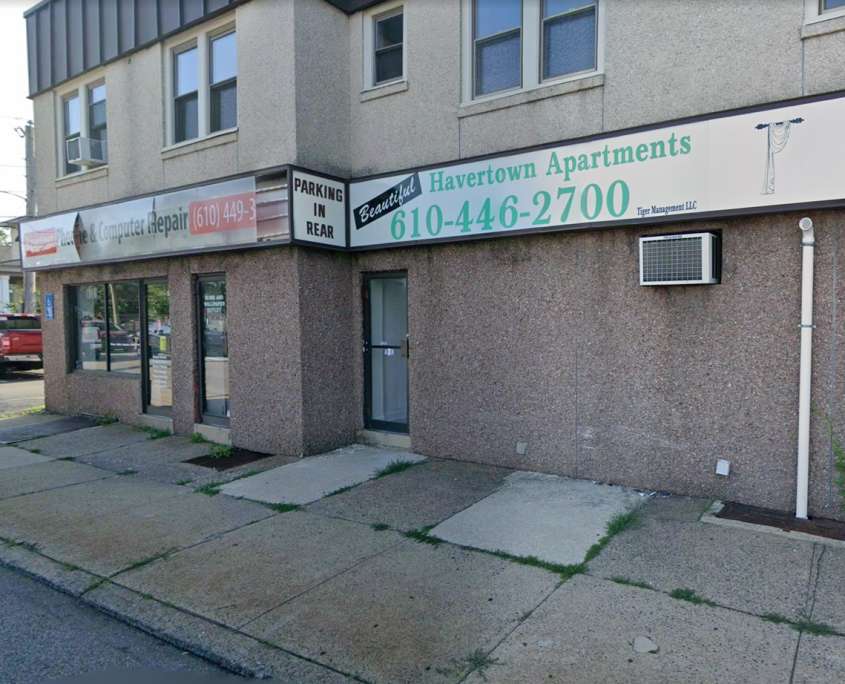
- SALVAGEDATA FRONT 11 N Eagle Rd – Havertown PA – cell phone shop
-
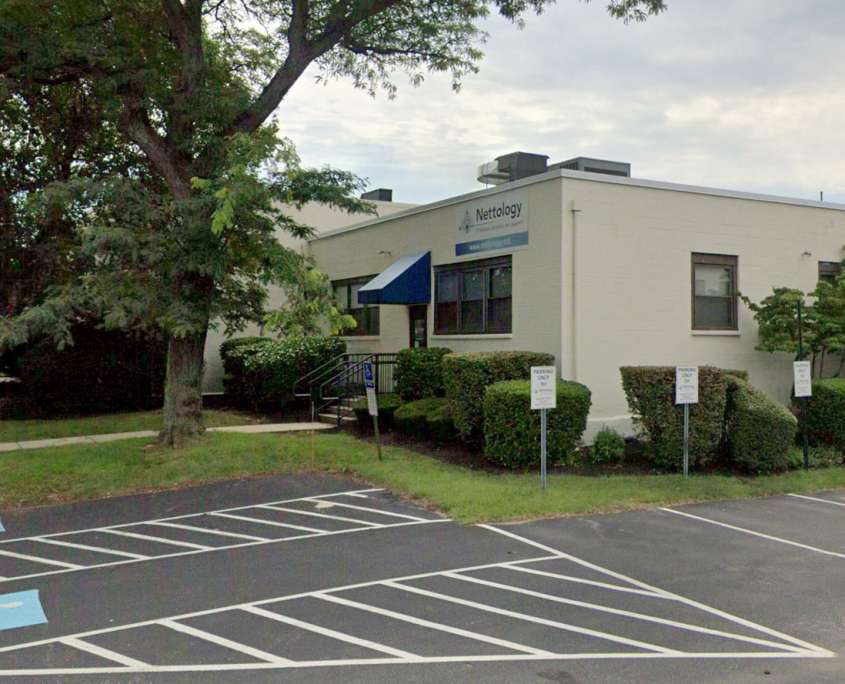
- SALVAGEDATA FRONT 50 W Powhattan Ave, Essington, PA 19029
Search data recovery in almost any town between Washington and Boston and you will find SALVAGEDATA Recovery Services with a local address and a local phone number. Our investigation has now cataloged sixty-four of them, across Pennsylvania, New Jersey, New York, Connecticut, Delaware, Maryland, Virginia, West Virginia and Washington DC. Not sixty-four laboratories. Sixty-four addresses.
The practical consequence is the one worth understanding. A customer who calls the second name because the first didn’t convince them has telephoned the same building twice. The comparison they believed they were making did not take place, and there is no disclosure anywhere in the results to tell them so. We have filed complaints with Google’s Business Redressal program on all sixty-four addresses where a national recovery listing sits at premises occupied by an independent business.
The form is public and free, and anyone can do the same.
We are one company with one point of contact: our headquarters in King of Prussia. It shares a building with other businesses, but our office is private and ours alone — the signage inside reads Tri-State Data Recovery.
Our recovery laboratory and certified clean rooms are housed separately, in an undisclosed, camera-monitored secure compound in Montgomery County. That facility is not open to the public — and by design. The sensitive data we handle, including files that may serve as legal evidence, demands strict chain-of-custody and HIPAA compliance, and a secure, access-controlled lab is how we guarantee it. Your drive never leaves Montgomery County or our chain of custody. And the engineer you speak with on the phone is the same person who opens it.
OUR OFFICE, AND OUR LABORATORY
ONE COMPANY, ONE POINT OF CONTACT
We are one company with one point of contact: our headquarters in King of Prussia. It shares a building with other businesses, but our office is private and ours alone — the signage inside reads Tri-State Data Recovery.
Our recovery laboratory and certified clean rooms are housed separately, in an undisclosed, camera-monitored secure compound in Montgomery County. That facility is not open to the public — and by design. The sensitive data we handle, including files that may serve as legal evidence, demands strict chain-of-custody and HIPAA compliance, and a secure, access-controlled lab is how we guarantee it. Your drive never leaves Montgomery County or our chain of custody. And the engineer you speak with on the phone is the same person who opens it.
So ask before anything moves, and ask it of us as readily as anyone else: is my drive shipped out of state, what is the name of the engineer that views my data, does this price include another company’s fee, which laboratory does the work, where is it, and what would that laboratory quote me directly? A single laboratory answers with one company and one name, and can tell you the town and county the work is done in.
VARIABLE THREE
Rush Tiers: When the Product Is the Queue
MAIL-IN OPERATIONS
Rossmann Repair Group, based out of Austin, Texas, publishes the queue price directly: “+$100 rush fee available on any job to move to the front of the queue,” under a site-wide notice reading “Add one to two months to every turnaround time published on this site.” Head replacements, surface damage and NAND swaps also carry a “50% deposit required,” and return shipping is conditional: “You pay return shipping if you want your original drive back.”
The ladder runs a second column for helium-sealed drives, where a head replacement is $3,000 to $4,500 and surface or platter damage is $4,000 to $5,000, with the helium refill billed separately at $400 to $800 on top and the donor drive on top of that. Apply their own backlog notice to their own four to eight week turnaround and a four thousand dollar job lands somewhere in the fourth month, half of it paid before the work starts.
Mail-in operations processing work from a wide area publish tiered turnarounds, and the shape is consistent: a standard service measured in weeks, then escalating fees to be handled sooner. A few hundred dollars to be seen within the week, more for a two-day turnaround, and up to four figures for same-day attention.
Read that structure carefully, because it tells you what the default is. The rush fee doesn’t buy better engineering. It buys position in a queue you were placed at the back of. The same engineer, the same equipment, the same clean room, earlier. And the standard tier being weeks long is a description of how much work is stacked ahead of yours.
CAUTION: Using a mail-in operation that routes your drive through an intake point carries many risks, including a lost chain of custody, potential HIPAA violations, package damage or loss, and possible data theft.
Ours works the other way round, because there is one laboratory and one engineer and the timeline is published rather than sold. Most cases are completed within one week without paying for expedited services. Rush services are offered on emergency cases at an additional expense based on the case and before the case is accepted, so you know the cost and what is possible before you commit. The difference is what the default is: a week as standard, with speed available on request, rather than weeks as standard with speed for sale.
VARIABLE FOUR
What a Free Evaluation Costs You
FREE DIAGNOSTIC OR FLAT RATE
A mail-in operation is the same arrangement with the counter removed. A free evaluation and a no data, no charge guarantee both describe what happens before a price exists, not what the recovery costs. The figure is set once your only copy is already inside a building you have never seen, at which point declining it means asking for the drive back, wondering what was done to it and hoping that it returns in the same condition as when it left. A prepaid shipping label is not a convenience in that arrangement. It is the step that makes the rest of it possible.
Ask before the label is used: what state and what county is the drive opened in, by who? What equipment are they certified on and can they prove it? Which ISO class is the clean room, and will you email me the certificate. Scheduling an appointment and hand delivering the drive is always the safest option and assures the chain of custody is kept intact, but some people still choose to ship, and our shipping page explains the proper way to do it, the risks involved in exposing your drive to the shipping process, and which service to use.
NOTHING CHARGED MEANS NOTHING ITEMIZED
Check the pricing yourself before you rely on any figure, including the ones on this page. That operation publishes a full price ladder rather than withholding a number until the drive arrives. It also charges no diagnostic fee, and that is the part to read twice, because a free diagnostic is not a discount. It is the step that removes the paperwork. Where no money changes hands there is no transaction, and where there is no transaction nothing obliges anyone to itemize what was opened, what was removed, what was attempted, or what condition the drive was in when it arrived. You paid nothing, so you are owed nothing on paper. The figure that matters arrives later, after your only copy is already inside a building you have never seen, and by then the question is no longer what the recovery costs. It is what it costs to get the drive back.
And one more that almost nobody thinks to ask, which is why it is worth asking. Will the drive come back in the same condition it left in? A drive returned after a declined quote may have been powered on repeatedly, had recovery software run against it, or been opened. A drive that was left alone is a materially different job from one that has been tried repeatedly, so a declined quote can quietly cost you more than the return postage. Get the answer in writing before anything ships.
A published diagnostic fee answers all of it in advance, which is the entire reason we charge one. $106 per drive, tax included, applied toward a successful recovery. You know the number before we have anything of yours, and you can compare it to anybody.
AND WHERE THE RECOVERED COPY ENDS UP
THE HANDOFF NOBODY COUNTS
A mail-in operation typically finishes by uploading the recovered files to a cloud account and emailing a download link, and the speed of that handoff is what gets advertised. Count the exposures. The only copy travels through a courier system. It is handled by technicians the customer never meets in a building they have never seen. And then a second copy of everything is pushed to a third party’s servers, under a retention policy the customer did not choose and cannot audit, reachable by a link that arrives in email. A company can call that secure. It cannot show you the copy being deleted.
Ours is handed back in person, on media. The files are verified with the engineer before you pay, and recovered data is securely erased two weeks after completion unless you arrange otherwise in writing.
A WORKED EXAMPLE
WHEN THE PRICE IS THE BRAND NAME
A Los Angeles company trades nationally as $300 Data Recovery, advertising into all fifty states and taking devices by mail. Everything below comes off its own pricing page. It is not $300.
The published tiers are $300, $500 and $700, set by the capacity of the device rather than the work involved. Any SSD is $500 regardless of size: a 256GB solid-state drive is a $500 recovery. Phones and tablets are $500. A 4TB drive holding 50GB is priced as a 4TB drive.
Their no data, no fee guarantee carries its exclusions inside its own parenthesis: “we only charge if we successfully recover your data (excluding the cost of a donor drive, shipping, and up-front fees, if applicable).” Three categories are carved out of the guarantee, and one of them is up-front fees.
Then come the items billed separately: donor parts, a transfer drive to receive your data, return shipping at $20 to $25, a $100 fee if the drive’s cover was ever opened by anyone, and a $100 labor fee if you decline a recovery that came back under 99%. Priority handling is $100 up front plus $200 on success. Transfer drives run from $135 for 1TB to $900 for 22TB. Their own published example of a customer quoted $300 and billed $525 appears in a review reply on their Google profile.
Arrays are where the name stops meaning anything, because each drive is charged at its own tier and the tiers are added together. These are their published examples, not ours:
2-drive mirror, both 1TB — $600
4-drive RAID-0, all 4TB — $2,000
4-drive all-SSD array, any size — $2,000
8-drive NAS, all 14TB — $5,600
And there is one more thing on that page worth reading closely, because it is the subject of this whole article. Phones and modern Macs with soldered SSDs are sent to a specialist. Their own page describes their role in those cases as project manager, sets the Mac specialist fee at $800, and adds three separate $25 shipping legs. For that class of work, the company advertising a flat rate is the intermediary.
Their frequently asked questions page sets out four categories of work it sends elsewhere. “If we can’t recover your flash/SSD device, we may offer to send your device to a flash/SSD specialist (we have special agreements with a few companies for our customers),” at $500 to $600 plus shipping. An iPhone goes to “an iPhone logic board specialist” at $600, or $800 for an iPhone 15. A hard drive they cannot recover gets a referral to another company, with the transfer handled and the relationship handed over afterward.
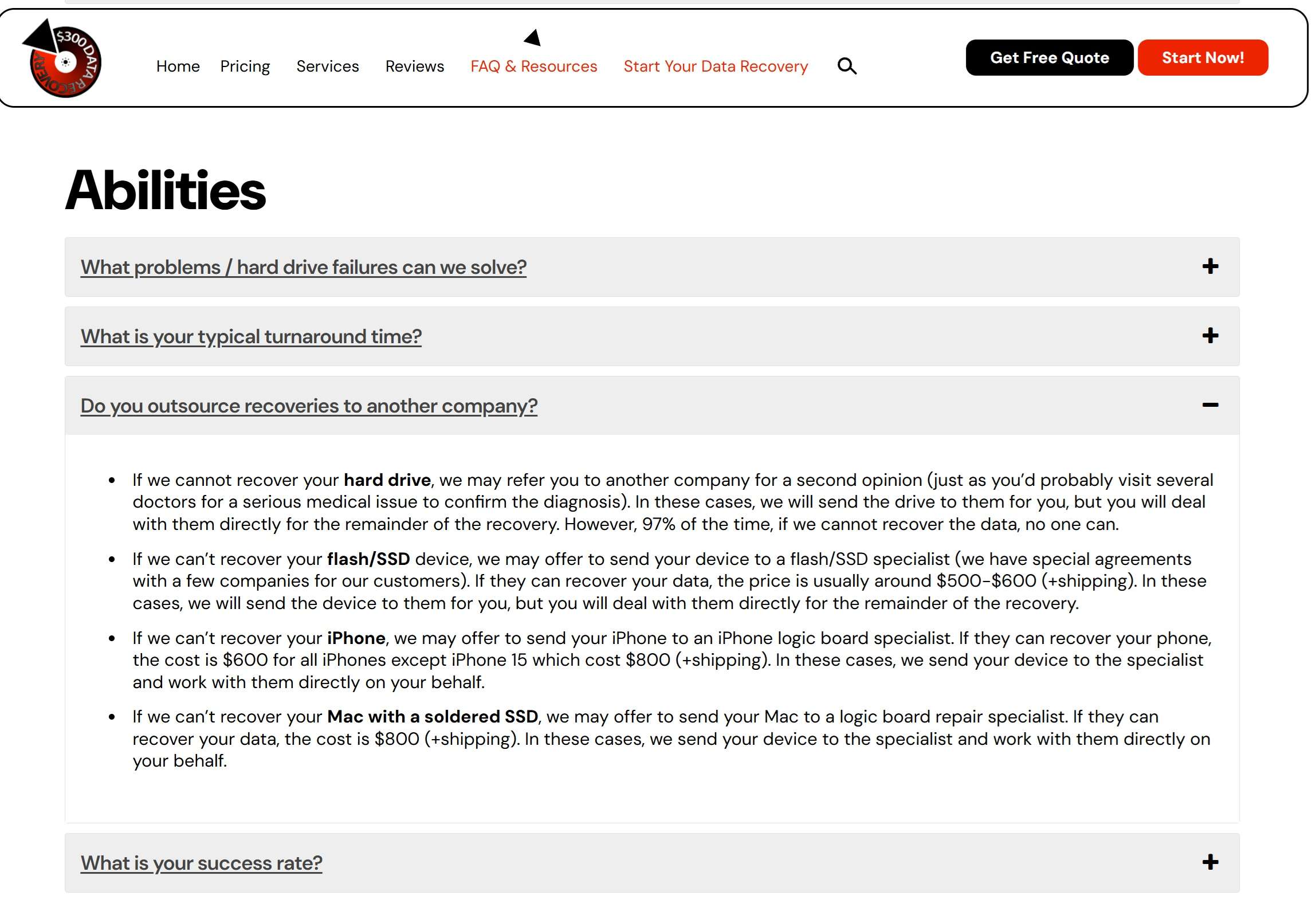
A different page on the same site says: “We are a full-service data recovery company and perform all repairs in-house. This includes head swaps, platter swaps, firmware corruption, and even manually rebuilding failed RAID arrays.”
Both sentences are published by the same company today. One says all repairs happen in-house. The other names four categories that go to outside specialists, with prices attached. We are not going to tell you which is true. We are telling you that a customer reading the first page would not know the second exists.
The same page states: “97% of the time, if we cannot recover the data, no one can.” It sits two paragraphs from the offer to send your device to a specialist who might. The homepage separately publishes “35,000+ successful recoveries” and a “90%+ success rate for RAID recoveries.” No independent body audits any of those figures. We publish no success-rate figure of our own, for that reason.
Now notice what a page that itemizes $20 return shipping, a $135 transfer drive and a $100 fee for an opened cover does not itemize. There is no class number for the clean room on the pricing page at all: the words clean room, head swap and platter swap appear, but the figure that would let you check any of it does not. The company’s own frequently asked questions page describes an ISO 5 environment. That is a real number and it is worth knowing what it means. It is one step dirtier than the Class 4 this work is done to, described in a place a customer comparing prices is unlikely to look.
A SECOND WORKED EXAMPLE
NUMBERS THAT DON’T DIVIDE
A Phoenix company trades as Desert Data Recovery. Its homepage states 71,380+ cases completed, 5,000+ donor drives in stock, and a 5.0 rating from 205 Google reviews. Its About page states the business was founded in 2013 and is now a division of ioLogik LLC. Posted hours are Monday to Friday, 9:00am to 5:00pm, and its own locations page states that “all work is completed in our fully equipped Phoenix office.”
Thirteen years at 71,380 cases is about 5,491 a year. Against the hours that page itself posts, Monday to Friday, nine to five, that is roughly 21 completed cases every working day at one laboratory, or one finished case about every 23 minutes the doors are open, sustained for thirteen years with no holiday, no vacation day and no weekend off. Over the same period, the 205 reviews published on that page when we read it work out to one review for every 348 cases.
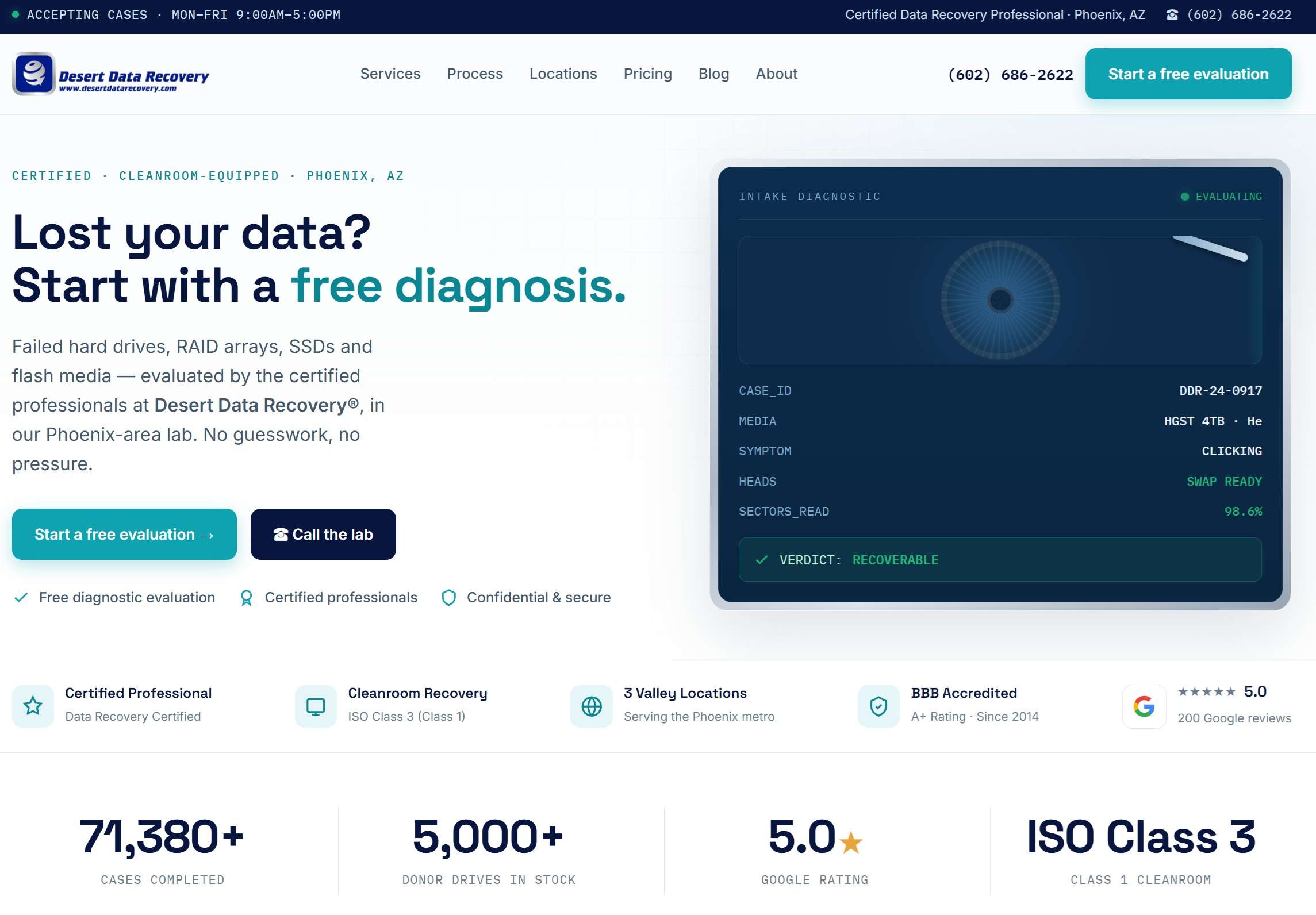
None of those figures is audited by anyone. That is the point of showing you the arithmetic rather than the claim. A case count is the easiest number in this trade to publish and the hardest to check, which is why the things worth asking for are the ones somebody outside the company put their name to: the clean room certificate, the training certifications, and the name of the engineer who opens the drive.
Claims about this company were read from their own published pages and verified on 1 October 2026. Published pages change, and this one has several times since posting about them.
A PAGE FOR EVERY CITY
THE LOCAL RESULT THAT WAS NEVER LOCAL
Search data recovery in almost any American town and two names surface repeatedly, in places neither has ever operated. Rossmann Repair Group, whose repair shop is in Austin, Texas. MDRepairs, whose repair shop is in Lincroft, New Jersey. Both publish a page for city after city across the country, built from one template with the place name swapped in.
Both pages have changed since we first wrote about them, and the change is worth recording. Rossmann’s Pennsylvania page used to print a mileage figure beside each city. Those figures are gone. What replaced them is a sentence we would rather see on every page of this kind: “Rossmann Repair Group has one lab, at 2410 San Antonio Street in Austin, Texas. We have no office, drop-off point or technician in Philadelphia or anywhere else in Pennsylvania.” MDRepairs now carries its own version: “MDrepairs serves Pennsylvania through our mail-in program. This page does not represent a Pennsylvania storefront.”
Credit where it is due. That is disclosure, it is more than most of this industry manages, and both companies are run by people who do real work. It does not change what the pages are for. A page built for the words data recovery Philadelphia still reaches somebody who typed those words expecting a laboratory they could drive to, and that person now has to read down to the disclosure to find out otherwise. The headline is still the thing that wins the click.
The Rossmann Pennsylvania page is the clearer illustration. It is headed Pennsylvania Hard Drive Data Recovery and it lists six cities — Philadelphia, Pittsburgh, Harrisburg, Lancaster, Reading and Scranton. The instruction on every one of them is to “ship it to 2410 San Antonio Street, Austin, TX 78705.” From Philadelphia that is roughly fifteen hundred miles.
The same page carries a second notice worth reading before you ship anything: “Add one to two months to every turnaround time published on this site. We’ve had a temporary influx of work that put us behind. Until that changes, plan on one to two months on top of whatever turnaround you read on any service or pricing page here.” So a drive sent from Pennsylvania travels roughly fifteen hundred miles into a queue the site itself measures in months. That is published, and we would rather a company said it than hid it. It is still a fact you want before the box leaves your hands, not after.
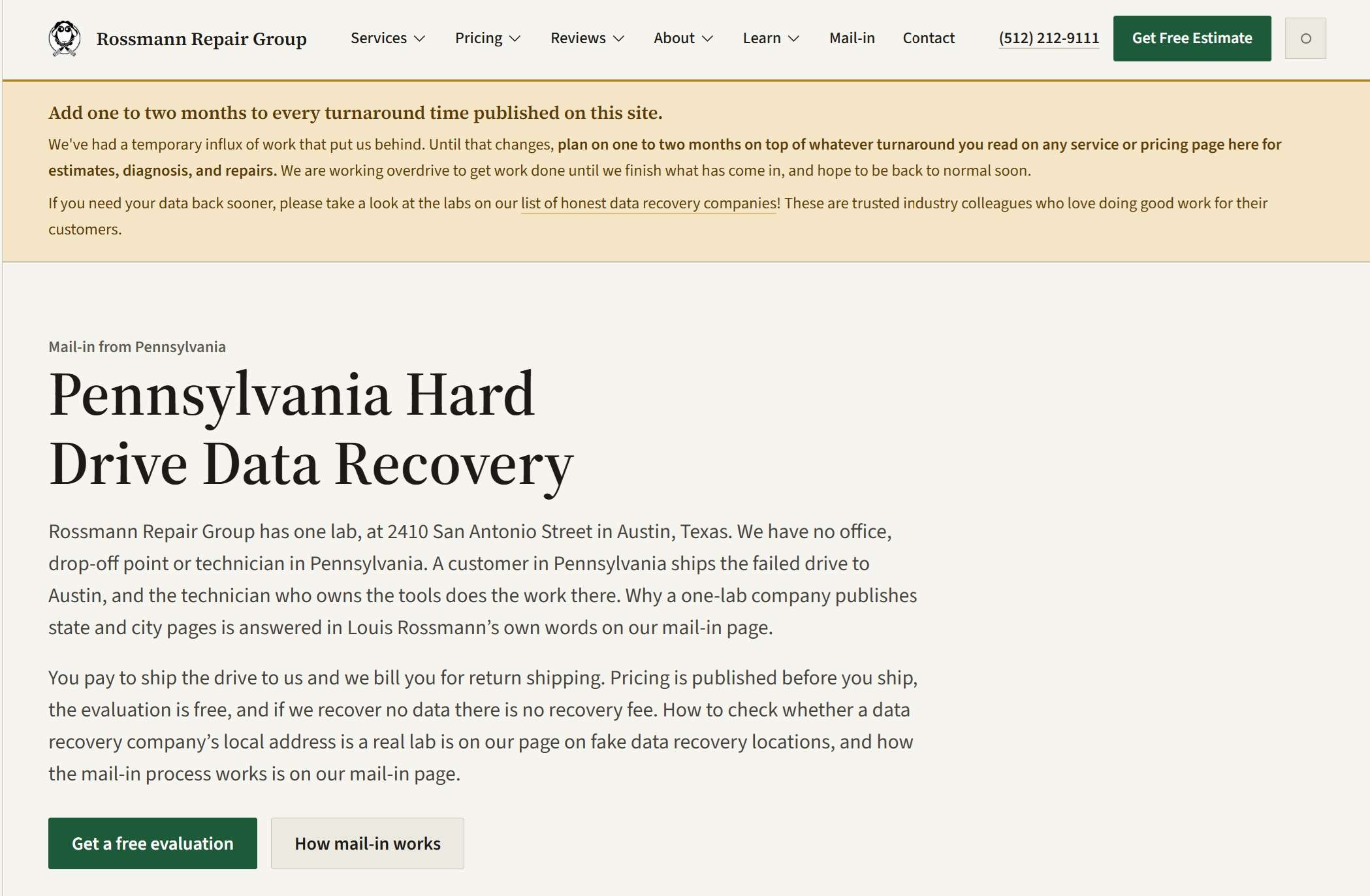
MDRepairs is a shorter trip and a longer list. Lincroft, New Jersey is a real address with a real shop in it, and for a reader in Bucks or Philadelphia county it is a drive rather than a flight. But the Pennsylvania page lists 313 separate Pennsylvania place names, and we counted them. Among them is Erie, which is better than four hundred miles from Lincroft, and Centralia, the abandoned mine-fire borough whose 2020 census population was five. Published turnaround on that page is four to six weeks. Three hundred and thirteen towns is not a service area. It is a keyword list.
There is one more layer, and it explains why these names keep appearing together. The Rossmann page routes readers who need data back sooner to “the labs on our list of honest data recovery companies,” described there as “trusted industry colleagues.” The company publishing that list also states it refers work it “can’t handle in-house to labs that can.” What that means for you is practical rather than sinister: choosing one of these names does not necessarily narrow the field to one company, and it is worth asking whether the recommendation you are reading is independent or reciprocal before you treat it as a second opinion.
So the check is the same as everywhere else on this page. Read the address, not the headline. Ask where the laboratory physically is, what the current turnaround actually is, and who opens the drive. Then ask for the document that separates a workshop from a certified laboratory: the clean room certificate, naming the testing firm, the standard, the class, the date and the technician who signed it. And ask for proof of their training. A page can be written for your town in an afternoon. A certificate cannot.
Claims about these two companies were read from their own published pages and verified on 5 October 2026. Published pages change, and these two have since posting about them.
THE ISO CLEAN ROOM CHECK
A STATED CLASS IS A CLAIM. A CERTIFICATE IS A MEASUREMENT.
ISO 14644-1 runs 1 to 9, lower is cleaner, each step about ten times. “ISO-certified” with no number tells you nothing. Class 9 is roughly an ordinary office, and “Class 100” comes from a standard withdrawn in 2001 and is about equal to ISO Class 5, one step dirtier than the Class 4 this work is done to. Ask for the document naming the testing firm, the standard, the class, the date and the technician who signed it. This matters more than anything when the platters are exposed for hours during a multi-platter recovery procedure.
This is the distinction worth understanding, because the hardware itself is buyable by anyone. An enclosure, a filter and an ionizing blower can be ordered online in an afternoon. What cannot be bought casually is an outside testing firm measuring the particle count inside it, issuing a certificate naming a standard and a class, and repeating that measurement on a recurring schedule. An enclosure tells you somebody bought equipment. A certificate tells you somebody measured it.
You will also see a filter specification offered in place of a class. A 0.02 micron ULPA-filtered laminar flow hood is a component that was purchased; an ISO class describes air that was measured, by an outside firm, on a stated date, with a signature on the certificate. Where the argument is made that ISO 14644-1 specifies particle concentration per cubic meter of air and does not require a walk-in room, that is correct, and it is not an answer to the question. A laminar flow hood can be measured and classified exactly like a room can. The question was never whether the enclosure has walls. It is what the measured class of that air is, which firm measured it, and on what date.
The same applies to photographs, including ours. A picture of an enclosure proves somebody owns an enclosure. It tells you nothing about the air inside it on the day your drive is opened.
We run two clean room flow hoods, both independently certified to ISO Class 4 under ISO 14644-1:2015 and both particle-tested by the firm that issued the certification, on a recurring schedule. The certificate names the testing firm, the class, the date and the NEBB-certified technician who signed it, and we’ll email it to you before you commit to anything. See our certifications page.
AND THE SAME QUESTION APPLIES TO THE ENGINEER
Anyone with money can purchase expensive equipment, but how do you know they are experts on it without proper training? A clean room, a PC-3000 and a shelf of donor drives can be bought by anyone with the capital. None of it arrives with the knowledge of how to use it.
Years in business is not a substitute, and it is the claim you will see most often. Anyone who worked in IT for twenty years can advertise twenty years of experience. A number of years describes how long a company has existed. It says nothing about which platforms its engineer was trained on, by whom, or whether anyone has opened a drive in filtered air. Longevity is a fact about a business. Certification is a fact about a person.
So a list of equipment is a receipt, not a qualification. A certified clean room in untrained hands is a well-filtered environment in which to destroy a drive: one wrong decision about a head replacement or a firmware area ends a recovery just as permanently in ISO Class 4 air as anywhere else. Ask which platforms the engineer is certified on, which body issued it, on what date, and whether they will send the documents. Ask it anywhere and the answer arrives in minutes or it doesn’t arrive.
Ours: expert-level certification on both PC-3000 and DeepSpar, micro-soldering rework and repair completed at ACI Technologies in Philadelphia in March 2020, and Certified HIPAA Security Professional through 4Med in September 2013, each with a named issuer and a date, and every document is on our certifications page.
A headline number wins the search and sets an expectation before anybody has seen your device. A capacity tier is not a diagnosis, and a name is not a quote. Read the separately-billed list, add up what applies to your device, and compare that figure rather than the one on the sign.
And weigh the journey, because it is part of what you are buying. A company advertising into all fifty states is asking every one of those customers to put their only copy in the mail and send it across the country: a transit you cannot watch, a queue you cannot see, and a chain of custody that starts the moment somebody else’s hands are on it.
Are you really paying less, or just risking more?
READ THE QUOTE LIKE AN ENGINEER
Three Claims Worth Questioning
“It’s in the clean room.” A clean room exists for one purpose: opening a sealed hard drive, where a single particle landing on an exposed platter destroys data permanently. Solid-state work is different. Removing a NAND chip from a board is board-level work with a hot-air station and a microscope, and it does not happen in filtered air because it does not need to. If a clean room is being cited for a device that has no platters in it, ask what specifically is being done in that room and why it requires one.
“It’s encrypted.” Encryption is often presented as though it were a technical obstacle that justifies a large figure. It is not. A BitLocker volume opens with the recovery key, and that key is yours: no laboratory can decrypt without it, and none needs a clean room to use it. It is also worth knowing that not every device is encrypted at all. On the earliest Surface Pro models the NAND is soldered but unencrypted, so once the chip is removed it can be read directly. On later models the picture reverses: the storage is bound to a TPM 2.0 security chip on the mainboard, which means removing the NAND yields nothing readable on its own. So encryption is not a difficulty that scales with price. On one generation it is absent, and on the other it is the thing that decides whether chip removal is worth attempting at all. If encryption is offered as the reason for a figure, ask which model it is, whether the storage is TPM-bound, and what work the figure actually covers.
“Nobody else will be able to recover it now.” Ask why not, and get the answer in writing. If a component has already been removed from the board, that is a material change to your device and you were entitled to know before it happened, not after. Ask what state the device is in, what will be returned to you, and whether it will function if reassembled. A statement that no one else can help is a claim about your options, and it is worth testing before you accept it.
None of these questions require any technical knowledge to ask. They require only that somebody write down what they did to your device and why the price is what it is. That is an ordinary expectation in every other trade, and there is no reason it should be unusual in this one.
THE COST THAT ISN’T ON ANY QUOTE
WHAT A BROKEN CHAIN OF CUSTODY COSTS
SHIPPING RISKS ARE REAL
Every hand-off in a recovery is a point where nobody can fully account for your drive. A counter takes it in, and may run recovery software on it that causes further damage. A courier moves it, and may drop it. A partner facility receives it, and somewhere in that sequence the question who had this, and when stops having an answer. A retail counter has no access control, no custody log, no agreement with you about who may handle your data, and no way to say who touched a drive between Tuesday and Friday. That isn’t a price on a quote, but it is a cost.
Here is what it looks like in practice. In 2024 a drive was mailed to us from Bucks County and never arrived on schedule. USPS tracking showed it bypassed our facility, went to Philadelphia, and sat there for several days before being delivered here, addressed to us the entire time. It arrived unrecoverable and did not match the client’s description. A police report was filed in Doylestown, Pennsylvania that same August.
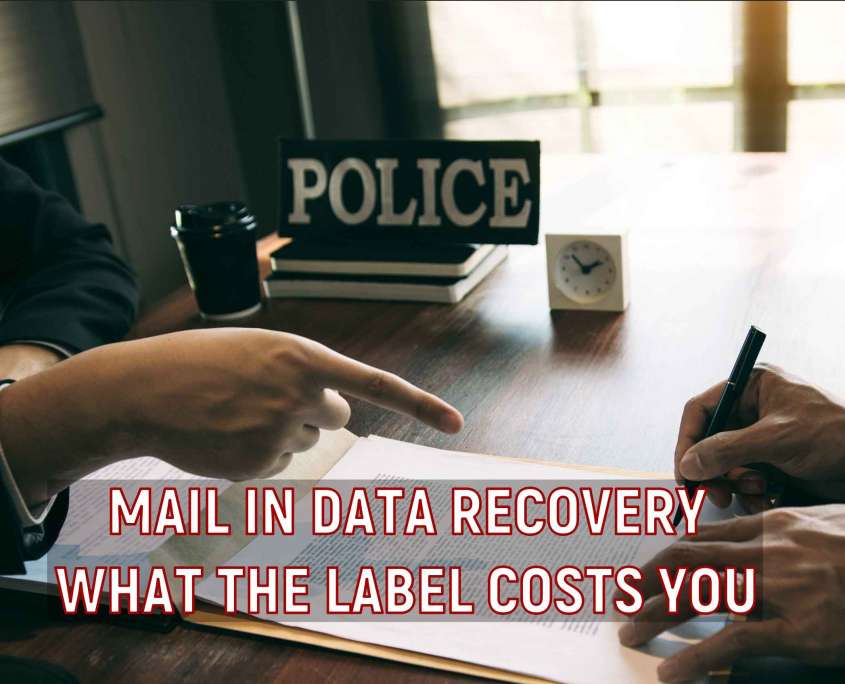
We cannot tell you what happened to that drive during those days, and neither can anyone else. That is the whole problem with a chain of custody that has a gap in it: the gap is only visible afterwards, and by then the drive is the evidence of what happened to it. The owner had done nothing wrong. She had simply put her only copy into a process with more hands in it than she knew about.
That was a single shipment to a single laboratory, and a gap still appeared. One journey is already more hands than anyone can name. Two or three journeys multiply every one of those hands, and the gaps get harder to see afterwards. So the question is not how far the drive is going. It is how many separate shipments it has to survive.
WHAT THE CARRIER ACTUALLY COVERS
Before you choose a service, read what the carrier actually promises. All three major US carriers publish the same figure, and it is one hundred dollars.
FedEx states that “The first $100 of value in your shipment is included in your shipping rate at no extra charge as part of our standard $100 limit of liability,” and separately that “Declared value is not shipping insurance.”
UPS, in its 2026 Tariff and Terms and Conditions of Service effective 17 April 2026, sets its maximum liability at “$100 per Package where no value is declared,” and states that “Declared Value is not insurance and does not constitute insurance.”
USPS publishes that “Priority Mail Express® and Priority Mail® services include up to $100 of insurance in the price.”
Read 3 October 2026. One hundred dollars, three carriers. That figure covers the replacement cost of a hard drive. It does not cover the photographs, the patient records, the case files or the only copy of a business. No carrier prices the contents, because no carrier can.
There is a second point in the same sentence. On a prepaid label generated on a company’s own carrier account, that company is the shipper of record, not you, which means the claim is theirs to file, on their timeline, and the carrier has no contract with you at all. Ask who the shipper of record is on the label you are sent, and what the declared value on it is.
You can declare a higher value, and you should. Understand what you are buying: a higher ceiling on the replacement of a physical object, with a claims process that requires proof of value. It does not make the data recoverable, and it does not shorten the gap if the parcel goes missing.
So insure it, and then pack it as though the insurance does not exist. For the thing you actually care about, it does not. If a drive is going to be shipped to anyone, read our page on shipping a drive for data recovery first.
Sources: FedEx Declared Value & Limits of Liability · 2026 UPS Tariff/Terms & Conditions of Service · USPS Shipping Insurance and Delivery Services. Read 3 October 2026.
So it’s worth asking what a company can actually account for. Ours: a documented chain of custody from intake to return, one named engineer from start to finish, NDAs signed upon request, a Business Associate Agreement where health data is involved, and recovered data securely erased two weeks after completion unless you arrange otherwise in writing. There is no partner facility in the process, so the answer to “where did my data go or who had access to it” is one sentence with one address in it.
BEFORE YOU SHIP PATIENT RECORDS, READ THIS
THE COMPLIANCE CONSEQUENCE MOST PEOPLE DON’T EXPECT
If there is protected health information on the drive, the decision you are about to make has a compliance consequence, and it is not the one most people expect. HIPAA does not flatly require encryption. Under the Security Rule it is an addressable implementation specification, at 45 CFR §164.312(a)(2)(iv) for data at rest and §164.312(e)(2)(ii) for transmission, which means you assess it, implement it or document why not.
The consequence sits in the Breach Notification Rule. An impermissible disclosure of protected health information is presumed to be a breach unless you can demonstrate a low probability that the information was compromised. There is one clean exit: information that was properly encrypted is not unsecured, and losing it is not a reportable breach. That is the safe harbor, and it is the most valuable thing a practice has when a device goes missing.
A failed drive usually cannot reach it. You cannot encrypt a drive that will not mount. If full-disk encryption was already in place before the failure and you still hold the key, the drive ships secured. If it was not, it cannot be made so now. It ships unsecured, and if that parcel disappears you are running a four-factor risk assessment on records you can no longer examine, then notifying every affected individual without unreasonable delay and no later than sixty days, notifying the Secretary, and above five hundred residents of one state, notifying the media.

There is a second problem in the same envelope. A recovery company handling protected health information on your behalf is a business associate and needs an agreement with you. If it outsources the drive to a laboratory it has not named, that laboratory is a subcontractor and the chain of agreements has to reach it. An agreement you cannot see is an agreement you cannot produce. So the question is not “are you HIPAA compliant,” which everyone answers yes to. It is: do you open drives at this address, and if not, which company opens them, in what state and what county, and will you name them in the agreement?
THINGS THAT LOOK LIKE VALUE AND AREN’T
WHY TWO QUOTES FOR THE SAME DRIVE CAN DIFFER BY THOUSANDS
A PUBLISHED SUCCESS RATE
Nobody audits them. No standard defines what counts as a success, no body collects the figures, and the company publishing it decides whether a partial recovery counts and whether declined cases are in the denominator. A number carried to a decimal point reads like a measurement. We publish none, because you couldn’t verify ours either.
“ISO-CERTIFIED” WITH NO CLASS NUMBER
ISO 14644-1 runs 1 to 9, lower is cleaner, each step permitting about ten times more airborne particles than the one below. The number is the whole meaning. “Class 100”, which many companies still advertise, comes from a US federal standard withdrawn in 2001 and is about equal to ISO Class 5, one step dirtier than the ISO Class 4 this work is done to. When platters are exposed for hours during a multi-platter recovery, that difference matters more than anything else in the clean room.
EQUIPMENT OR YEARS, NAMED INSTEAD OF TRAINING
A clean room, a PC-3000 and a shelf of donor drives can be bought by anyone with the capital. None of it arrives with the knowledge of how to use it, and anyone who worked in IT for twenty years can claim experience. A list of equipment is a receipt; a count of years is a company’s age. Ask which platforms the engineer is certified on, who issued it, and whether they will send the documents.
A PRICE QUOTED BEFORE THE DRIVE IS SEEN
It’s a starting figure, not a quote. What actually failed, heads, firmware, electronics, platter surface, is what sets the work, and none of it is known until somebody looks. Ask when the firm number arrives and what it’s based on.
What can be checked instead: a clean room certificate naming the testing firm, the standard, the class, the date and the technician who signed it · the engineer’s training certifications on the platforms actually used · a straight answer on whether the drive is outsourced, and the town and county the work is done in · the name of the person who opens the drive · a published diagnostic fee and a published range. Ours is ISO Class 4 under ISO 14644-1:2015, and we’ll email you the certificate before you commit to anything.
WHAT YOU ARE ACTUALLY COMPARING
AN INTAKE ARRANGEMENT, OR A SINGLE LABORATORY
ALSO HANDLED HERE
ENCRYPTED MEDIA, FORENSICS AND ARRAYS
Encrypted & Regulated Media
Encrypted volumes, corporate laptops and records held under retention obligations. Encrypted machines need the recovery key or password, check your Microsoft account for BitLocker keys. We’ll sign an NDA before work begins, BAA where health data is involved, and securely erase our copy of your data two weeks after completion.
FORENSICS & SECOND OPINIONS
Write-block imaging, court-ready reports on findings and expert testimony for legal and insurance matters, and second-opinion evaluations when a previous attempt failed. Tell us what was attempted, what they said failed and what you were quoted. Bring the receipts and any proof of correspondence.
RAID, NAS & Servers
Power the unit down and stop. Every member is repaired and imaged individually before we attempt to reconstruct the copies, and a rebuild attempted first is what usually ends the array. Label the drives in the order they came out of the bays, or bring the entire server as it is. Quoted per case after diagnosis.