A BUYER’S GUIDE FROM A REAL LAB
How to Choose a Data Recovery Company
Search for a data recovery service in your city and you’ll get national chains, local computer fronts, youtubers, and software ads, all claiming a local presence while baiting the community into shipping their only copy hundreds of miles away, through a small referral network, to labs in Arizona, Los Angeles, Austin or Lincroft, New Jersey. Most people can’t tell the difference until it’s too late. Here are the ten questions that separate a real laboratory from a markup middleman or mail-in fishing lures advertising in your city, and, unlike most guides, we show you how to verify every answer.
LEARN MORE ABOUT THE TRUE COSTS OF “DATA RECOVERY”
BEFORE YOU CHOOSE ANYONE
You Usually Get One Good Attempt
Here’s the single most important thing to understand before you hand your drive to anyone: the first recovery attempt has the highest chance of success. Data recovery is not a series of tries. Each failed or careless attempt — running software on a physically failing drive, or opening it outside a clean room — can lower the odds of the next one, sometimes to zero.
That’s why choosing the right company the first time matters more than finding the cheapest one. A drive that arrives at a real lab untouched is far more recoverable than one that’s already been through a computer shop’s “let’s try some software” phase. When the data matters, stop, and choose carefully.
KNOW WHO YOU’RE ACTUALLY CALLING
The Three Kinds of “Data Recovery Company”
Nearly every provider you’ll find falls into one of these three groups. The trouble is, they can look identical in a search result.
Unfortunately America lacks knowledge in this industry and does not regulate it. What this means is that American companies and consumers are losing petabytes of data each month, and are at risk of data theft because there is no standard set in America. It is up to you to research your due diligence.
TYPE 1
The Middleman
How to spot it: put the street address into Street View and read the sign over the door. If another business trades there under its own name, and has its own listing at the same address, that address is a counter.
TYPE 2
The National Chain
How to spot it: count what they advertise. Dozens or hundreds of locations means intake points, not laboratories, and the class number is usually missing or comes from a standard withdrawn in 2001.
TYPE 3
The Independent Lab
How to spot it: they answer all ten questions below in a single phone call, and the certificate and training documents arrive the same day.
⚠️ The pattern to watch for: We regularly hear from customers who shipped a drive to a distant company on a low “evaluation” quote — only to be told, once the company already had their drive, that the real cost was four figures, far outside the original estimate. By then the drive is in someone else’s building, and walking away can mean a cancellation fee. A firm written quote before any work begins, from a lab you can actually reach, is the simplest protection against this.
ASK EVERY PROVIDER THESE
10 Questions That Reveal the Truth
Ask these before you send a drive anywhere. The answers tell you more than any badge on a homepage. We’ve included how we answer each — so you can hold us to the same standard.
1. Do you recover the data in-house, or do you ship it to a third party?
This is the single most revealing question. Many “local” providers outsource every recovery, or the advanced cases. If the answer is vague, assume your drive is going somewhere else — and ask exactly where.
Ours: In our own local laboratory after meeting in King of Prussia, PA. Your drive does not leave the engineer’s chain of custody, and it is never shipped out or sent to a third party.
2. Can I visit your lab and drop off my drive in person?
The simplest test there is, and the most revealing. Ask it of anyone and listen for whether a person is at the other end of the address. I’ve walked through many labs in this industry, from small operations in Arizona and home setups in Connecticut to advanced facilities in Budapest, and I’ve seen firsthand how far the reality can sit from the website. A company that can’t put you in a room with the person handling your drive is telling you something.
What matters is not a tour. It’s whether you can meet the engineer, hand the drive over yourself, and see your files before you pay. Most of what advertises locally can’t offer any of that, because the address is a counter and the work happens somewhere the person behind it has never been.
Our answer: yes, by appointment. Clients drop off at 630 Freedom Business Center Drive, Floor 3, King of Prussia, meet the engineer working their case, and review their recovered files in person before paying. That office shares a building with other businesses, but the office itself is private and ours alone, and the signage inside reads Tri-State Data Recovery.
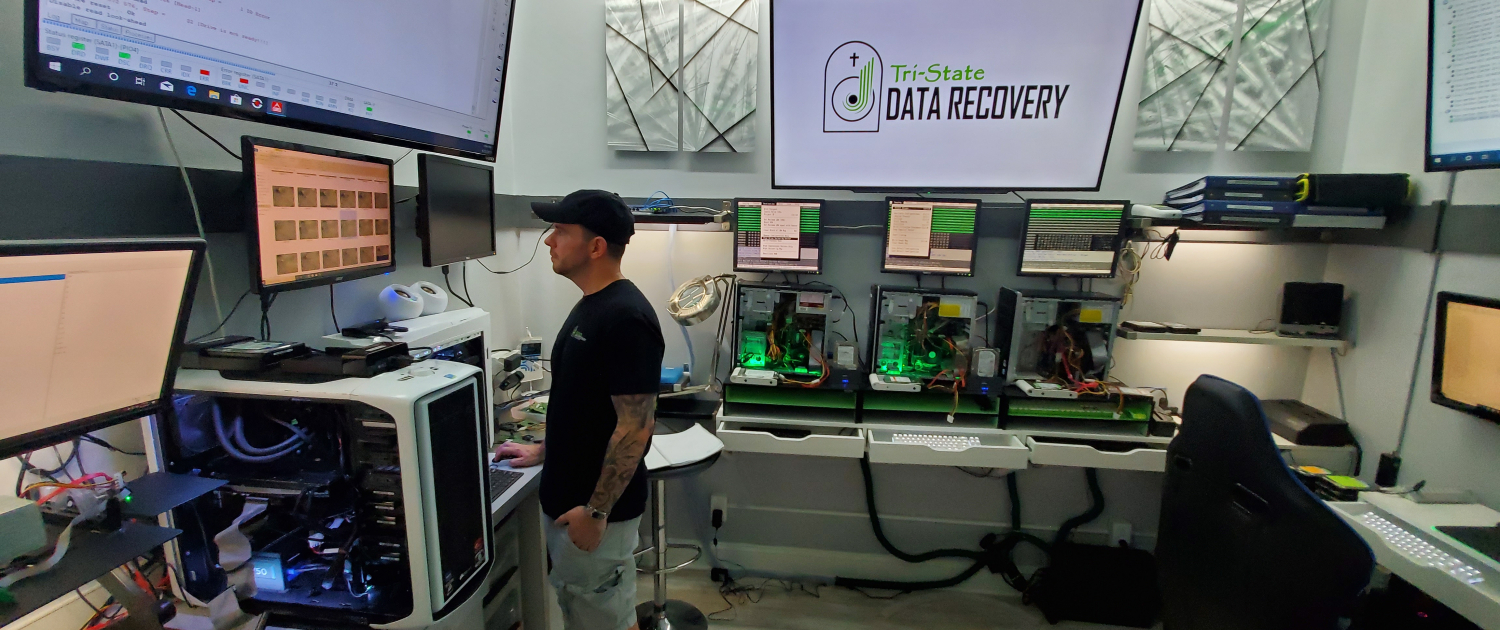
The recovery laboratory and certified clean rooms are housed separately, in an undisclosed, camera-monitored secure compound in Montgomery County. That facility is not open to the public, by design. We handle medical records and material that may serve as legal evidence, and strict chain of custody and HIPAA compliance are not things you can maintain with visitors walking through. Your drive never leaves Montgomery County or our chain of custody, and the engineer you speak with on the phone is the same person who opens it.
3. Do you have a real clean room, and is it independently certified?
“Certified clean room” is on nearly every recovery website — but we’ve been inside labs in this industry where the setup didn’t match the marketing. There’s often a real gap between the website and the bench. Ask who certified the clean room, to what standard, and whether you can see the certificate. Mechanically failed drives can’t be safely opened without a genuine one.
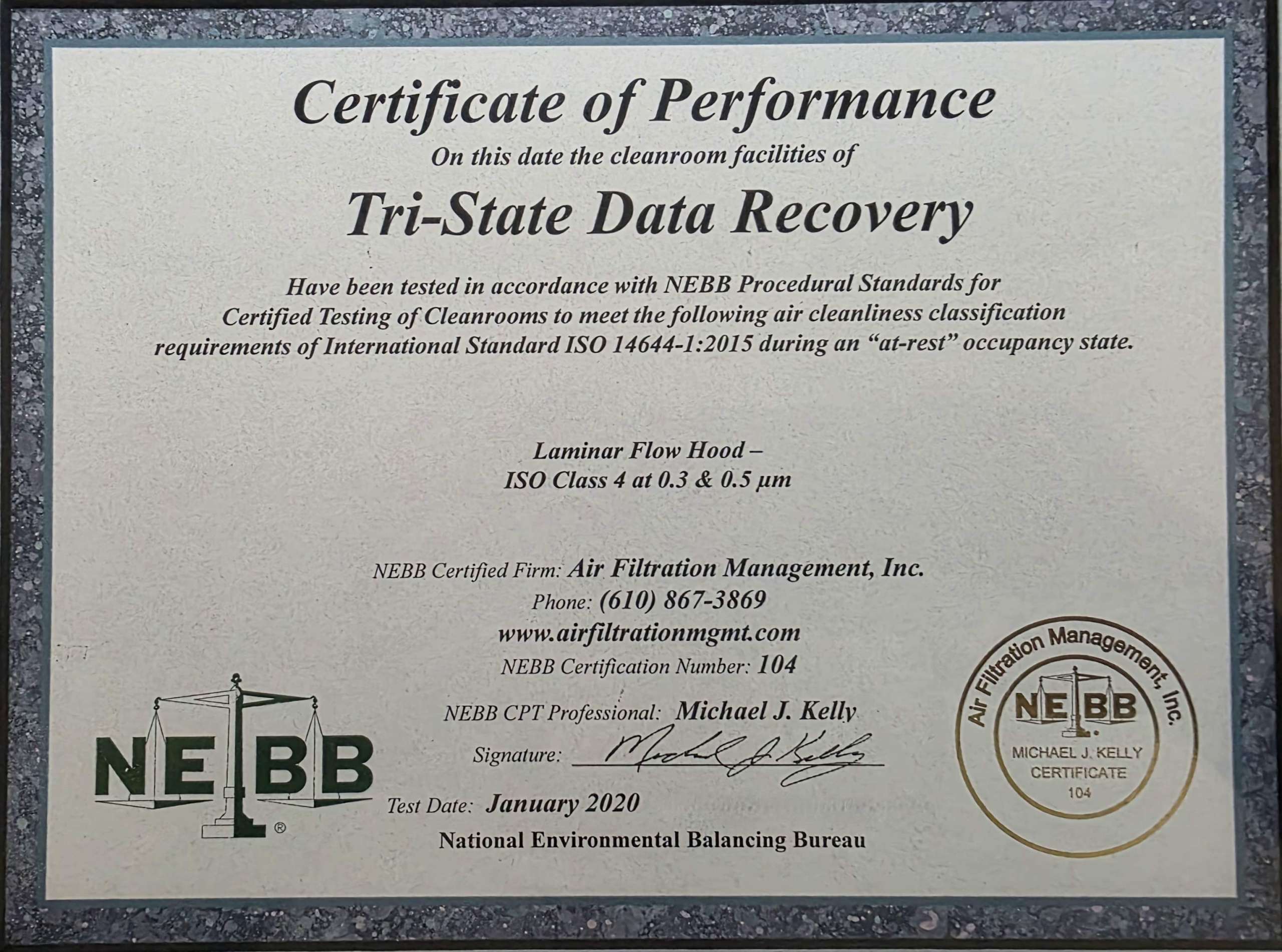
Our answer: An on-site clean room independently tested to ISO Class 4 (ISO 14644-1:2015). We’ll show you the certificate — and the room. See our certifications.


4. Which platforms is the engineer certified on, who issued it, and will you send me the documents?
Anyone with a background in IT can claim twenty years experience. Anyone with capital can buy a clean room and a PC-3000. Neither one comes with the knowledge of how to use it, and a list of equipment on a website is a receipt rather than a qualification.
Trade secrets and developer trainings are not revealed in online forums. Real recovery means more than plugging a drive into a computer and asking online for advice. Ask about PC-3000 (the industry-standard imaging and firmware platform), DeepSpar, donor-drive inventory for head swaps, and micro-soldering for chip-off work.
Then ask them to back it up. Which platforms is the engineer certified on, at what level, who issued the certification, and will they send you the documents? Those four answers arrive in minutes or they don’t arrive.
Ask the same about the room. Not “is it certified” but which ISO class, tested by whom, and on what date. ISO 14644-1 runs 1 to 9, lower is cleaner, and each step permits about ten times more airborne particles than the one below. “Class 100,” which many companies still advertise, comes from a federal standard withdrawn in 2001 and is about ten times dirtier than the ISO Class 4 this work is done to. When platters are exposed for hours during a multi-disc recovery, that difference matters more than anything else on the bench.
Vague answers usually mean consumer software, untested equipment, or training nobody will put a name to.
Our answer: expert-level certification on both PC-3000 and DeepSpar; Micro-Soldering Rework and Repair, completed March 2020 at the Learning Center of the National Electronics Manufacturing Technology Center of Excellence (ACI Technologies, Philadelphia); and two flow hoods independently certified to ISO Class 4 under ISO 14644-1:2015 — certification page,
5. Is the diagnostic fee credited toward the recovery?
A very low “evaluation fee” that isn’t credited toward anything is a lead-generation tool, not a service. Ask whether it comes off the final price.
Our answer: $106 per drive (tax included), applied toward your successful recovery. See our published pricing.
6. Will I get a firm quote before any work begins?
The most common complaint in this industry is a low quote that balloons once the company has your drive. A firm written quote before work starts eliminates that surprise.
Our answer: Always. No work proceeds until you approve the quote — and no charge beyond the diagnostic if we can’t recover your data.
7. Can I review my recovered data before I pay?
A file list isn’t proof. Being able to actually see your recovered data before money changes hands is the strongest protection you have. Some companies only offer a remote screen-share — being able to verify in person is better.
Our answer: Yes — in person, at our office, before you pay. Not a remote session.
8. What is your cancellation policy once you have my drive?
Ask this every time. Some companies charge a steep percentage of the quote to cancel — meaning once your drive is in their building, walking away costs you money. Know this before you ship.
Our answer: Decline the quote and you pay only the diagnostic; your drive is returned. No cancellation penalty.
9. Who will I actually be talking to — and who touches my drive?
If reviews consistently praise a friendly “account manager” or “case coordinator,” there’s a sales layer between you and whoever handles your data. That’s a business-model choice; just know which one you’re buying.
Our answer: Don Anderson — the engineer working your drive — start to finish. No sales team, no call center.
10. Do the reviews come from verifiable, real customers?
Stars on a company’s own website mean little. Look for independent Google reviews with real, clickable reviewer profiles — and read the critical ones, not just the glowing ones. Many reviews are paid for and come from unverifiable sources.
Our answer: 4.9 stars across nearly 300 Google reviews and a 5.0 Facebook rating, with named reviewers you can click through and verify. Read them all — including any critical ones.
QUICK REFERENCE
Walk Away If You Hear These Red Flags to Avoid Malpractice
🚩 “We’ll need to send it out.” — Outsourcing, often undisclosed.
🚩 A price that jumps after they have your drive. — The classic bait-and-switch.
🚩 Does my drive stay with you or get forwarded, and what town and county is the work done in? — Check it on a map before you ship and confirm that it isn’t a front.
🚩 A guaranteed success rate. — Some drives can’t be recovered; certainty is a sales tactic.
🚩 Pressure to decide right now. — A real lab tells you to stop and think, not to sign immediately.
🚩 Steep cancellation fees. — Means declining the quote isn’t really an option.
🚩 Non Certified ISO Clean Room — They can’t show you a legitimate clean room certification from the NEBB – If they are using a flow hood that hasn’t been properly tested, or use low cost consumer particle counters as testing claims, then they are exposing your drive to contamination which can result in partial or complete data loss.
ISO 14644-1 runs 1 to 9. Lower is cleaner, and each step permits about ten times more airborne particles than the one below. “ISO-certified” with no number tells you nothing — Class 9 is roughly an ordinary office.
“Class 100,” which many companies still advertise, comes from a federal standard withdrawn in 2001. It corresponds to roughly ISO 5, about ten times dirtier than the ISO Class 4 this work is done to.
That difference is invisible until a drive is open. When platters are exposed for hours during a multi-disc recovery, the air above them matters more than anything else on the bench — which is why we built a larger, cleaner hood rather than working only from the 18-to-24-inch ISO 5 enclosures most of this industry uses. And had it independently certified by a NEBB firm rather than a non certified $200 consumer particle counter advertised by some companies.