✓ The Honest Answer

Is Tri-State Data Recovery Legit?

Yes — and we’d rather you verify that yourself than take our word for it.  Check our certifications →

You’re about to hand a stranger a drive holding something you can’t replace, and possibly spend four figures doing it. Being skeptical isn’t rude; it’s the correct instinct. So instead of a page telling you how great we are, here’s everything you need to check us out independently — plus the questions you should be asking any data recovery company, including the ones we’d rather you didn’t ask us.  Learn more about how you should choose a data recovery lab.

 2011

Founded


  • Profiled by the Philadelphia Inquirer 
  • 4.9 stars across Google & Facebook – thousands of drives recovered
  • HTCIA member

Trusted by

DON’T TRUST US – CHECK

Verify Everything on This Page in About Five Minutes

Every claim below links to something outside our control. That’s the point: anyone can write “trusted” and “certified” on their own website. Learn more about the true cost of data recovery…

Newspaper Newspaper

Newspapers

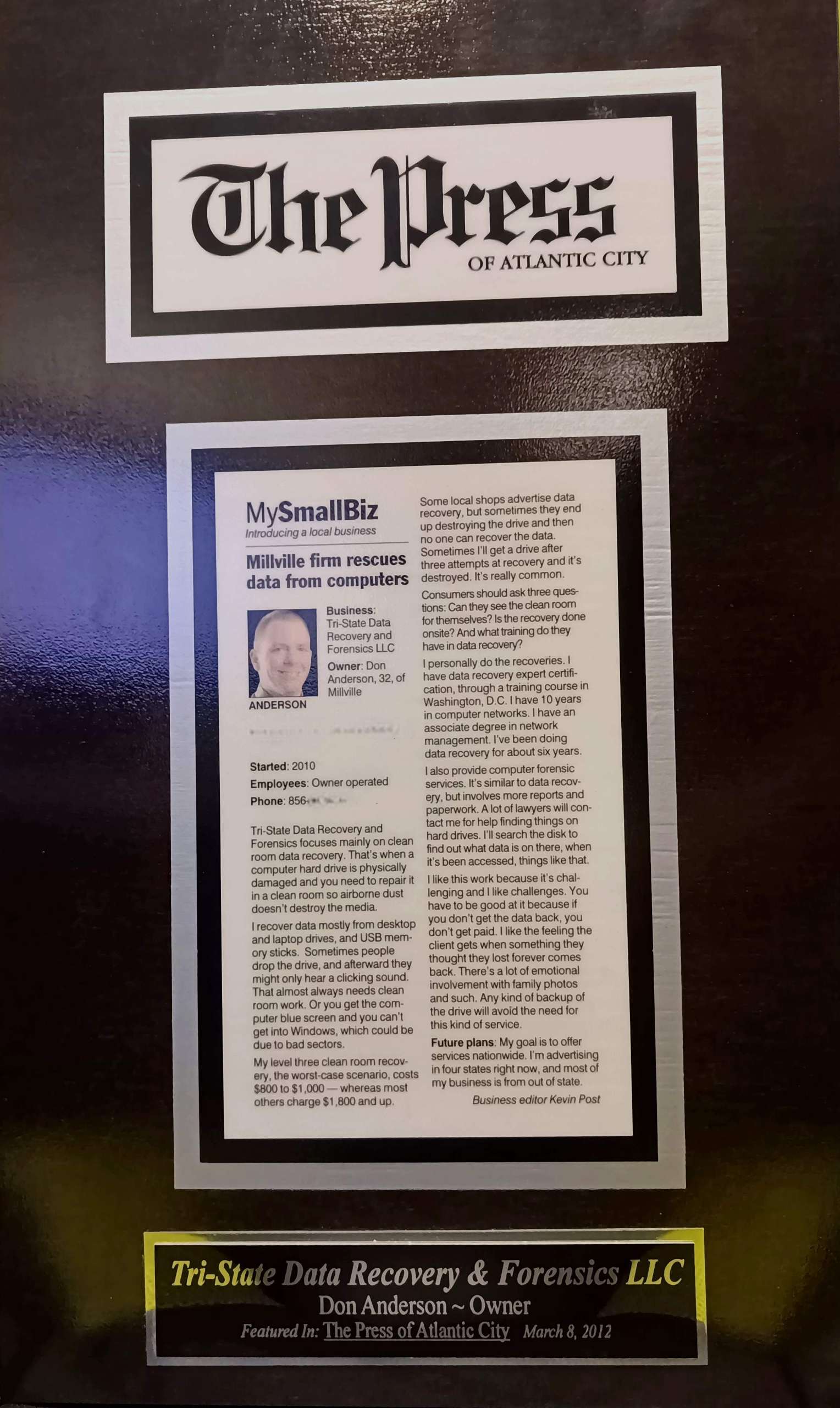
The Philadelphia Inquirer profiled our lab and our engineer in 2013 — photographs, interviews, and a description of the work. It’s still on the Inquirer’s own website, more than a decade later. Independent regional press coverage is the single hardest credential to fake.  The Mainline Times covered us a few years later in 2015 and the Press of Atlantic City back in 2012.

Read the Inquirer feature →

ratings-rate-svgrepo-com

Online Reviews

Our Google rating is 4.9 across hundreds of reviews.  Read more on Facebook and even local reddit mentions. Click any reviewer’s name and you’ll see their profile and their other reviews — real accounts, real histories. Read the critical ones too; they’re there. A company with only glowing five-star reviews and no verifiable reviewers is a company worth a second look.

Read the Google reviews →

Location Location

Physical Address

630 Freedom Business Center Drive, Floor 3, King of Prussia, PA 19406. It’s a real office building; you can view it on Street View, and you can book an appointment and walk in. Clients regularly drop off drives in person, meet the engineer working their case, and review their recovered files on site before paying anything.

See the location on Google Maps →

Heart-empty Heart-empty

Our Clients

Our reviews include named organizations — a children’s health system, a private school district, an insurance agency, a film production company, a recording studio, and engineering firms. Those are people who attached their employer’s name to their opinion of us. That’s not something you do casually.

OUTSIDE COVERAGE

What Other People Have Said About Us

Coverage we didn’t write, on platforms we don’t control.

📰 The Philadelphia Inquirer (2013)

A feature on the lab and its engineer, published by Philadelphia’s paper of record and still live on Inquirer.com over a decade later. Read it here →

Don Anderson Data Recovery Philadelphia Inquirer

🎙️ New York Business Radio Interview

Engineer Don Anderson on data recovery, why the industry outsources, and what actually happens to a failed drive — a broadcast interview on NBR NYC.

🎓 University Lectures

Don has lectured at universities in the region on data recovery and digital forensics, including at Rowan University. Video of one of those lectures is on our Our Story page. Institutions generally don’t invite people to teach their students without checking them first.

WHY YOU’RE EVEN ASKING THIS QUESTION

Data Recovery Is an Unregulated Industry

There is no license required to advertise data recovery in the United States. No governing board, no mandatory certification, no inspection, no minimum standard for what counts as a “clean room” or a “lab.” Anyone with a website and a screwdriver can call themselves a data recovery laboratory — and plenty do.  Everywhere from Los Angeles to Austin to Lincroft.

That’s why searching “is [company] legit” before handing over a drive is a genuinely smart thing to do. It’s also why the search results for data recovery are a mix of real laboratories, computer shops that outsource the work, and national marketing operations running drop-off counters that ship your drive somewhere else entirely.

We think the honest response to an unregulated industry isn’t to shout louder than everyone else. It’s to hand you the tools to evaluate all of us — including us.

USE THIS ON ANYONE – INCLUDING US

11 Questions to Ask Any Data Recovery Company

Ask these before you send a drive anywhere. The answers tell you more than any badge on a homepage. Ours are included so you can hold us to the same standard.

Many companies advertising local service operate intake counters, not laboratories. Or they use computer shops to advertise for them.  Your drive gets boxed and shipped to a central facility —  in another state, occasionally another country. That’s not necessarily fraud, but it opens your data up to many risks, and you deserve to know it’s happening.


Ours: We are one company with one point of contact: our headquarters in King of Prussia. It shares a building with other businesses, but our office is private and ours alone — the signage inside reads Tri-State Data Recovery.

Our recovery laboratory and certified clean rooms are housed separately, in an undisclosed, camera-monitored secure compound in Montgomery County. That facility is not open to the public — and by design. The sensitive data we handle, including files that may serve as legal evidence, demands strict chain-of-custody and HIPAA compliance, and a secure, access-controlled lab is how we guarantee it. Your drive never leaves Montgomery County or our chain of custody. And the engineer you speak with on the phone is the same person who opens it.

This is the question that separates laboratories from resellers fastest, and notice it isn’t about seeing a room. A tour proves a room exists. It proves nothing about who works in it, or whether your drive stays there.

Ask instead: can I hand the drive to the person doing the work, speak to them about my own case, and see my files before I pay? Most of what advertises locally cannot offer any of that, because the address is a counter and the recovery happens somewhere the person behind it has never been.


Ours: yes, by appointment. Clients drop off at 630 Freedom Business Center Drive, Floor 3, King of Prussia, meet the engineer working their case, and review their recovered files in person before paying anything. That office shares a building with other businesses, but the office itself is private and ours alone, and the signage inside reads Tri-State Data Recovery.

The recovery laboratory and certified clean rooms are housed separately, in an undisclosed, camera-monitored secure compound in Montgomery County. That facility is not open to the public, by design. We handle medical records and material that may serve as legal evidence, and strict chain of custody and HIPAA compliance are not things you can maintain with visitors walking through. Your drive never leaves Montgomery County or our chain of custody, and the engineer you speak with on the phone is the same person who opens it.

Anyone with capital can buy a clean room, a PC-3000 and a shelf of donor drives. None of it arrives with the knowledge of how to use it. And anyone who worked in IT for twenty years can advertise twenty years of experience, which describes how long a company has existed rather than what its engineer was trained to do.

Ask which platforms the engineer is certified on, who issued the certification, and whether they will send you the documents. A company that owns the equipment but cannot name a training body has told you which half of that pairing it has.


Ours: expert-level certification on both PC-3000 and DeepSpar, with the documents available on request. Ask us and they arrive the same day.

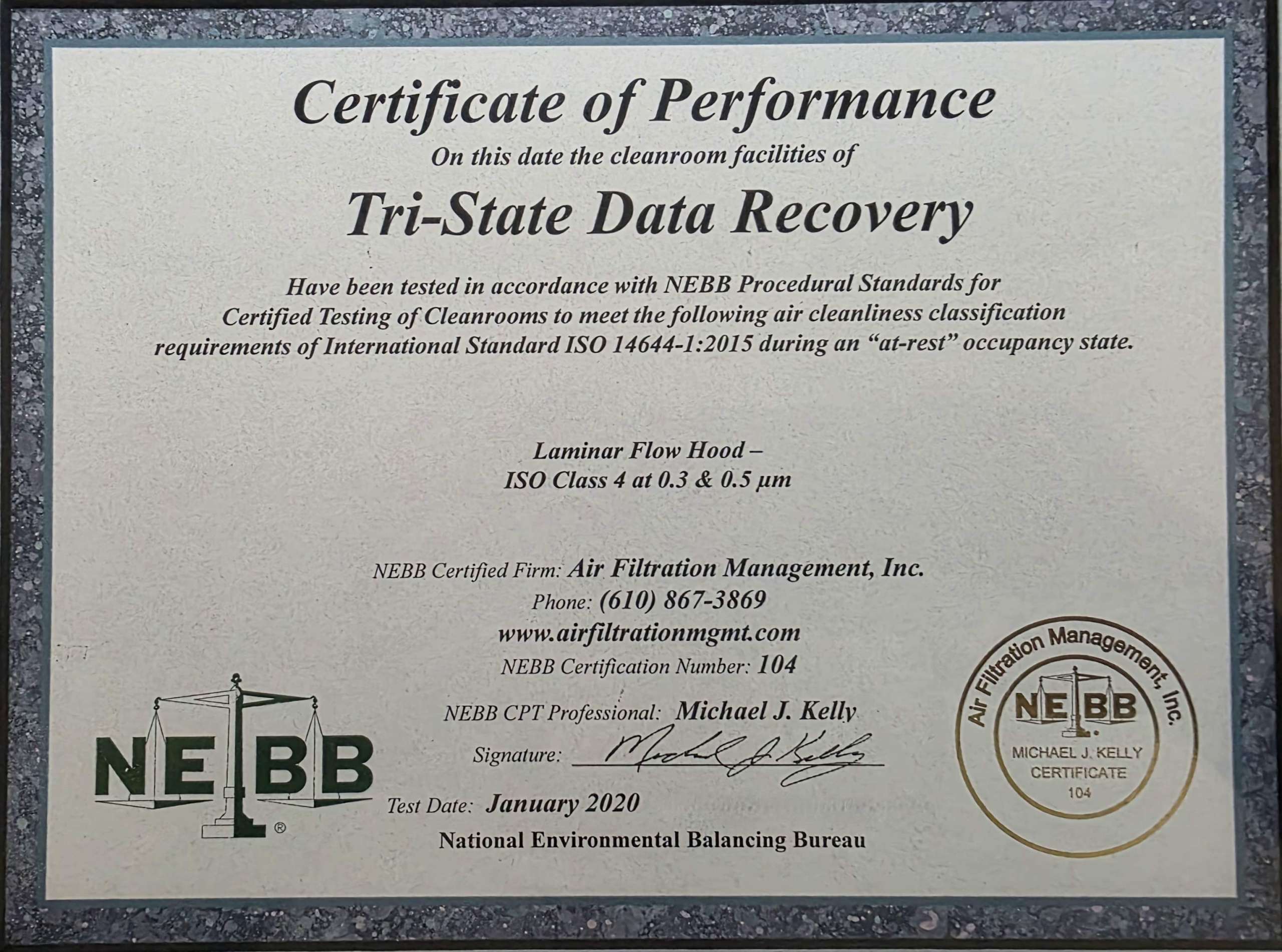
“Certified clean room” appears on nearly every data recovery website in the country. Ask who certified it, to what standard, and when it was last tested. The specificity of the answer is the answer. ISO 14644-1 runs 1 to 9, lower is cleaner, each step permitting about ten times more airborne particles than the one below. The number is the whole meaning. “Class 100”, which many companies still advertise, comes from a US federal standard withdrawn in 2001 and corresponds to roughly ISO 5, about ten times dirtier than the ISO Class 4 this work is done to. When platters are exposed for hours during a multi-disc recovery, that difference matters more than anything else on the bench.


Ours: An on-site class 4 clean room, in Montgomery County was independently tested to ISO Class 4 under ISO 14644-1:2015 when it was commissioned in 2020, and it’s particle-tested on a recurring schedule since — we’re happy to show you the documentation.

A very low evaluation fee that isn’t credited toward anything is a lead-generation tool, not a service.  And a free diagnostic is a lure, not a thorough examination. Ask directly whether it comes off the final price.


Ours: $106 per drive, tax included, applied toward your successful recovery.

The most common complaint pattern in this industry is a low quoted evaluation followed by a dramatically higher contract once the company already has your drive. This is the point in completing a thorough diagnostic first.  No guessing!  A firm quote before work starts eliminates that.


Ours: Always. No work proceeds until you approve the quote.

“No recovery, no fee” is common marketing, but the details matter — some companies still charge for parts, shipping, or evaluation. Get the specifics.


Ours: Nothing beyond the diagnostic fee (and any parts costs you specifically approved in advance).

A file list isn’t proof. Being able to actually see and open your data before money changes hands is the strongest protection you have.


Ours: Yes — in person, at the lab, on your own terms.

This question surprises people, and it should be asked every time. Some companies charge a substantial percentage of the quoted price to cancel — meaning once your drive is in their building, walking away costs you money. Ask before you ship.


Ours: If you decline the quote, you pay the diagnostic fee and your drive is returned. There is no cancellation penalty.  If you cancel after the quote has already been approved and the recovery has been completed, then you are responsible for the balance.  If you are uncertain what is on the drive then you may ask if a file list is possible before approving the quote.

If reviews for a company consistently praise a friendly “account manager” or “case coordinator,” there is a sales layer between you and whoever touches your drive. That’s a business model choice — just know which one you’re buying.


Ours: Don Anderson, the engineer working your drive. Same person, start to finish.

Your recovered files sit on someone else’s equipment. Ask how long they’re retained, how they’re secured, and how they’re destroyed — especially for medical, legal, or financial data.


Ours: Securely erased two weeks after completion unless you arrange otherwise in writing. HIPAA-compliant handling and documented chain of custody available on request.

WARNING SIGNS

Red Flags Worth Noticing

None of these prove a company is dishonest. All of them are worth a direct question before you commit.

⚠️ No verifiable address

“Our advanced laboratory” with no street address, or an address that turns out to be a mailbox or virtual office. Check it on Street View before you ship.

⚠️ The price changes after they have your drive

A low or free evaluation fee or “flat rate” that becomes a four-figure contract once the drive is in their possession. Get the quote structure in writing first.

⚠️ Vague answers about who does the work

If a company won’t say plainly whether your drive stays in their building, assume it doesn’t and ask again.

⚠️ Steep cancellation fees

Charging a large percentage of the quote to return your own drive means declining the quote isn’t really an option. Ask before shipping.

⚠️ Guarantees no one can make

Very high blanket success rates and promises of “guaranteed recovery” ignore reality: some drives are genuinely unrecoverable. Confidence is good; certainty is a sales tactic.

⚠️ No Training or Clean Room Certification

Anyone with money can purchase expensive tools or a flow hood, but having an independent NEBB firm come out test the ISO Class to verify safety, or being trained by the developers of the tools themselves, could be the difference of whether your data gets recovered, or your drive destroyed in the process…

IN FAIRNESS

What We’re Not

If a company can’t tell you its limitations, it’s selling rather than explaining. Here are ours.

𝟏

We’re not the cheapest option.

There are operations that may quote you less. Some have skill; and some will run software on a physically failing drive and turn a recoverable case into a permanent loss. Price is a real factor, and ours is fair — just know what you’re buying.

𝟐

We can’t recover every drive.

Nobody can, and any company claiming otherwise is telling you something about their honesty rather than their capability. Platters can be scored beyond reading. Chips can be too degraded to work with. We’ll tell you plainly when a case looks bad, before you spend anything beyond the diagnostic.

𝟑

We don’t work on phones or tablets.

Phones and tablets are a different trade with different tooling, and we don’t pretend otherwise. If that’s what you have, we’ll tell you on the first call rather than after we have your device.

𝟒

We’re one laboratory, not fifty locations.

If you’re far outside the Philadelphia region, we take shipped cases with tracking and insurance — but we won’t pretend shipping is as good as walking in and meeting the person handling your data.

𝟓

We don’t do everything.

Data recovery and digital forensics are what we do. We’re not a managed service provider, a cell phone repair shop, or a backup vendor — which is also why we can work with those companies as partners rather than competitors.

WHEN THE DATA ISN’T RECOVERABLE

Some drives can’t be saved. What matters then is whether you were told the truth, told it early, and treated decently while you absorbed it.

“Although my data could not ultimately be recovered, he still deserves every one of these five stars… He did not make unrealistic promises, take advantage of my desperation, or pretend that he could perform the impossible. Instead, he patiently explained the problem and taught me an invaluable lesson about never storing important information in only one location.

A five-star professional is not only someone who succeeds when recovery is possible. It is also someone who is honest and compassionate when it is not.“

If we can’t recover your data, you pay the diagnostic and nothing more, and you can request your drive back. You’ll also get a straight explanation of what failed and why, which is worth having whoever you use next.

🎖 Military & Veterans Discount

Tri-State Data Recovery proudly offers a permanent 20% discount on all data recovery services for active military and veterans with valid military ID. We understand your sacrifice and are honored to serve those who served us.

Still Not Sure? Call and Ask.

You’ll reach Don Anderson — the engineer, not a sales department. Ask him the ten questions above. Ask about your specific drive and your specific failure. It costs nothing, and it’s the fastest way to find out whether we’re the real thing.