DATA RECOVERY
TRENTON, NEW JERSEY
2013
QUALIFIED AS AN EXPERT, IN TRENTON
THE TRIBUNAL WAS IN THIS CITY
QUALIFIED AS AN EXPERT IN TRENTON, ON THE RECORD
In January 2013, in Trenton, Don Anderson was qualified and gave expert testimony before the New Jersey Office of Administrative Law. Not a certificate bought online, not a badge on a website: a tribunal in this city accepted him as an expert, on the record, and the testimony was given.
That matters here beyond any courtroom, because it describes the standard the work is done to. Trenton runs on records that have to withstand being questioned: state agencies, regulated files, litigation, public records requests, insurance claims. What decides whether a recovery holds up is how the drive was handled in the first hour, before anyone knew it would be contested. Write-block imaging so the original is never altered, a chain of custody with no gaps in it, a written report on findings, and one identifiable person who can say what was done and when.
The rest of the record is New Jersey too. Born here. Company founded in Gloucester County in 2011. The Press of Atlantic City in Millville in 2012, and a Philadelphia Inquirer reporter and photographer at the Gloucester City laboratory in 2013. Degree from Cumberland County College. Every item is verifiable by somebody other than us, which is the entire point of listing them.
WHAT ACTUALLY HAPPENS TO A FAILING DRIVE
A REPAIR COUNTER AND A LABORATORY ARE DIFFERENT BUILDINGS
A computer shop diagnoses a failing drive by reading it with consumer software or docking stations. Those are the only instruments on the counter. The software assumes a healthy drive with a logical fault, so it starts at the beginning and works through to the end, hammering the damaged areas hardest, on the one copy you have. A failing drive has a finite number of reads left in it, and that is how they get spent.
A laboratory uses professional hardware like the PC-3000 to test the drive, unlock its service area, back up and repair its firmware, create a head map and target the sectors relevant to your data. The file table is read first, so the imaging is aimed at the sectors your files actually occupy, with the weakest areas left for last. Consumer software has no such target: it attempts a full clone and spends the drive’s remaining reads on empty space. If heads have to be replaced, it is done with precision-matched donor parts inside a certified clean room, because a single particle on a platter surface is larger than the flying height of the head. Modern hard drives add a further requirement. The circuit board carries a locked serial flash ROM holding adaptive data unique to that drive, so electronics faults mean advanced micro soldering, chip replacement and reflow, and ROM programming. It takes expert-level training to do any of that without destroying the board or the chip.
None of that equipment is something a repair counter owns. It costs more than the shop’s entire tool inventory and it takes years to use properly. What costs you the data is not the diagnosis, it is the attempt. Ask the counter one question before you leave the drive: do you open drives here, or does this go somewhere else?
WHERE THE DRIVE ACTUALLY GOES
COLLECTED IN ONE PLACE, OPENED IN ANOTHER
A great deal of advertised data recovery is collected in one place and performed in another. The counter that takes the drive, the company on the invoice and the engineer who opens it can be three separate parties, and you are usually told about the first one only. The price you were quoted then contains somebody else’s fee, a margin you were not shown, shipping risks, possible data theft or a broken chain of custody.
A mail-in operation is the same arrangement with the counter removed. A free evaluation and a no data, no charge guarantee both describe what happens before a price exists, not what the recovery costs. The figure is set once your only copy is already inside a building you have never seen, at which point declining it means asking for the drive back, wondering what was done to it and hoping that it returns in the same condition as when it left. Because when you pay nothing for a diagnostic then they aren’t required to give you any paperwork explaining what they did to it. A prepaid shipping label is not a convenience in that arrangement. It is the step that makes the rest of it possible.
That much is disclosed. Nothing past it is. So ask the question in a form that cannot be answered sideways: what town and what county is my drive opened in, by whom and will it come back in the same condition as when it left? Ask for it in writing. A single laboratory answers with one company and one name. A partner facility, a lab network or somewhere nobody will name is the answer to a different question, and ask for the split while you are there. A company that performs its own recoveries has no reason to withhold it.
FOUR CHECKS, UNDER FIVE MINUTES
WHAT A LISTING CAN’T FAKE
Each has a document, an address or a number behind it. All four work on us as well as on anyone else.
SEARCH THE STREET NUMBER ON ITS OWN
A national company sometimes uses a repair shop to host its listing on Google Maps, and a page can be generated for a town name without anyone being in the town. Put the street address into a search by itself and see who else is listed there, then put it into Street View and read the sign on the building. Comparing the opening hours of two listings at one address, or asking for the clean room certification, will usually expose the truth.
Our answer: 630 Freedom Business Center Drive, Floor 3, King of Prussia, published on every page we write
CHECK THE PHONE NUMBER AGAINST THE ADDRESS
Mercer County is 609. A page written for Trenton answering on a number from another state is being answered in another state, and a local-format number can still ring somewhere else. “Serving Trenton” is not an address. A laboratory occupies a building, and one that won’t name the building has told you something.
Our answer: an 800 number answered by the engineer who does the work
ASK WHICH ISO CLASS, AND FOR THE CERTIFICATE
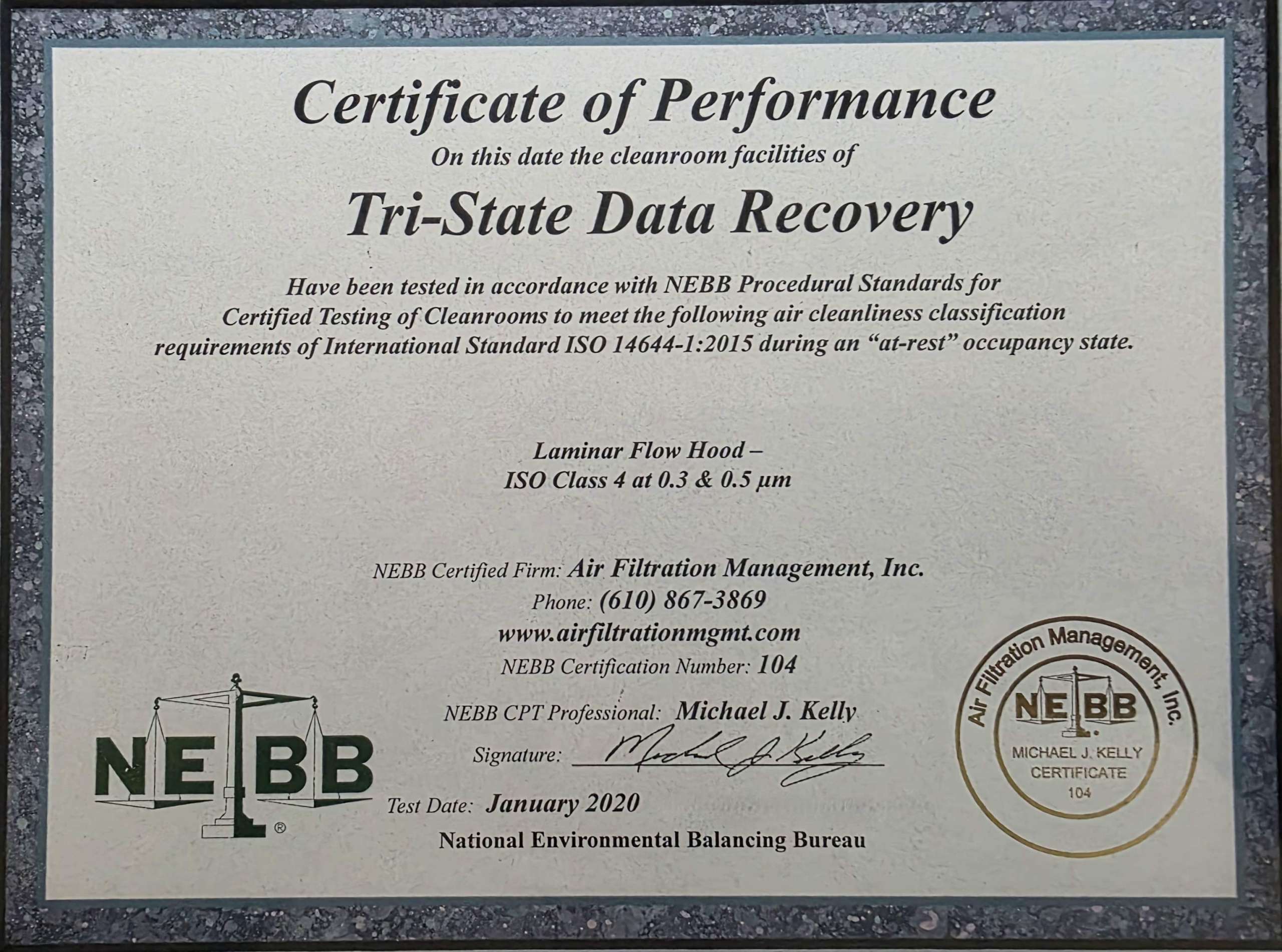
ISO 14644-1 runs 1 to 9, lower is cleaner, each step about ten times. “ISO-certified” with no number tells you nothing. Class 9 is roughly an ordinary office, and “Class 100” comes from a standard withdrawn in 2001 and is about equal to ISO Class 5, one step dirtier than the Class 4 this work is done to. Ask for the document naming the testing firm, the standard, the class, the date and the technician who signed it. This matters more than anything when the platters are exposed for hours during a multi-platter recovery procedure.
Our answer: ISO Class 4 under ISO 14644-1:2015, certificate viewable now
ASK WHAT THE ENGINEER IS CERTIFIED ON, AND FOR WRITE-BLOCK IMAGING
Anyone with money can buy the equipment. Ask which platforms the engineer is personally certified on, who issued the certification, and whether they will send you the documents. Then ask whether the drive will be imaged with a hardware write-blocker and whether you will get a written custody record. Ask it even if litigation seems unlikely today, because it is the only version of the question that cannot be answered later.
Our answer: expert-certified on PC-3000 and DeepSpar, documents on request, with write-block imaging and a written custody record on every case where it may matter
EXPERIENCE THE DIFFERENCE
A SHIPPING LABEL, OR A NAMED ENGINEER
WHAT WE RECOVER
RECORDS THAT HAVE TO WITHSTAND QUESTIONS
Hard Drive Recovery
Hard drives that are clicking, seized and beeping from a drop; head crashes, firmware faults and bad sectors caused from media damage. Weak or faulty head assemblies replaced with precision-matched donor parts inside our certified ISO 4 clean rooms.
SSD & NVMe Recovery
Solid-state storage degrades with use, and when it fails there’s no warning. Controller failure, corrupted firmware, degraded NAND, and drives that vanish from BIOS, recovered in-house with PC-3000 and DFL, including chip replacement and advanced cooling and reflow techniques. Certified in advanced micro-soldering through ACI Technologies in Philadelphia.
RAID, NAS & Servers
Failed rebuilds and degraded arrays in offices and households. Drives bought together fail together, which is why the rebuild rather than the first failure usually ends an array. Power down and call before anyone rebuilds.
LEGAL & EVIDENTIARY MEDIA
Drives attached to litigation, employment matters, insurance claims and public records requests. Write-block imaging, documented custody from intake to return, court-ready reporting and expert testimony where required.
Apple & Mac Devices
Macs and MacBooks with a removable SSD or hard drive, Fusion Drives, iMacs, and the MacBook models that carry Apple’s data-recovery (“lifeboat”) connector. Also Airport Time Capsule and LaCie external drives. We don’t perform board repairs on current MacBooks with soldered storage — we’ll tell you that on the first call rather than after we have your machine.
AGENCY & INSTITUTIONAL SYSTEMS
YOUR DRIVE IS TRAVELING. CHOOSE WHERE.
There’s no certified recovery laboratory in Mercer County, so this isn’t a choice between local and distant. It’s a choice between forty-five minutes you drive yourself and a courier to an address nobody will name. Scheduling an appointment and hand delivering the drive is always the safest option, but some people still choose to ship. We’ve put together a dedicated page explaining the proper way to do it and the risks involved in exposing your drive to the shipping process.
Call first and we’ll tell you how to pack it properly, free, and which service to use, whether or not you send it to us. The most common mistake is cushioning a drive without immobilizing it: wrapped loosely in a padded box it can still move, and a drop the packaging survives can move a head across a platter.
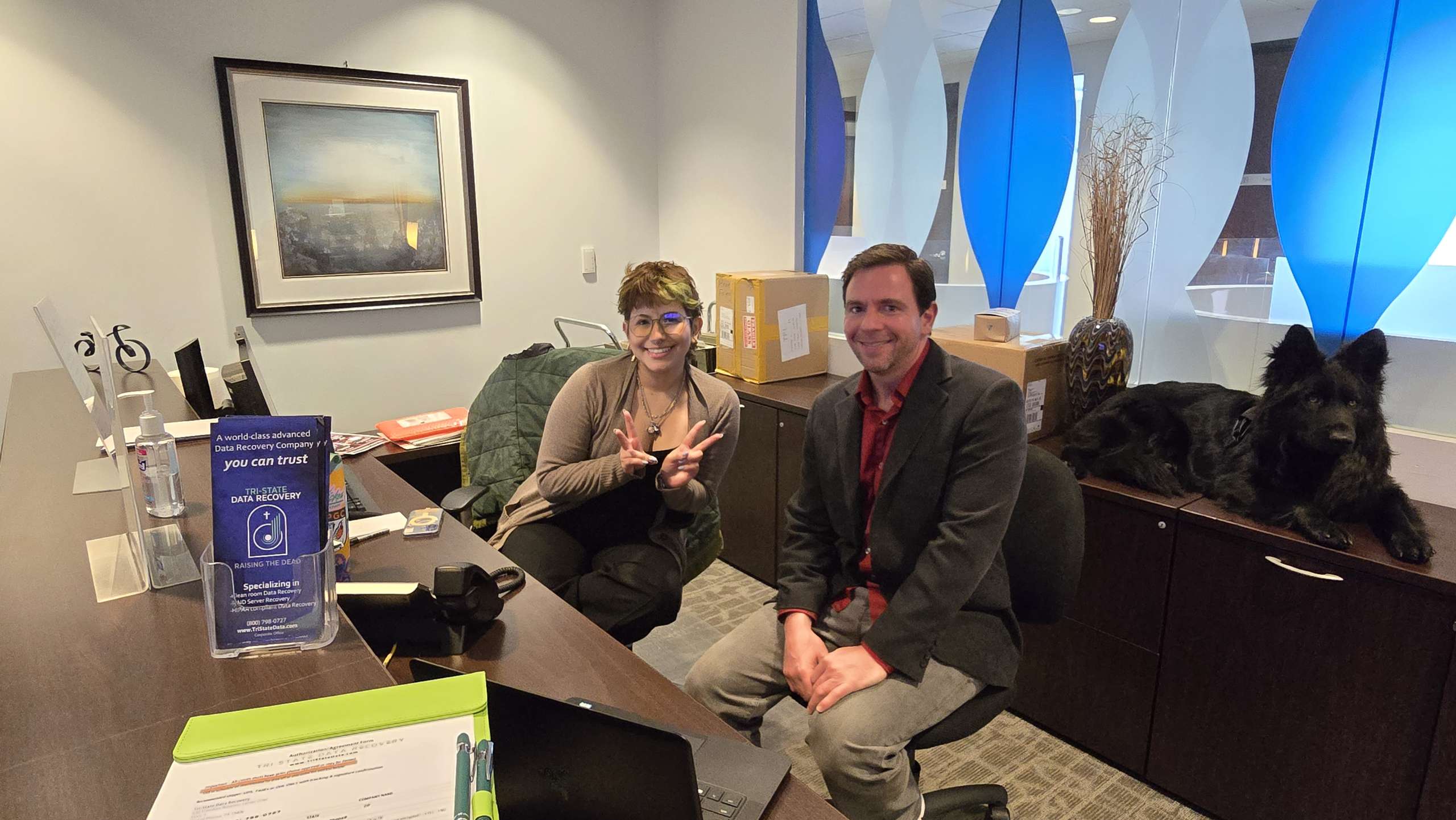
If you’d rather drive, give us a call first to discuss your case and to schedule your appointment, our office is at 630 Freedom Business Center Drive, Floor 3, King of Prussia, about forty-five minutes from Trenton across the river and up 95, and there’s parking. You hand the drive to the engineer who will do the work and collect it from the same person. The laboratory itself is a secured Montgomery County facility we don’t open to visitors, because we handle medical records and legal evidence and restricted access is part of the chain of custody.