DATA RECOVERY
VINELAND, NEW JERSEY
2011
FOUNDED IN NEW JERSEY
CUMBERLAND COUNTY
This Is Where It Started
Don Anderson was born in New Jersey and took his degree at Cumberland County College, here in Vineland. Tri-State Data Recovery was founded in Gloucester County in 2011, and by 2012 the lab was temporarily moved to Millville — six miles down the road — where the Press of Atlantic City covered it that March.
In 2013 it moved to Gloucester City, and a Philadelphia Inquirer reporter and photographer came out to the laboratory and put the work in the paper; that feature is still live. In January that year he was qualified and gave expert testimony before the New Jersey Office of Administrative Law in Trenton. The laboratory has been in Pennsylvania since 2014, but thousands of New Jersey drives have crossed it since 2011.
None of that is a slogan — every item is verifiable by somebody other than us, which is the entire reason for listing it. Ask any company advertising into Vineland for the equivalent: a college, a town, a newspaper, a date. A page generated for a town name carries none of those, and that is the difference worth checking.
BEFORE YOU HAND IT TO ANYONE
Four Questions, Asked at the Counter
None of them are technical. Ask them out loud, and get the answers in writing.
"WHAT WILL YOU RUN ON IT, AND HOW WILL YOU PERFORM A DIAGNOSTIC?"
A laboratory uses professional hardware like the PC-3000 to test the drive, unlock its service area, backup it’s firmware, create a head map and target the sectors relevant to your data. Recovery software does the opposite: it reads the failing original, continuously, across the damaged areas, for as long as it takes. If nothing gets imaged first, every minute of the attempt is spent out of the drive’s remaining life.
"DOES THE DRIVE STAY HERE, OR DOES IT GO SOMEWHERE ELSE?"
A great deal of advertised data recovery is collected in one place and performed in another. If it leaves, ask what town and what county the work is done in, and who opens it. A single laboratory answers with one company and one name. A quote with no laboratory named behind it contains somebody else’s fee, a margin you were not shown, shipping risks or a broken chain of custody.
"WHO IS TRAINED ON THE EQUIPMENT, AND CAN YOU PROVE IT?"
Anyone with capital can buy a clean room and a PC-3000, and none of it comes with the knowledge of how to use it. Twenty years in IT is experience, not training. Ask which platforms, at what level, issued by whom, and whether they will send the documents.
"WHICH ISO CLASS IS THE CLEAN ROOM, TESTED BY WHOM AND CAN YOU SHOW ME THE CERTIFICATE?"
ISO 14644-1 runs 1 to 9. Lower is cleaner, and each step permits about ten times more airborne particles than the one below. “ISO-certified” with no number tells you nothing — Class 9 is roughly an ordinary office.
“Class 100,” which many companies still advertise, comes from a federal standard withdrawn in 2001. It corresponds to roughly ISO 5, about ten times dirtier than the ISO Class 4 this work is done to.
That difference is invisible until a drive is open. When platters are exposed for hours during a multi-disc recovery, the air above them matters more than anything else on the bench — which is why we built a larger, cleaner hood rather than working only from the 18-to-24-inch ISO 5 enclosures most of this industry uses. And had them independently certified by a NEBB firm rather than a non certified $200 consumer particle counter advertised by most companies
EXPERIENCE THE DIFFERENCE
TAMPERED WITH, OR PROFESSIONALLY RECOVERED
WHAT WE RECOVER
FROM FARM OFFICES TO FAMILY ARCHIVES
Hard Drive Recovery
Hard drives that are clicking, seized and beeping from a drop; head crashes, firmware faults and bad sectors caused from media damage. Weak or faulty head assemblies replaced with precision-matched donor parts inside our certified ISO 4 clean rooms.
SSD & NVMe Recovery
These devices degrade while in use and develop bad sectors , firmware corruption and some times require NAND-level recovery on solid-state drives that are no longer recognized. Degraded NVMe drives require specialized hardware, not a software license.
RAID, NAS & Servers
Failed rebuilds and degraded arrays for practices and businesses across Cumberland and Salem counties. Drives bought together fail together — power down and call before anyone rebuilds.
Practices & Regulated Records
Practice management databases, imaging archives and client files across Cumberland County. NDA on request before work begins, Business Associate Agreement where health data is involved, documented custody from intake to return.
Apple & Mac Devices
Macs and MacBooks with a removable SSD or hard drive, Fusion Drives, iMacs, and the MacBook models that carry Apple’s data-recovery (“lifeboat”) connector. Also Airport Time Capsule and LaCie external drives. We don’t perform board repairs on current MacBooks with soldered storage — we’ll tell you that on the first call rather than after we have your machine.
OLD DRIVES & OBSOLETE FORMATS
Collected in One Place, Opened in Another
A shop takes the drive over the counter, quotes a price and sends it on to a laboratory. That is a separate entity collecting drives and forwarding them for an arrangement, exposing your drive and data to many risks, and the customer is rarely told the name of the company that opens their drive. That much is disclosed. Nothing past it is.
What the phrasing leaves out is everything you would want to know. The quote contains a laboratory’s fee and a second company’s margin in one number, and the split is not published. Your position in the queue is set by somebody you will never speak to. The chain of custody has a link in it that nobody in the conversation can describe exposing it to many risks and possible HIPAA violations. Who exactly has access to your data and is their copy securely erased after the recovery. And if the drive comes back unrecovered, no one in the chain can tell you what was attempted.
The same gap opens from the other direction. Companies with no presence in Cumberland County generate a page for every town name, buy advertising against those names so a paid position sits above local businesses, and publish a number that forwards elsewhere. Some attach a listing to a street address occupied by another business. A free evaluation means no price exists until your only copy is already in their building and they aren’t required to supply documentation on what was done to your drive. Three checks close it: search the street number on its own and see who else is listed there, put it into Street View and read the sign, and compare the opening hours of any two listings at one address.
We won’t pretend Vineland is close, it’s a little over an hour up 55 and across. But whichever company you choose, the drive travels. The question is who receives it and how many hands it passes through getting there. But if the data is that important then hand delivering it to a qualified engineer and knowing exactly who has access to your data may be worth the drive. And if you’d still rather ship it, then call first and we’ll tell you how to pack it properly, free, whether or not you send it to us. The most common mistake is cushioning a drive without immobilizing it: wrapped loosely in a padded box it can still move, and a drop the packaging survives can move a head across a platter.
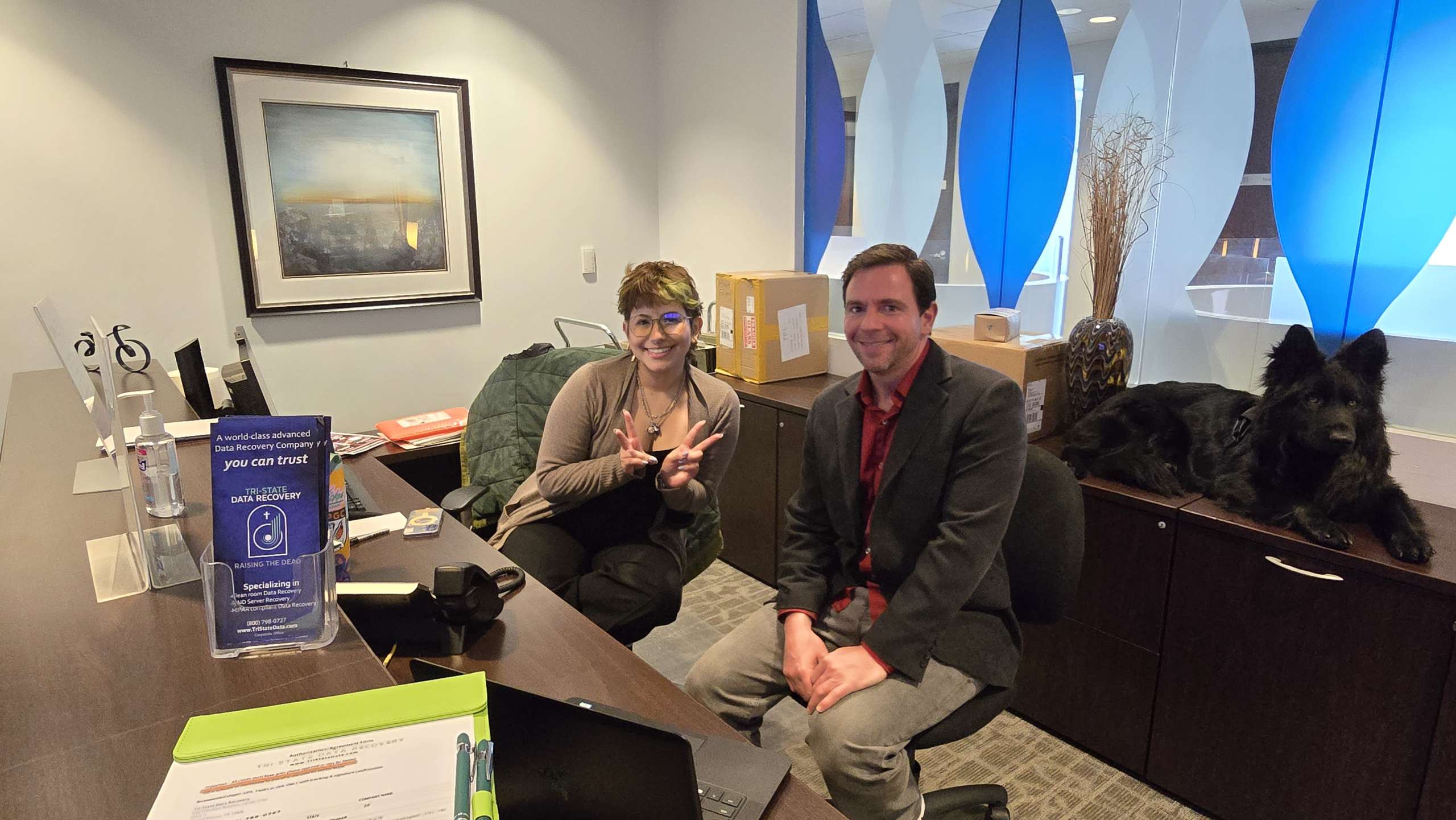
And so you know exactly who receives it: we are one company with one point of contact, our headquarters at 630 Freedom Business Center Drive, Floor 3, King of Prussia. It shares a building with other businesses, but our office is private and ours alone, and the signage inside reads Tri-State Data Recovery. The recovery laboratory and certified clean rooms are housed separately, in an undisclosed, camera-monitored secure compound in Montgomery County, not open to the public and by design: the material we handle, including files that may serve as legal evidence, demands strict chain of custody and HIPAA compliance. Your drive never leaves Montgomery County or our chain of custody, and the engineer you speak with on the phone is the same person who opens it.