DATA RECOVERY
SCRANTON, PA
ONE
LABORATORY, NOT A HUNDRED AND FIFTY.
WHY THE NUMBER MATTERS
A CLEAN ROOM IS A BUILDING, NOT A BRANCH
People picture a clean room as a tidy workbench. It isn’t. It’s an engineered environment — filtered air moved in one direction at a controlled rate, positive pressure so unfiltered air can’t drift in, materials that don’t shed, restricted access, and particle counts measured on a schedule by a firm with no stake in the result.
That’s why the count gives it away. Certifying and maintaining that environment in a hundred and fifty places would cost more than the industry earns. What scales cheaply is an address: a desk, a phone number in the local area code, and a courier. So when a company advertises how many locations it has, it is telling you, accurately, that the location is not the laboratory.
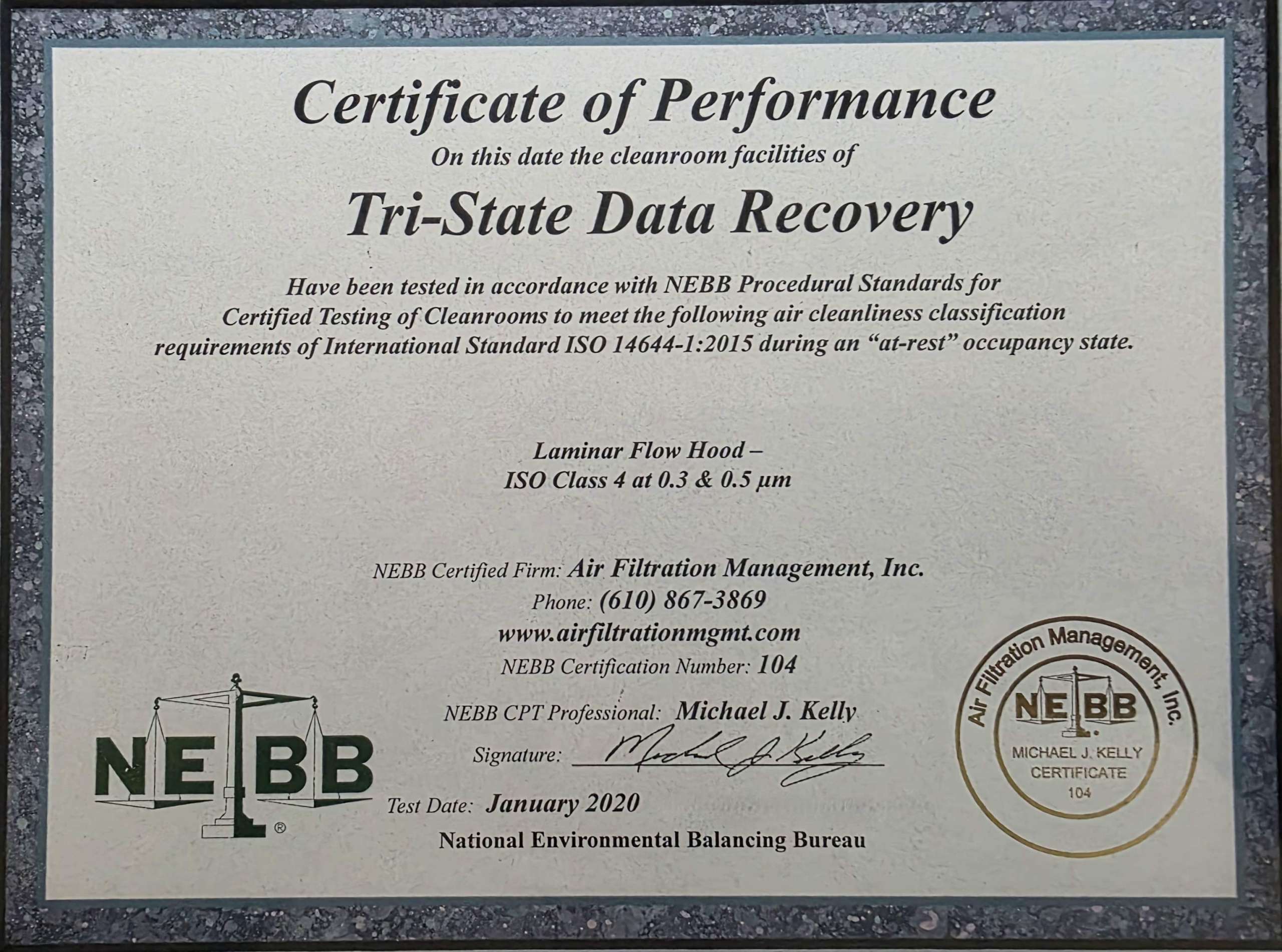
Ours is one room, in Montgomery County, tested by an outside firm and certified to ISO Class 4 under ISO 14644-1:2015, signed by a NEBB-certified performance technician. We’ll email you that certificate before you commit to anything, and you should ask everyone else for theirs, because it’s the one claim in this industry that can actually be checked.
FOUR CHECKS, UNDER TWO MINUTES
WHAT A LISTING CAN’T FAKE
Each has a document, an address or a number behind it. They work on us as well as on anyone else.
HOW MANY LABORATORIES, AND WHICH ONE?
Not how many locations — how many laboratories, and which building would open your drive. A single lab answers with one address. A number in the dozens or hundreds is a count of counters, and the recovery happens at one facility that may be a thousand miles from the one you’d visit.
Our answer: one laboratory, in Montgomery County, and it’s the one that opens your drive
WHICH AREA CODE ANSWERS THE PHONE?
570 and 272 are northeastern Pennsylvania. A page written for Scranton that answers on 732 is New Jersey; 512 is Texas. An 800 number could be anywhere — ours is one, which is exactly why our street address appears on every page we publish.
Our answer: an 800 number, with 630 Freedom Business Center Drive published on every page
WHO IS TRAINED ON THE EQUIPMENT, AND CAN THEY PROVE IT?
Anyone with capital can buy a clean room and a PC-3000. None of it comes with the knowledge of how to use it, and anyone who worked in IT for twenty years can advertise twenty years of experience. Ask which platforms the engineer is certified on, who issued it, and whether they will send the documents.
Our answer: View our training and certifications now
WHICH ISO CLASS, AND WILL YOU SEND ME THE CERTIFICATE?
ISO 14644-1 runs 1 to 9. Lower is cleaner, and each step permits about ten times more airborne particles than the one below. “ISO-certified” with no number tells you nothing — Class 9 is roughly an ordinary office.
“Class 100,” which many companies still advertise, comes from a federal standard withdrawn in 2001. It corresponds to roughly ISO 5, about ten times dirtier than the ISO Class 4 this work is done to.
That difference is invisible until a drive is open. When platters are exposed for hours during a multi-disc recovery, the air above them matters more than anything else on the bench — which is why we built a larger, cleaner hood rather than working only from the 18-to-24-inch ISO 5 enclosures most of this industry advertises.
Our answer: ISO Class 4 under ISO 14644-1:2015, certificate viewable now.
EXPERIENCE THE DIFFERENCE
A NETWORK OF ADDRESSES, OR ONE LABORATORY
WHAT WE RECOVER
CLEAN ROOM CASES AND PHYSICALLY DAMAGED DRIVES
Hard Drive Recovery
Hard drives that are clicking, seized and beeping from a drop; head crashes, firmware faults and bad sectors caused from media damage. Weak or faulty head assemblies replaced with precision-matched donor parts inside our certified ISO 4 clean rooms.
SSD & NVMe Recovery
Solid-state media degrades with use, and there’s no warning. Controller failure, corrupted firmware, degraded NAND — recovered in-house with PC-3000 and DFL, including chip replacement and advanced cooling and reflow techniques at the bench. Certified in advanced micro-soldering through ACI Technologies in Philadelphia.
RAID, NAS & Servers
Failed rebuilds, simultaneous drive failures and degraded arrays for businesses across NEPA. Drives bought together fail together — power down and call before anyone attempts a rebuild.
COLD, DAMP & FLOOD-DAMAGED MEDIA
Drives out of unheated buildings, damp basements and flooded properties. Corrosion continues long after the outside looks dry, so these are the most time-sensitive cases we handle. Seal it and call.
Apple & Mac Devices
Macs and MacBooks with a removable SSD or hard drive, Fusion Drives, iMacs, and the MacBook models that carry Apple’s data-recovery (“lifeboat”) connector. Also Airport Time Capsule and LaCie external drives. We don’t perform board repairs on current MacBooks with soldered storage — we’ll tell you that on the first call rather than after we have your machine.
OLD DRIVES & OBSOLETE FORMATS
Your Drive Is Traveling Either Way
We’re not going to pretend Scranton is close to King of Prussia. It’s about two hours down the Northeast Extension. But there is no certified recovery laboratory in Lackawanna County, which means whichever company you choose, the drive is going to travel. That isn’t the question.
Some out-of-state laboratories publish the distance themselves, and it is worth looking. The pattern is consistent: a page headed with your state, mail-in service only, and a list of cities with the mileage printed beside each one. Not a few hundred miles. Often well over a thousand. Read further down and you may also find a notice asking you to add weeks or months to whatever turnaround the rest of the site advertises.
Neither fact is hidden, and both are easy to miss beside a headline carrying the name of your city. So ask three things before you agree to anything: where is the laboratory as a physical location, what is the turnaround today rather than the published figure, and does my drive stay with that company or get passed to somebody on a recommended list. Ours: about two hours from Scranton, most cases completed within a week, and nothing forwarded to anybody.
The question is who receives it at the other end, and how many hands it passes through getting there. A drive shipped once, to a laboratory whose address and clean room certificate you’ve already seen, has traveled better than one handed across a counter, boxed, driven to a hub, and forwarded onward to a facility nobody in the chain will name.
So ship it if that’s easier — most people do. Call first and we’ll tell you how to pack it properly, free, whether or not you send it to us. The most common mistake is cushioning a drive without immobilizing it: wrapped loosely in a padded box it can still move, and a drop the packaging survives can move a head across a platter.