Data Recovery
Harleysville, PA
30 MIN
SAME COUNTY – AND PARKING AT OUR END
THE QUESTION A FREE EVALUATION POSPONES
Ask What It Costs to Say No
A free evaluation sounds like the safe option, and it’s worth understanding what it actually does. It moves your only copy into somebody else’s building before any price exists. The number arrives afterwards, set by the company that now holds the drive, at a facility that may be several hundred miles away.
At that point the decision is no longer a comparison. It’s a choice between a figure you weren’t expecting and a return shipment you may also be paying for. Ask three things before anything leaves your hands: what does the recovery cost, what happens if I decline – who pays to send it back and can I see your certificates.
Ours are published so you never have to ask under pressure. $106 per drive, tax included, applied toward a successful recovery. A firm no obligation quote after the drive has been examined, not before. Most single-drive physical recoveries from $400. Nothing beyond the diagnostic if we can’t recover it — the drive can be requested back at before the process starts – and our certificates can be viewed online right now.
THREE CHECKS, UNDER TWO MINUTES
What Marketing Can’t Answer
All three work on us as well as on anyone else. Run them before you hand over a drive.
1. WHERE IS THE LABORATORY, AS A STREET ADDRESS?
Not a service area, not a town named in a headline. A building. Then ask whether that building is where your drive gets opened, or whether it moves again once it arrives. Losing the chain of custody caused from middle men repair shops exposes your data to many risks along with ballooned quotes.
Ours: 630 Freedom Business Center Drive, Floor 3, King of Prussia, and our own Montgomery County laboratory
2. WHO PERSONALLY OPENS THE DRIVE?
A name, and whether you can speak to them or view their credentials. A single laboratory answers immediately. Where the answer is a case number, a queue or a partner facility, the recovery is happening somewhere the person on the phone can’t describe.
Our answer: Nothing forwarded · Don Anderson, who also answers the phone
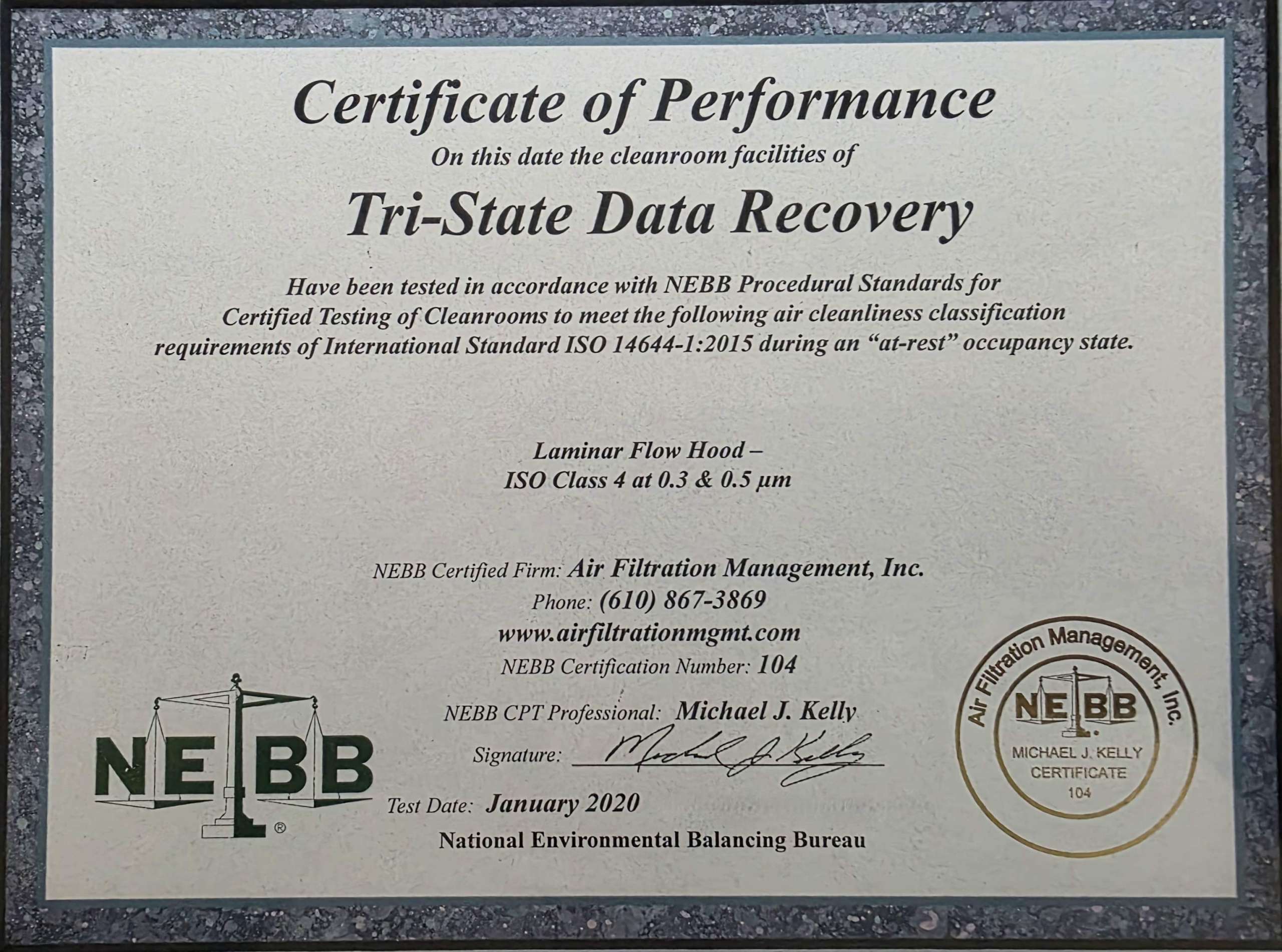
3. WHICH ISO CLASS, AND WILL YOU SEND ME THE CERTIFICATE?
ISO 14644-1 runs 1 to 9, lower is cleaner, each step about ten times. “ISO-certified” with no number tells you nothing — Class 9 is roughly an ordinary office, and “Class 100” comes from a standard withdrawn in 2001.
Our answer: ISO Class 4 under ISO 14644-1:2015, certificate viewable here.
EXPERIENCE THE DIFFERENCE
A TOWN NAME IN A HEADLINE, OR AN ADDRESS
THE REBUILD IS THE DANGER
When a Server Loses a Drive
A lot of what reaches us from this part of the county is a small NAS in an office or a back room, holding everything a business has. One disk fails, the unit reports it, and the instinct is to slot in a replacement and let it heal. That instinct is what turns one failure into two.
A rebuild reads every sector of every remaining disk, continuously, for hours. Those disks were bought together, installed together, and have run the same hours at the same temperature. A rebuild is the heaviest workload the array will ever see, applied to drives that are all the same age as the one that just died. A second failure part-way through leaves you with a partially rewritten array rather than an intact one.
So power the unit down and leave it. Don’t replace the disk, don’t let it resynchronize, and don’t reseat anything. If drives are already out, note which bay each one came from — that order matters and reconstructing it later is harder than writing it down now. Then call, and say it’s an array before anything else.
WHAT WE RECOVER
The Cases That Need a Clean Room and Expert Skill
Hard Drive Recovery
Hard drives that are clicking, seized and beeping from a drop; head crashes, firmware faults and bad sectors caused from media damage. Weak or faulty head assemblies replaced with precision-matched donor parts inside our certified clean rooms.
SSD & NVMe Recovery
These devices degrade while in use and develop bad sectors , firmware corruption and some times require NAND-level recovery on solid-state drives that are no longer recognized. Degraded NVMe drives require specialized hardware, not a software license.
NAS, RAID & SMALL SERVERS
Failed rebuilds, degraded arrays and units that won’t mount. Power down before anything else and tell us it’s an array on the first call — the order the disks came out in matters.
OLD DRIVES & OBSOLETE FORMATS
IDE and PATA, SCSI, SAS, old laptop drives and enclosures whose connector no longer exists on any modern machine. Don’t test an old drive to see if it works — it may spin up once, and that once should be a controlled image.
Apple & Mac Devices
Macs and MacBooks with a removable SSD or hard drive, Fusion Drives, iMacs, and the MacBook models that carry Apple’s data-recovery (“lifeboat”) connector. Also Airport Time Capsule and LaCie external drives. We don’t perform board repairs on current MacBooks with soldered storage — we’ll tell you that on the first call rather than after we have your machine.