DATA RECOVERY
WEST CHESTER, PA
40 Min
From West Chester
When a drive, RAID array, or business server fails in West Chester, the search results are full of national companies that will ask you to ship it out of state. We’re the real alternative Chester County has been missing — a certified laboratory in Montgomery County, where your drive is recovered in person, in-house, and never leaves our hands or loses the chain of custody.
THE TRUTH ABOUT “WEST CHESTER DATA RECOVERY”
Most “Local” Listings Ship Your Drive Out of State
A page can be generated for a town name without anyone being in the town, and advertising is bought against those same names. Read far enough down one and it asks you to request a prepaid shipping label, because the laboratory is not in West Chester at all. The free diagnostic is the lure: it describes what happens before a price exists, not what the recovery costs, and the figure is set once your only copy is already in a building you have never seen. What follows is usually a menu of tiers, where paying more does not buy more skill, it buys a place further up a queue you cannot see, priced by somebody you will never speak to.
The end of the job deserves as much attention as the beginning. A mail-in operation typically finishes by uploading your recovered files to a cloud account and emailing you a download link, and the speed of that handoff is what gets advertised. Count what it takes to get there. Your only copy travels through a courier system, it is handled by technicians you never meet in a building you have never seen, and then a second copy of everything is pushed to a third party’s servers, under a retention policy you did not choose and cannot audit, reachable by a link that arrives in your email. A company can call that secure. It cannot show you the copy being deleted. We hand your data back in person at our King of Prussia office, on media, and you verify your files with the engineer before you pay. Recovered data is securely erased two weeks after completion unless you arrange otherwise in writing.
Before any of that, ask for credentials rather than claims. Which ISO class is the clean room, and will you email me the certificate? Which platforms is the engineer certified on, who issued the certification, and will you send the documents? What state and what county is the drive opened in, and by whom? Anyone with money can purchase expensive equipment, but how do you know they are experts on it without proper training? A single laboratory answers all of it with one company and one name. Ours is an independently certified laboratory and the documents go out the same day you ask.
This page was written for West Chester because our mission statement is to give the Tri-State area a local option, not generated for it. Client drop-off and collection are at our King of Prussia office, about forty minutes up 202, and the drive is opened in our own Montgomery County laboratory by the engineer who answered the phone. Never shipped, never outsourced to a partner laboratory, and never out of our chain of custody.
SETTLE THESE BEFORE YOU HAND IT OVER
THREE THINGS TO ESTABLISH FIRST
None of them is technical, and every one of them can be answered in writing. They work on us as well as on anyone else.
DO YOU OPEN DRIVES HERE, AND IF NOT, WHO DOES?
An intake counter and a laboratory are not always the same building, and often not the same state. Ask which company opens it, in what state and what county, and ask for the split between their fee and the laboratory’s. A national company sometimes uses a repair shop to host its listing on Google Maps, and a page can be generated for a town name without anyone being in the town. Put the street address into a search by itself and see who else is listed there, then read the sign on the building in Street View.
Ours: the laboratory is a secured Montgomery County compound and every drive is opened there in our certified ISO Class 4 clean rooms, with client drop-off and collection at our corporate office located at 630 Freedom Business Center Drive, Floor 3, King of Prussia
WHAT IS THE ENGINEER CERTIFIED ON, AND WHO ISSUED IT?
Anyone with money can purchase expensive equipment, but how do you know they are experts on it without proper training? Ask which platforms the engineer is certified on, who issued the certification, and whether they will email you the documents. Then ask whether you can speak to that person before you commit. A case number is an answer to a different question.
Our answer: Don Anderson performs every recovery, expert-certified on PC-3000 and DeepSpar and micro soldering certified through ACI Technologies in Philadelphia
WHICH ISO CLASS IS THE CLEAN ROOM, AND WHERE IS THE CERTIFICATE?
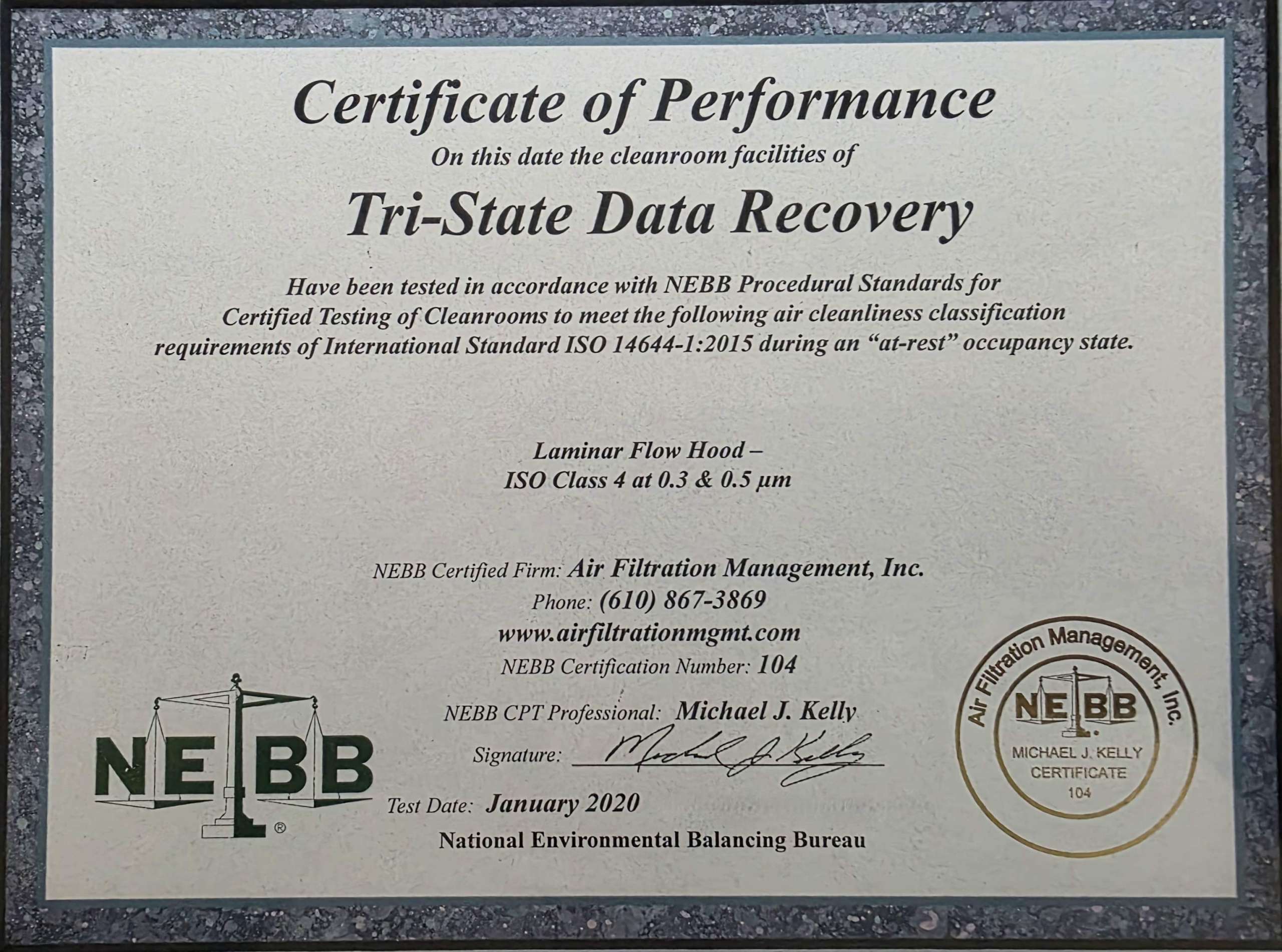
ISO 14644-1 runs 1 to 9, lower is cleaner, each step about ten times. “ISO-certified” with no number tells you nothing. Class 9 is roughly an ordinary office, and “Class 100” comes from a standard withdrawn in 2001 and is about equal to ISO Class 5, one step dirtier than the Class 4 this work is done to. Ask for the document naming the testing firm, the standard, the class, the date and the technician who signed it. This matters more than anything when the platters are exposed for hours during a multi-platter recovery procedure.
Our answer: ISO Class 4 under ISO 14644-1:2015, certificate viewable now
WHAT ACTUALLY HAPPENS TO A FAILING DRIVE
A Repair Counter and a Laboratory Are Different Rooms
A counter diagnoses a failing drive by reading it, because that is the only instrument on the counter. The software assumes a healthy drive with a logical fault, so it starts at the beginning and works through to the end, hammering the damaged areas hardest, on the one copy you have. A failing drive has a finite number of reads left in it, and that is how they get spent. Every minute of the attempt is spent out of the drive’s remaining life resulting in creating more bad sectors, a head crash or complete destruction of the drive. Local shops have been known to still charge a hefty price for returning only corrupted data.
A laboratory uses professional hardware like the PC-3000 to test the drive, unlock its service area, back up and repair its firmware, create a head map and target the sectors relevant to your data. The file table is read first, so the imaging is aimed at the sectors your files actually occupy, with the weakest areas left for last, while also separating any damaged files so you know exactly what you are paying for. Consumer software has no such target: it attempts a full clone and spends the drive’s remaining reads on empty space. If heads have to be replaced, it is done with precision-matched donor parts inside a certified clean room, because a single particle on a platter surface is larger than the flying height of the head.
Modern hard drives add a further requirement. The circuit board carries a serial flash ROM holding adaptive data unique to that drive that needs modification to allow access to the service area, so modern data recovery means advanced micro soldering, chip replacement and reflow, and ROM programming and SED unlocking. It takes expert-level training to do any of that without destroying the board or the chip.
None of that equipment is something a repair counter owns. It costs more than the shop’s entire tool inventory and it takes years to use properly. What costs you the data is not the diagnosis, it is the attempt. If your drive has already been through it, say so on the first call. It changes the approach, and what can be done.
THE DIFFERENCE IS CLEAR
WHO ACTUALLY OPENS IT
THE COUNTY SEAT
FILES THAT BELONG TO SOMEBODY ELSE
West Chester is the county seat, and the work that comes out of it reflects that. Law offices around the courthouse, title and settlement companies, accounting practices, surveyors and engineering firms, medical and dental practices, and the university. In most of those cases the data on the failed drive is not the owner’s own: it belongs to a client, a patient, a borrower or a research project, and somebody has an obligation attached to it.
That changes what the recovery has to protect. A missed filing date is a different kind of loss from a lost photograph, and privileged or regulated material carries a second problem on top of the first: not only getting it back, but being able to say afterwards exactly where it went and who touched it. We sign NDAs on request and Business Associate Agreements where health data is involved, work stays in-house under a documented chain of custody, and recovered data is securely erased two weeks after completion unless you arrange otherwise in writing. And we never upload your data to the cloud afterward.
If a deadline is driving the case, say so on the first call. Tell us which files or the database you need first, because that determines what gets targeted first, and rush service on emergency cases is quoted per case, by the engineer, before the case is accepted.
WHAT WE RECOVER
PRACTICES, FIRMS AND HOUSEHOLDS
Hard Drives
Clicking, grinding, dropped, or beeping drives; bad sectors, firmware failure, and physical damage — recovered in our certified ISO Class 4 clean rooms.
SSD & NVMe
Solid-state storage degrades with use, and when it fails there’s no warning. Controller failure, corrupted firmware, degraded NAND, and drives that vanish from BIOS, recovered in-house with PC-3000 and DFL, including chip replacement and advanced cooling and reflow techniques. Certified in advanced micro-soldering through ACI Technologies in Philadelphia.
RAID, NAS & Servers
Failed rebuilds, degraded arrays, simultaneous failures and virtual machines for Chester County businesses. Every member is repaired and imaged individually before we attempt to reconstruct the copies.
PRACTICES, FIRMS & REGULATED RECORDS
Apple & Mac
Macs and MacBooks with a removable SSD or hard drive, Fusion Drives, iMacs, Airport Time Capsule and LaCie external drives. On 2016 and 2017 MacBook Pro models we can read the onboard storage using Apple’s Customer Data Migration Tool. We don’t perform board repairs of any kind, so machines with a T2 chip or Apple Silicon are declined on the first call rather than after we have your machine.