Data Recovery
Ardmore, PA
$800
WHERE LEVEL 2 PHYSICAL RECOVERY STARTS
TWO PARTIES, ONE INVOICE
What a Four-Figure Quote Is Actually Made Of
When a physically failed drive is taken in at a counter and sent elsewhere, two businesses are paid out of one number. The laboratory charges for the recovery. The shop charges for arranging it, carrying the risk, and handling you. Both are real charges and a shop that says the work is outsourced has told you the truth about the arrangement.
What isn’t published is the split, and that’s the number that matters to you. The same drive, taken directly to the laboratory that would have received it anyway, is quoted once. You can’t compare the two unless you ask, and by the time a quote arrives the drive is usually already gone.
The margin isn’t the only thing added. A forwarded drive gains a courier journey, a position in somebody else’s queue, and a chain of custody with a hand-off in the middle of it — and when you want to ask a specific question about what failed, you’re asking the counter rather than the engineer.
So ask before anything moves: which laboratory, where is it, who opens the drive, and what would they quote me directly? Ours are published so the question doesn’t arise: $106 diagnostic per drive, $400 and up logical, $800 and up Level 2, $1,500 to $2,500 clean room, a firm written quote after the drive is examined, and nothing beyond the diagnostic if we can’t recover it.
FOUR CHECKS, UNDER TWO MINUTES
What a Quote Can’t Hide
All four work on us as well as on anyone else. Ask them before you agree to anything.
DOES THIS PRICE INCLUDE SOMEBODY ELSE’S FEE?
The plainest version of the question. If the drive is going to a laboratory partner, you’re paying two parties out of one number, and you’re entitled to know which laboratory and roughly what share is theirs.
Our answer: no — there is no partner laboratory in our process
DOES MY DRIVE STAY WITH YOU, OR GET OUTSOURCED?
A street address and a name. A single laboratory answers immediately. Where the answer is a partner facility or a queue, the work is happening somewhere the person quoting you can’t describe — and neither can you, if a client ever asks.
Our answer: 630 Freedom Business Center Drive, Floor 3, King of Prussia, and Don Anderson, who also answers the phone
WHO IS TRAINED ON THE EQUIPMENT, AND CAN THEY PROVE IT?
Anyone with capital can buy a clean room and a PC-3000. None of it comes with the knowledge of how to use it, and anyone who worked in IT for twenty years can advertise twenty years of experience. Ask which platforms the engineer is certified on, who issued it, and whether they will send the documents.
Our answer: View our training and certifications now
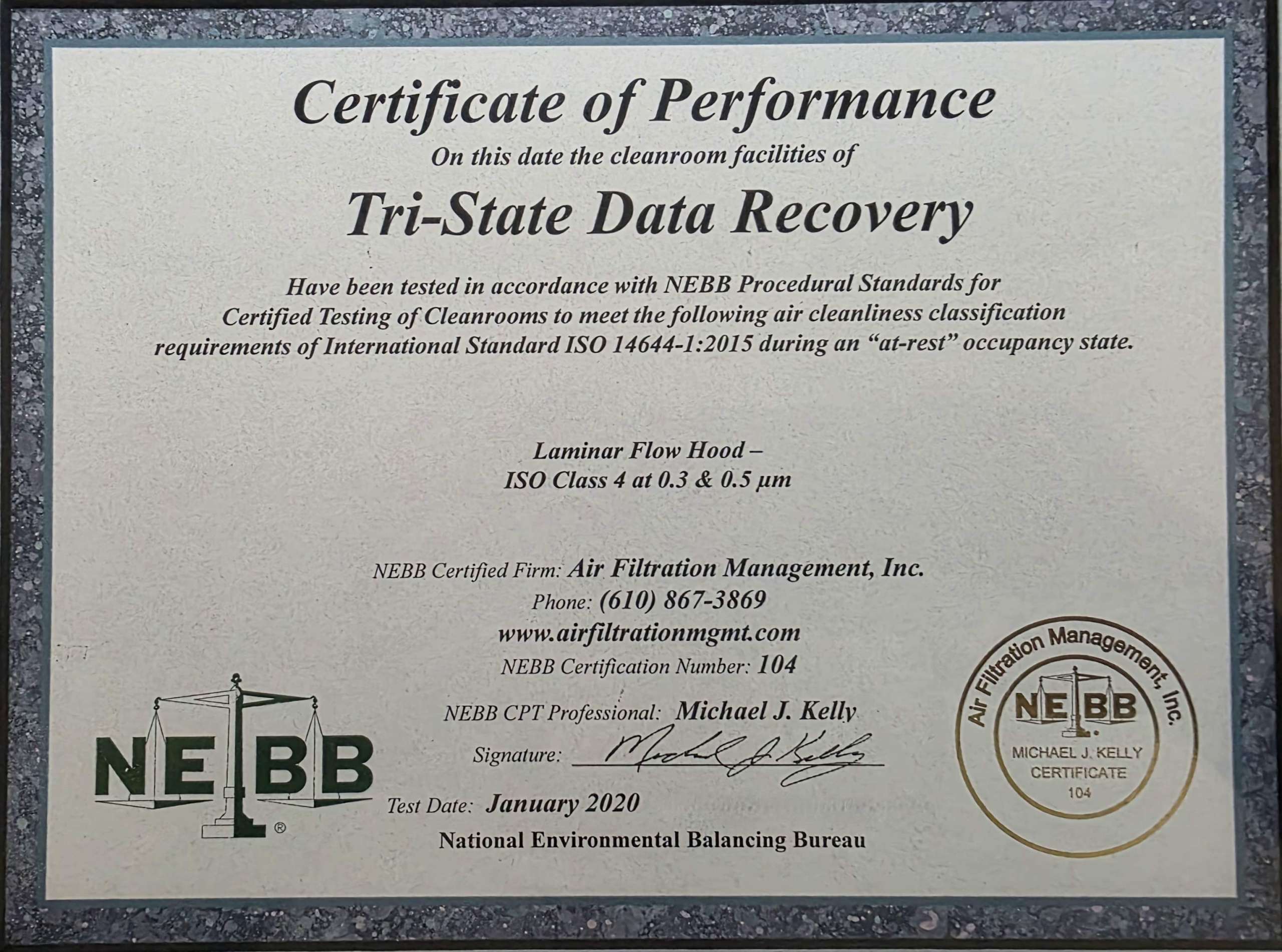
WHICH ISO CLASS, AND WILL YOU SEND ME THE CERTIFICATE?
ISO 14644-1 runs 1 to 9. Lower is cleaner, and each step permits about ten times more airborne particles than the one below. “ISO-certified” with no number tells you nothing — Class 9 is roughly an ordinary office.
“Class 100,” which many companies still advertise, comes from a federal standard withdrawn in 2001. It corresponds to roughly ISO 5, about ten times dirtier than the ISO Class 4 this work is done to.
That difference is invisible until a drive is open. When platters are exposed for hours during a multi-disc recovery, the air above them matters more than anything else on the bench — which is why we built a larger, cleaner hood rather than working only from the 18-to-24-inch ISO 5 enclosures most of this industry advertises.
Our answer: ISO Class 4 under ISO 14644-1:2015, certificate viewable now.
EXPERIENCE THE DIFFERENCE
AN OUTSOURCED DRIVE, OR A DIRECT HAND-OFF
WHAT WE RECOVER
HOUSEHOLDS, PRACTICES AND LOWER MERION BUSINESSES
Hard Drive Recovery
Hard drives that are clicking, seized and beeping from a drop; head crashes, firmware faults and bad sectors caused from media damage. Weak or faulty head assemblies replaced with precision-matched donor parts inside our certified ISO 4 clean rooms.
SSD & NVMe Recovery
These devices degrade while in use and develop bad sectors , firmware corruption and some times require NAND-level recovery on solid-state drives that are no longer recognized. Degraded NVMe drives require specialized hardware, not a software license.
RAID, NAS & Servers
Failed rebuilds and degraded arrays in offices and households. Drives bought together fail together, which is why the rebuild rather than the first failure usually ends an array. Power down and call before anyone rebuilds.
Practices & Regulated Records
Practice management databases, imaging archives and client files across Lower Merion. NDA on request before work begins, Business Associate Agreement where health data is involved, documented custody from intake to return.
Apple & Mac Devices
Macs and MacBooks with a removable SSD or hard drive, Fusion Drives, iMacs, and the MacBook models that carry Apple’s data-recovery (“lifeboat”) connector. Also Airport Time Capsule and LaCie external drives. We don’t perform board repairs on current MacBooks with soldered storage — we’ll tell you that on the first call rather than after we have your machine.
OLD DRIVES & OBSOLETE FORMATS
Tell Us What Was Done to It
A fair share of what reaches us from the Main Line has been looked at once already, and that isn’t a problem to hide. It’s the single most useful thing you can tell us on the first call, because a drive that was left alone is a materially different job from one that has been tried repeatedly.
Three specifics matter more than anything else. How many times it was powered on. Whether any recovery software was run against it. Whether anyone opened it. Say all three plainly and nobody is getting judged — it changes what we look at first and what we tell you is realistic.
And if you’ve been quoted somewhere already, say the number. We’ll tell you straight whether it sounds like a physical case at all, at no charge, including when the answer is that what you were told is right and you don’t need us.