DATA RECOVERY
EXTON, PENNSYLVANIA
25 MIN
TO OUR KOP OFFICE, WITH PARKING
WHO WROTE THE PAGE YOU LANDED ON
Generated for Exton, Answered From Somewhere Else
Put any town in this county into a search and the same page comes back with the name changed. That is the product: one template produced per town name, advertising bought against those same names so a paid position sits above local businesses, and a local-format phone number that rings somewhere else. None of it requires a building in Chester County, and none of it tells you where your drive would be opened. A national company sometimes uses a repair shop to host its listing on Google Maps, so the pin on the map is not proof of a laboratory either.
A mail-in operation is the same arrangement with the counter removed. A free evaluation and a no data, no charge guarantee both describe what happens before a price exists, not what the recovery costs. The figure is set once your only copy is already inside a building you have never seen, at which point declining it means asking for the drive back, wondering what was done to it and hoping that it returns in the same condition as when it left. When you pay nothing for a diagnostic, they aren’t required to give you any paperwork explaining what they did to it. A prepaid shipping label is not a convenience in that arrangement. It is the step that makes the rest of it possible.
This page was written for Exton because our mission statement is to give the Tri-State area a local option, not generated for it. Your drive is opened in Montgomery County, by the engineer who answered the phone, and it does not leave our chain of custody. Scheduling an appointment and hand delivering it is always the safest option and assures the chain of custody is kept intact. From Exton that is about twenty-five minutes, and you collect it from the same person you handed it to.
BETWEEN YOUR OFFICE AND A CLEAN ROOM
How Many Hands Does the Drive Pass Through?
Along this corridor the drive usually leaves through somebody else first. An office manager hands it to the IT provider, or a shop takes it over a counter, and from there it goes out. A great deal of advertised data recovery is collected in one place and performed in another. The party that takes the drive, the company on the invoice and the engineer who opens it can be three separate names, and you are usually told the first one only.
If it leaves, ask what town and what state the work is done in, and who opens it. A single laboratory answers with one company and one name. A quote with no laboratory named behind it contains somebody else’s fee, a margin you were not shown, shipping risks, possible data theft or a broken chain of custody. For a practice or a firm holding records under a retention obligation, that last item is not a detail. It is the part you would have to explain later.
Ask for the split while you are there, in writing: what is your fee, and what is the laboratory’s? A company that performs its own recoveries has no reason to withhold it. And you are free to shorten the chain yourself by bringing the drive to the engineer who will open it, which takes about twenty-five minutes from Exton.
THREE CHECKS, UNDER TWO MINUTES
WHAT A LISTING CAN’T FAKE
All three work on us as well as on anyone else. Run them before you hand a drive to anybody, including your own vendor.
SEARCH THE STREET NUMBER ON ITS OWN
A national company sometimes uses a repair shop to host its listing on Google Maps, and a page can be generated for a town name without anyone being in the town. Put the street address into a search by itself and see who else is listed there, then put it into Street View and read the sign on the building. Comparing the opening hours of two listings at one address, or asking for the clean room certification, will usually expose the truth.
Our answer: 630 Freedom Business Center Drive, Floor 3, King of Prussia, published on every page we write
ASK WHICH ISO CLASS, AND FOR THE CERTIFICATE
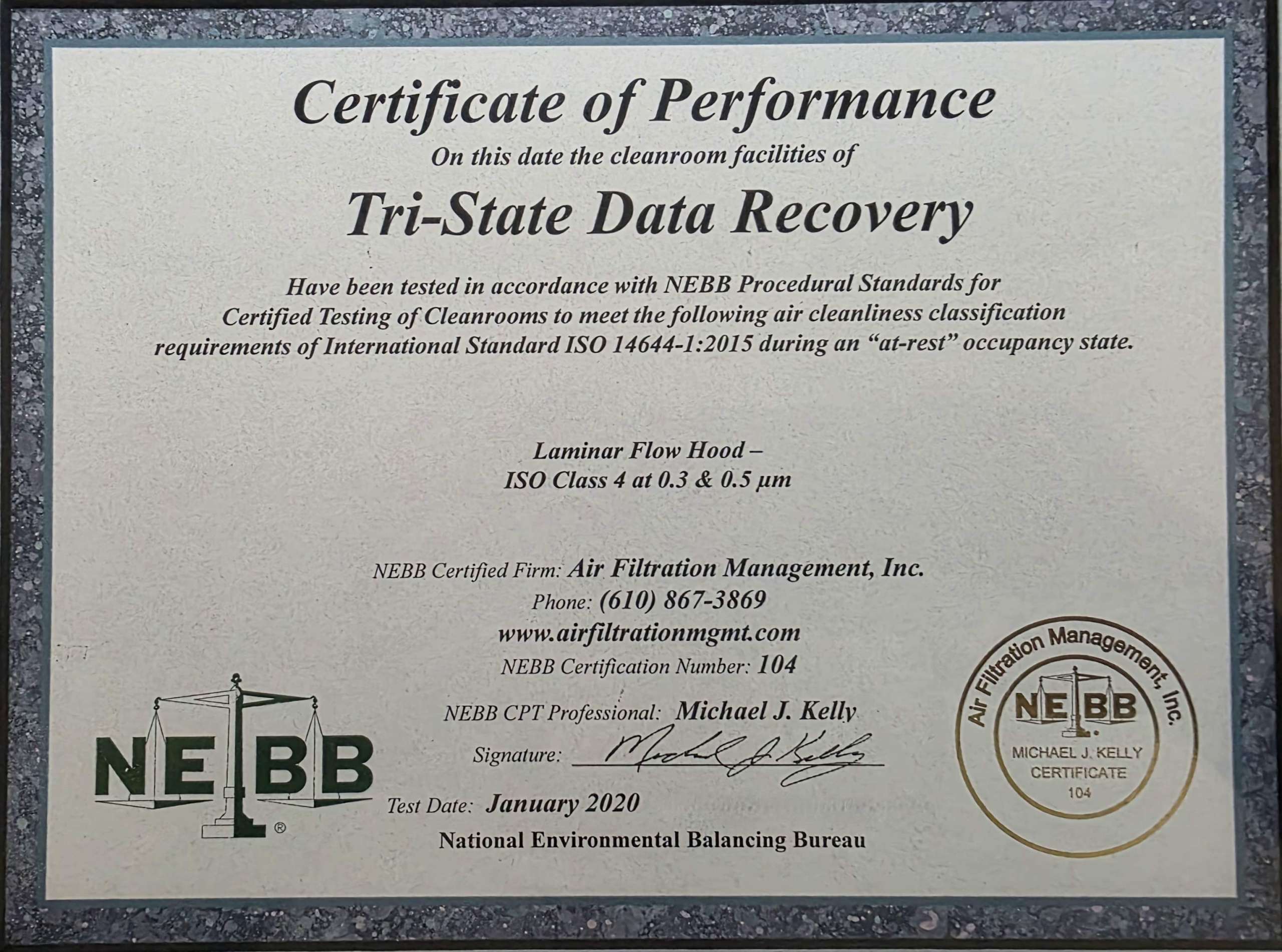
ISO 14644-1 runs 1 to 9, lower is cleaner, each step about ten times. “ISO-certified” with no number tells you nothing. Class 9 is roughly an ordinary office, and “Class 100” comes from a standard withdrawn in 2001 and is about equal to ISO Class 5, one step dirtier than the Class 4 this work is done to. Ask for the document naming the testing firm, the standard, the class, the date and the technician who signed it. This matters more than anything when the platters are exposed for hours during a multi-platter recovery procedure.
Our answer: ISO Class 4 under ISO 14644-1:2015, certificate viewable now
ASK WHAT THE ENGINEER IS CERTIFIED ON
Anyone with money can buy the equipment. Ask which platforms the engineer is personally certified on, who issued the certification, and whether they will send you the documents. Then ask who will physically open the drive, and whether you can speak to that person before you commit to anything.
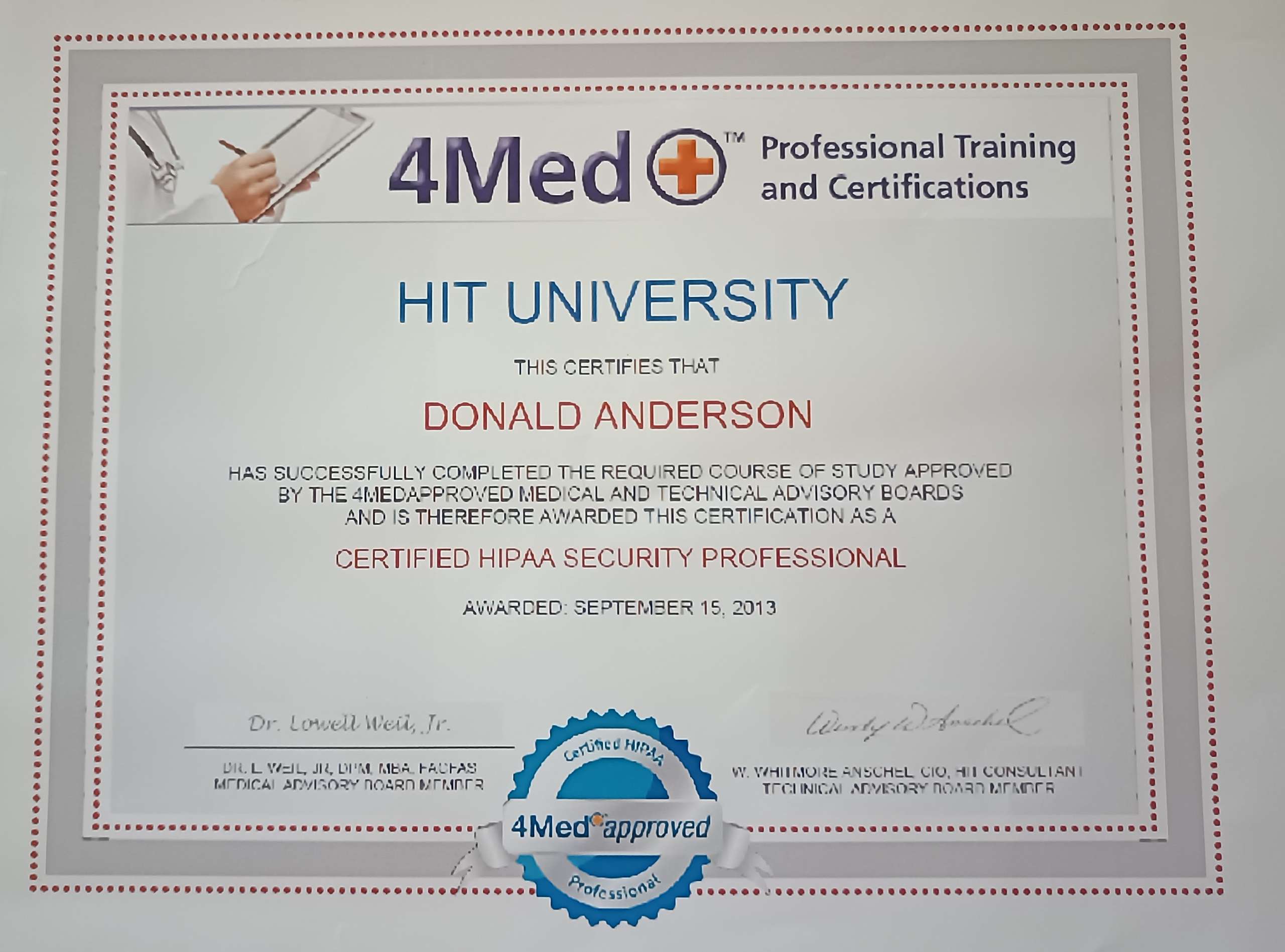
Our answer: expert-certified on PC-3000 and DeepSpar, view all of our certifications, and Don Anderson opens the drive
WHAT ACTUALLY HAPPENS TO A FAILING DRIVE
READING A DYING DRIVE IS NOT DIAGNOSING IT
The usual first move is to point recovery software at the drive and leave it running overnight. The software assumes a healthy drive with a logical fault, so it starts at the beginning and works through to the end, hammering the damaged areas hardest, on the one copy you have. A failing drive has a finite number of reads left in it, and an overnight scan is how they get spent. If nothing gets imaged first, every minute of the attempt is spent out of the drive’s remaining life.
A laboratory uses professional hardware like the PC-3000 to test the drive, unlock its service area, back up and repair its firmware, create a head map and target the sectors relevant to your data. The file table is read first, so the imaging is aimed at the sectors your files actually occupy, with the weakest areas left for last. Consumer software has no such target: it attempts a full clone and spends the drive’s remaining reads on empty space. If heads have to be replaced, it is done with precision-matched donor parts inside a certified clean room, because a single particle on a platter surface is larger than the flying height of the head. Modern hard drives add a further requirement. The circuit board carries a locked serial flash ROM holding adaptive data unique to that drive, so advanced micro soldering, chip replacement and reflow, and ROM programming are required just to access the service area. It takes expert-level training to do any of that without destroying the board or the chip.
None of that equipment is something a repair counter owns. It costs more than the shop’s entire tool inventory and it takes years to use properly. What costs you the data is not the diagnosis, it is the attempt. Ask the counter one question before you leave the drive: do you open drives here, or does this go somewhere else?
EXPERIENCE THE DIFFERENCE
A CHAIN OF CUSTODY, OR A CHAIN OF VENDORS
WHAT WE RECOVER DATA FROM
Client Files to Family Archives
Hard Drive Recovery
Hard drives that are clicking, seized and beeping from a drop; head crashes, firmware faults and bad sectors caused from media damage. Weak or faulty head assemblies replaced with precision-matched donor parts inside our certified clean rooms.
SSD & NVMe Recovery
These devices degrade while in use and develop bad sectors , firmware corruption and some times require NAND-level recovery on solid-state drives that are no longer recognized. Degraded NVMe drives require specialized hardware, not a software license.
RAID, NAS & Server Recovery
Failed rebuilds, simultaneous drive failures, degraded arrays and virtual machines for the businesses along the Route 100 and Whiteland corridors. Power down and call before anyone rebuilds.
Practices & Regulated Records
Practice management databases, imaging archives and records held under retention obligations. HIPAA Certified Security Professional authorized to work with confidential data. NDA upon request, BAA upon request where health data is involved, documented chain-of-custody from intake to return.
Apple & Mac Devices
Macs and MacBooks with a removable SSD or hard drive, Fusion Drives, iMacs, and the MacBook models that carry Apple’s data-recovery (“lifeboat”) connector. Also Airport Time Capsule and LaCie external drives. We don’t perform board repairs on current MacBooks with soldered storage — we’ll tell you that on the first call rather than after we have your machine.
SECOND OPINIONS
IF YOU’VE ALREADY BEEN QUOTED
Bring the Quote With You
A steady share of the drives that reach this bench have already been somewhere else. Somebody sent the drive off on a free evaluation or “flat-rate”, and a four-figure number came back once the company already had it. If that’s happened to you, bring the quote. Tell us the figure, what they said failed, and what they said they’d do about it.
Two things come out of that. It tells us what’s already been attempted, which changes what’s still possible — a drive that has been powered on repeatedly, or run through consumer software, is a different job from one that was left alone. And it lets us tell you plainly whether the price was reasonable, including when the answer is that it was. We’d rather say so than pretend otherwise; a fair quote from a competent lab is a fair quote wherever it came from.