DATA RECOVERY
LEVITTOWN, PA
45 MIN
WEST ON THE TURPIKE – PARKING AT OUR END
WHERE THE DRIVE ACTUALLY GOES
A COUNTER FIVE MILES AWAY IS STILL NOT A LABORATORY
Proximity is the easiest thing to manufacture in a local search. A national company sometimes uses a repair shop to host its listing on Google Maps, and it can do that at more than one shop in the same area, each with its own local-format phone number. The shops are real businesses. The laboratory is not at either one. What the counter does is take the drive in and ship it out of state, exposing it to many risks while ballooning the quote.
That is worth understanding rather than resenting. The counter that takes the drive, the company on the invoice and the engineer who opens it can be three separate parties, and you are usually told about the first one only. The price you were quoted then contains somebody else’s fee, a margin you were not shown, shipping risks, possible data theft or a broken chain of custody. A free evaluation completes it, because no price exists until your only copy is already in their building, and when you pay nothing for a diagnostic they aren’t required to give you any paperwork explaining what they did to it.
That much is disclosed. Nothing past it is. So ask the question in a form that cannot be answered sideways: what town and what county is my drive opened in, and by whom? Ask for it in writing. A single laboratory answers with one company and one name, and ask for the split while you are there. A company that performs its own recoveries has no reason to withhold it.
FOUR CHECKS, UNDER FIVE MINUTES
WHAT A LISTING CAN’T FAKE
Each has a document, an address or a number behind it. All four work on us as well as on anyone else.
READ THE COMPANY NAME ON EVERY RESULT, AND COUNT IT
Several listings with the same name and different addresses or phone numbers can still be one company. National companies use repair shops to host their Google listings while having them ship your sensitive drive out of state, exposing it to many risks along with a ballooned quote. When the same name appears more than once throughout the region, that is not two laboratories. It is one operation with more than one local-looking front door, and the count itself is the tell.
Our answer: one company, appearing once, at one address
SEARCH THE STREET NUMBER ON ITS OWN
A national company sometimes uses a repair shop to host its listing on Google Maps, and a page can be generated for a town name without anyone being in the town. Put the street address into a search by itself and see who else is listed there, then put it into Street View and read the sign on the building. Comparing the opening hours of two listings at one address, or asking for the clean room certification, will usually expose the truth.
Our answer: 630 Freedom Business Center Drive, Floor 3, King of Prussia, published on every page we write
ASK WHICH ISO CLASS, AND FOR THE CERTIFICATE
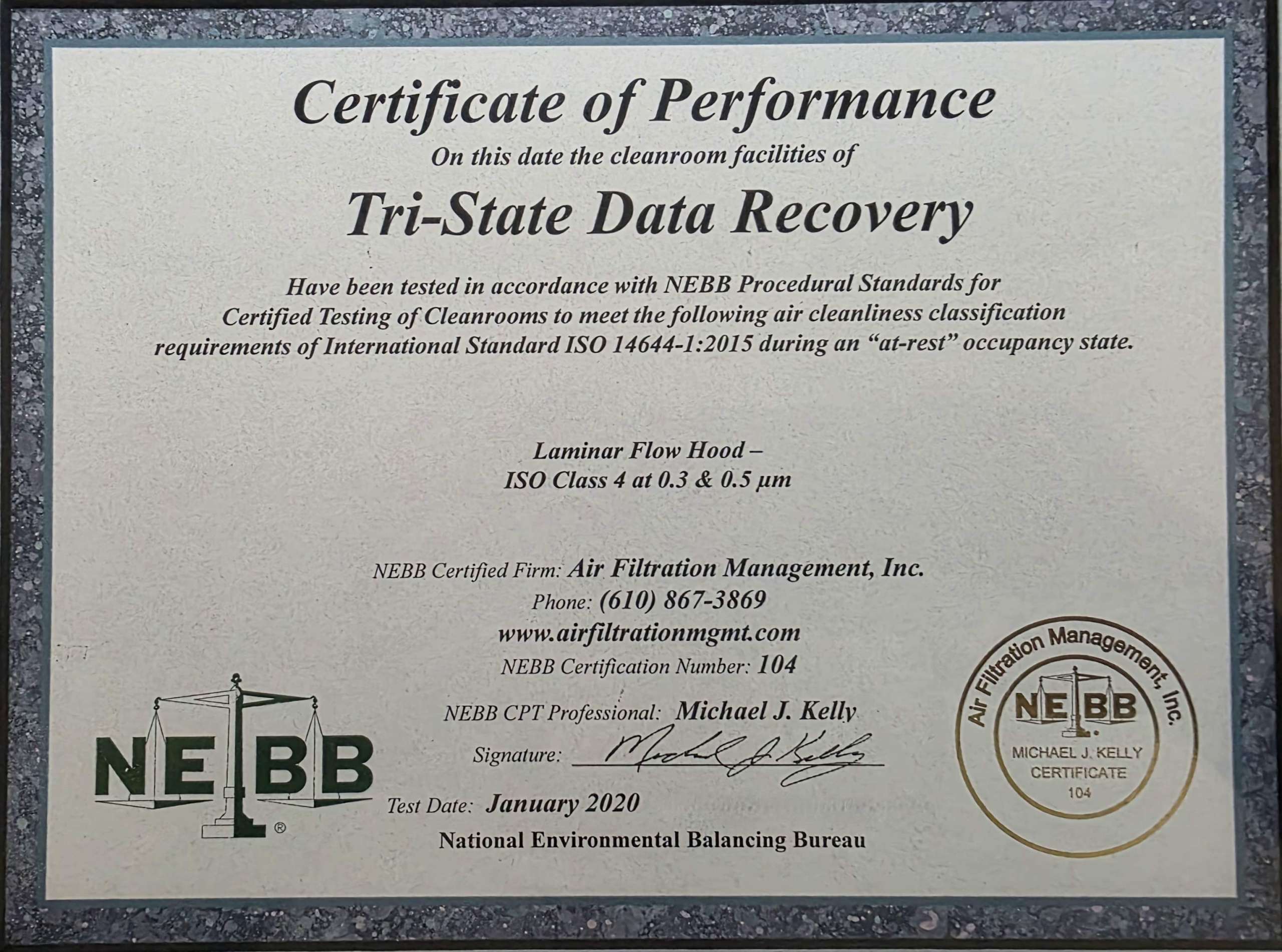
ISO 14644-1 runs 1 to 9, lower is cleaner, each step about ten times. “ISO-certified” with no number tells you nothing. Class 9 is roughly an ordinary office, and “Class 100” comes from a standard withdrawn in 2001 and is about equal to ISO Class 5, one step dirtier than the Class 4 this work is done to. Ask for the document naming the testing firm, the standard, the class, the date and the technician who signed it. This matters more than anything when the platters are exposed for hours during a multi-platter recovery procedure.
Our answer: ISO Class 4 under ISO 14644-1:2015, certificate viewable now
ASK WHAT THE ENGINEER IS CERTIFIED ON
Anyone with money can buy the equipment. Ask which platforms the engineer is personally certified on, who issued the certification, and whether they will send you the documents. Then ask who will physically open the drive, and whether you can speak to that person before you commit to anything.
Our answer: expert-certified on PC-3000 and DeepSpar, view all of our certifications, and Don Anderson opens the drive
WHAT A COUNTER CAN AND CAN’T DO
THE DOCKING STATION IS THE INSTRUMENT, AND THAT’S THE PROBLEM
A computer shop diagnoses an old drive by connecting it and reading it, because that is the only instrument on the counter. On a healthy disk that is harmless. On a drive with one spin-up left it is the recovery, spent. And if the drive is physically failing, the software makes it worse deliberately: it assumes a logical fault, so it starts at the beginning and works through to the end, hammering the damaged areas hardest, on the one copy you have.
A laboratory uses professional hardware like the PC-3000 to test the drive, unlock its service area, back up and repair its firmware, create a head map and target the sectors relevant to your data. The file table is read first, so the imaging is aimed at the sectors your files actually occupy, with the weakest areas left for last. Consumer software has no such target: it attempts a full clone and spends the drive’s remaining reads on empty space. Where heads have to be replaced it is done with precision-matched donor parts inside a certified clean room, because a single particle on a platter surface is larger than the flying height of the head.
Hard drives add one more requirement. The circuit board carries a serial flash ROM holding adaptive data unique to that drive, so a donor board on its own does not work, and electronics faults mean advanced micro soldering, chip replacement and reflow, and ROM programming. On a twenty-year-old board with aged components that is routine work here and impossible on a counter. Ask the counter one question before you leave the drive: do you open drives here, or does this go somewhere else?
EXPERIENCE THE DIFFERENCE
SEVERAL FRONTS, OR ONE CERTIFIED PENNSYLVANIA LABORATORY
LOWER BUCKS HOUSEHOLDS HOLD ONTO THEIR DRIVES
AN OLD DRIVE SAVED BECAUSE OF THE MEMORIES IT CONTAINS
Levittown was built to be lived in, and a lot of these houses have had the same family in them since the fifties. The drives follow: an external in a closet, a tower in the basement, a disk somebody pulled out of a dead computer in 2009 and meant to deal with. Nobody goes looking for them on an ordinary Tuesday. It’s a wedding, a funeral, or a house being cleared out, and suddenly it matters what’s on them.
Two things about aged media catch people out. Age is damage even when nothing was running. Lubricant migrates away from where it is needed, heads can stick to the platter surface, rubber and electrolytic components on the circuit board degrade, and the magnetic signal weakens slowly over a decade or two. And a drive that has been still for that long may spin up exactly once.
That one spin-up is the whole recovery, and it belongs in a laboratory rather than in a USB dock on a kitchen table. So don’t test it. Call and describe it instead: the make if the label is still readable, whether it came out of a machine or was always external, and roughly when it was last used. Tell us which files matter and we target those sectors first.
WHAT WE RECOVER
HOUSEHOLDS, TRADES AND LOWER BUCKS BUSINESSES
Hard Drive Recovery
Hard drives that are clicking, seized and beeping from a drop; head crashes, firmware faults and bad sectors caused from media damage. Weak or faulty head assemblies replaced with precision-matched donor parts inside our certified ISO 4 clean rooms.
SSD & NVMe Recovery
Solid-state storage degrades with use, and when it fails there’s no warning. Controller failure, corrupted firmware, degraded NAND, and drives that vanish from BIOS, recovered in-house with PC-3000 and DFL, including chip replacement and advanced cooling and reflow techniques. Certified in advanced micro-soldering through ACI Technologies in Philadelphia.
RAID, NAS & EXTERNALS
External drives that fail to mount or ask to be reformatted. Degraded RAID arrays for practices and businesses with security and HIPAA compliance. Drives bought together fail together, which is why the rebuild rather than the first failure usually ends an array. Power down and call before anyone rebuilds.
TRADES & SMALL BUSINESS SYSTEMS
Job records, estimates, customer lists and the one office machine that runs a contracting or service business. Say if the business is stopped, and tell us which files you need first.
Apple & Mac Devices
Macs and MacBooks with a removable SSD or hard drive, Fusion Drives, iMacs, and the MacBook models that carry Apple’s data-recovery (“lifeboat”) connector. Also Airport Time Capsule and LaCie external drives. We don’t perform board repairs on current MacBooks with soldered storage — we’ll tell you that on the first call rather than after we have your machine.