DATA RECOVERY
COATESVILLE, PA
45 MIN
EAST ON THE 30 – PARKING AT OUR END
WHAT ACTUALLY HAPPENS TO A FAILING DRIVE
A Repair Counter and a Laboratory Are Different Buildings
A computer shop diagnoses a failing drive by reading it. That is the only instrument on the counter. The software assumes a healthy drive with a logical fault, so it starts at the beginning and works through to the end, hammering the damaged areas hardest, on the one copy you have. A failing drive has a finite number of reads left in it, and that is how they get spent.
A laboratory uses professional hardware like the PC-3000 to test the drive, unlock its service area, back up and repair its firmware, create a head map and target the sectors relevant to your data. The file table is read first, so the imaging is aimed at the sectors your files actually occupy, with the weakest areas left for last. Consumer software has no such target: it attempts a full clone and spends the drive’s remaining reads on empty space. If heads have to be replaced, it is done with precision-matched donor parts inside a certified clean room, because a single particle on a platter surface is larger than the flying height of the head. Modern hard drives add a further requirement. The circuit board carries a serial flash ROM holding adaptive data unique to that drive, so electronics faults mean advanced micro soldering, chip replacement and reflow, and ROM programming. It takes expert-level training to do any of that without destroying the board or the chip.
None of that equipment is something a repair counter owns. It costs more than the shop’s entire tool inventory and it takes years to use properly. What costs you the data is not the diagnosis, it is the attempt. Ask the counter one question before you leave the drive: do you open drives here, or does this go somewhere else?
WHERE THE DRIVE ACTUALLY GOES
Collected in One Place, Opened in Another
A great deal of advertised data recovery is collected in one place and performed in another. The counter that takes the drive, the company on the invoice and the engineer who opens it can be three separate parties, and you are usually told about the first one only. The price you were quoted then contains somebody else’s fee, a margin you were not shown, shipping risks, possible data theft or a broken chain of custody.
That much is disclosed. Nothing past it is. So ask the question in a form that cannot be answered sideways: what town and what county is my drive opened in, and by whom? Ask for it in writing. A single laboratory answers with one company and one name. A partner facility, a lab network or somewhere nobody will name is the answer to a different question, and ask for the split while you are there. A company that performs its own recoveries has no reason to withhold it.
THREE CHECKS, UNDER TWO MINUTES
What a Listing Can’t Fake
All three work on us as well as on anyone else. Run them before you hand a drive to anybody.
SEARCH THE STREET NUMBER ON ITS OWN
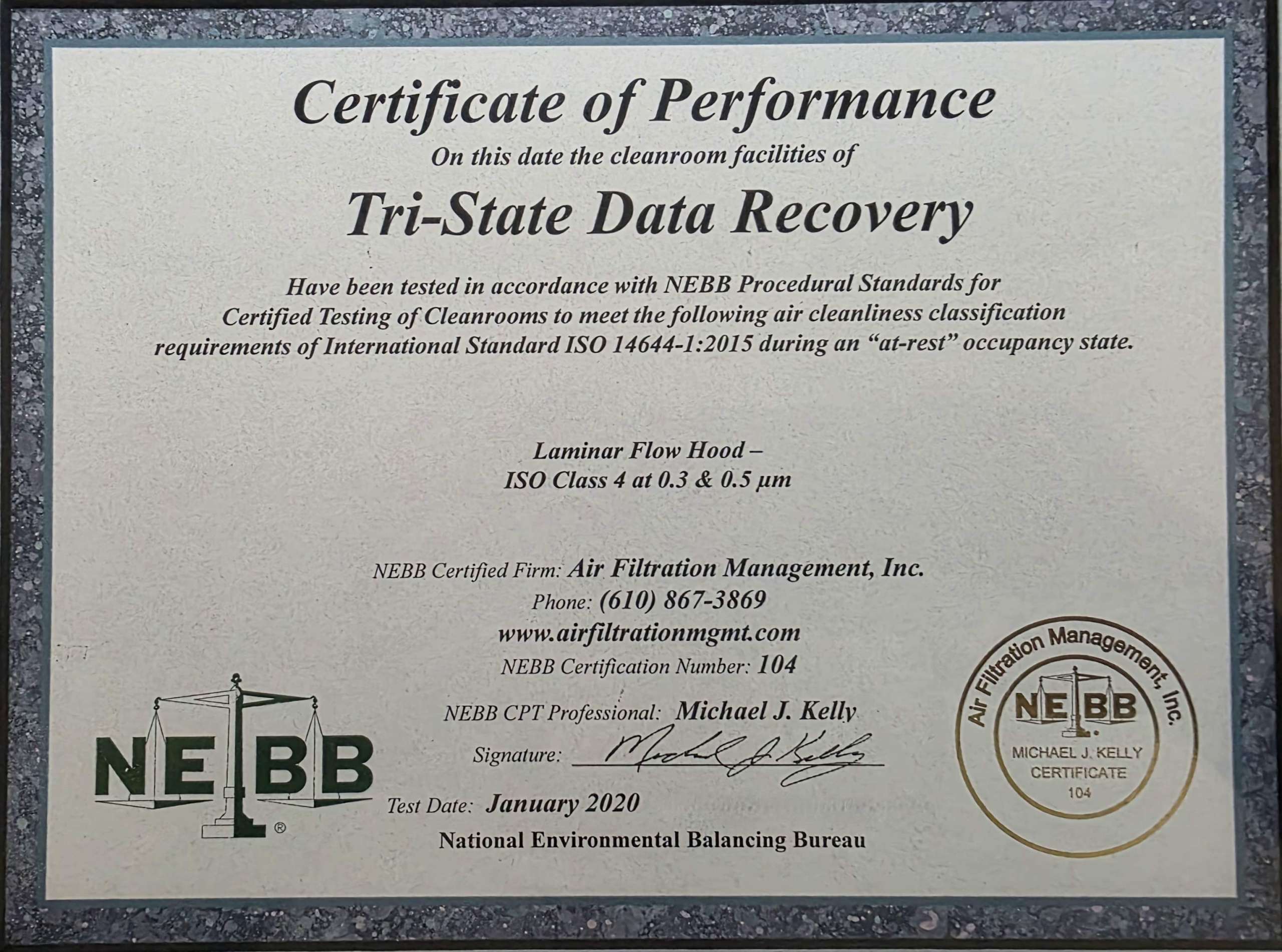
A national company sometimes uses a repair shop to host its listing on Google maps and page can be generated for a town name without anyone being in the town. Put the street address into a search by itself and see who else is listed there, then put it into Street View and read the sign on the building. Comparing the opening hours of two listings at one address, viewing the actual building in street view, or asking for the clean room certification will usually expose the truth.
Our answer: 630 Freedom Business Center Drive, Floor 3, King of Prussia, published on every page we write and our certifications posted publicly
CHECK THE PHONE NUMBER AGAINST THE ADDRESS
Chester County is 610 and 484. A page written for Coatesville answering on a number from another state is being answered in another state, and a local-format number can still ring somewhere else. “Serving Coatesville” is not an address. A laboratory occupies a building, and one that won’t name the building has told you something.
Our answer: an 800 number where you can speak to the engineer engineer who does the work
ASK WHICH ISO CLASS, AND FOR THE CERTIFICATE
ISO 14644-1 runs 1 to 9, lower is cleaner, each step about ten times. “ISO-certified” with no number tells you nothing. Class 9 is roughly an ordinary office, and “Class 100” comes from a standard withdrawn in 2001 and is about equal to ISO Class 5, which is a class below what this work is done to. Ask for the document naming the testing firm, the standard, the class, the date and the technician who signed it. This matters more than anything when the platters are exposed for hours during a multi-disc recovery procedure.
Our answer: ISO Class 4 under ISO 14644-1:2015, certificate viewable now
EXPERIENCE THE DIFFERENCE
AN INTAKE POINT, OR A LABORATORY
WE SEE A LOT OF DRIVES FROM HERE
Western Chester County Sends Us Work
Coatesville is not a town we found on a map for a search result. A steady share of what reaches the laboratory comes from here and from Parkesburg, Thorndale and Honey Brook. Usually by word of mouth, because somebody had a drive recovered and told a neighbor, a foreman or their accountant.
If that’s how you found us, say so on the first call. Not for our benefit, but because it usually means somebody has already had a look at the drive, and what was done to it changes what’s still possible. Be straight about it and nobody is getting judged: how many times it was powered on, whether recovery software was run, whether anyone opened it. A drive that was left alone is a different job from one that has been tried repeatedly.
The other thing worth knowing about this end of the county: a lot of what reaches us is the only machine a small operation has. A contractor’s estimates and job history, a shop’s books, twenty years of customer records on one desktop that was never imaged. If that’s what you’re holding, say it on the call and let us know exactly which files you need so we can target them first. Most cases are completed within a week without paying for expedited services, but if you need us to rush the case then let us know and we’ll tell you the cost and what’s possible before you commit.
WHAT WE RECOVER
TRADES, SMALL OFFICES AND FAMILY ARCHIVES
Hard Drive Recovery
Hard drives that are clicking, seized and beeping from a drop; head crashes, firmware faults and bad sectors caused from media damage. Weak or faulty head assemblies replaced with precision-matched donor parts inside our certified ISO 4 clean rooms.
SSD & NVMe Recovery
These devices degrade while in use and develop bad sectors , firmware corruption and some times require NAND-level recovery on solid-state drives that are no longer recognized. Degraded NVMe drives require specialized hardware, not a software license.
RAID, NAS & Servers
Failed rebuilds and degraded arrays in offices and households. Drives bought together fail together, which is why the rebuild rather than the first failure usually ends an array. Power down and call before anyone rebuilds.
TRADES & CONTRACTOR SYSTEMS
Estimates, job history, invoicing and the one office machine that runs a contracting, landscaping or service business. Say if the business is stopped, and tell us which files you need first.
Apple & Mac Devices
Macs and MacBooks with a removable SSD or hard drive, Fusion Drives, iMacs, and the MacBook models that carry Apple’s data-recovery (“lifeboat”) connector. Also Airport Time Capsule and LaCie external drives. We don’t perform board repairs on current MacBooks with soldered storage — we’ll tell you that on the first call rather than after we have your machine.