Allentown Data Recovery
1 Hour
Down the Northeast Extension · parking at our end
THE TRADE NOBODY SPELLS OUT
An Hour in Your Own Car, or Days in a Truck You Don’t Control
From Allentown we are about an hour down the Northeast Extension, and we will not pretend that is nothing. It is the honest cost of hand delivery, and it is the shortest trip your drive can make. The alternative is not a shorter journey, it is a longer one you cannot watch: a sorting facility, a truck, a second sorting facility, and a building you have never seen. Drops, heat, cold and loss all happen in that stretch, and a drive that already has a mechanical fault is the worst possible passenger.
The label is also what sets the price. A free evaluation and a no data, no charge guarantee both describe what happens before a price exists, not what the recovery costs. The figure is set once your only copy is already inside that building, at which point declining it means asking for the drive back, wondering what was done to it and hoping that it returns in the same condition as when it left. When you pay nothing for a diagnostic, they aren’t required to give you any paperwork explaining what they did to it. A prepaid shipping label is not a convenience in that arrangement. It is the step that makes the rest of it possible.
This page was written for Allentown because our mission statement is to give the Tri-State area a local option, not generated for it. Scheduling an appointment and hand delivering the drive is always the safest option and assures the chain of custody is kept intact, and some people still choose to ship, which is why we publish a dedicated page explaining the proper way to do it and the risks involved in exposing your drive to the shipping process. Either way the drive is opened in our own Montgomery County laboratory, by the engineer who answered the phone, and no case is outsourced to a partner laboratory.
THREE QUESTIONS, NONE OF THEM TECHNICAL
Ask Before the Drive Leaves Your Hands
All three work on us as well as on anyone else, and the answers are checkable before you commit to anything.
WHERE IS THE LABORATORY, AND IS IT THE BUILDING THAT OPENS MY DRIVE?
A street address, not a service area. “Serving the Lehigh Valley” is not an address. A national company sometimes uses a repair shop to host its listing on Google Maps, and a page can be generated for a city name without anyone being in the city. Put the street address into a search by itself and see who else is listed there, then read the sign on the building in Street View. Comparing the opening hours of two listings at one address, or asking for the clean room certification, will usually expose the truth.
Our answer: the laboratory is a secured Montgomery County facility and every drive is opened in it, with client drop-off and collection at 630 Freedom Business Center Drive, Floor 3, King of Prussia
WHO PERFORMS THE RECOVERY, AND WHAT ARE THEY CERTIFIED ON?
Anyone with money can purchase expensive equipment, but how do you know they are experts on it without proper training? Ask which platforms the engineer is certified on, who issued the certification, and whether they will email you the documents. Then ask whether you can speak to that person before you commit, and ask for the split between the company’s fee and the laboratory’s. A case number is an answer to a different question.
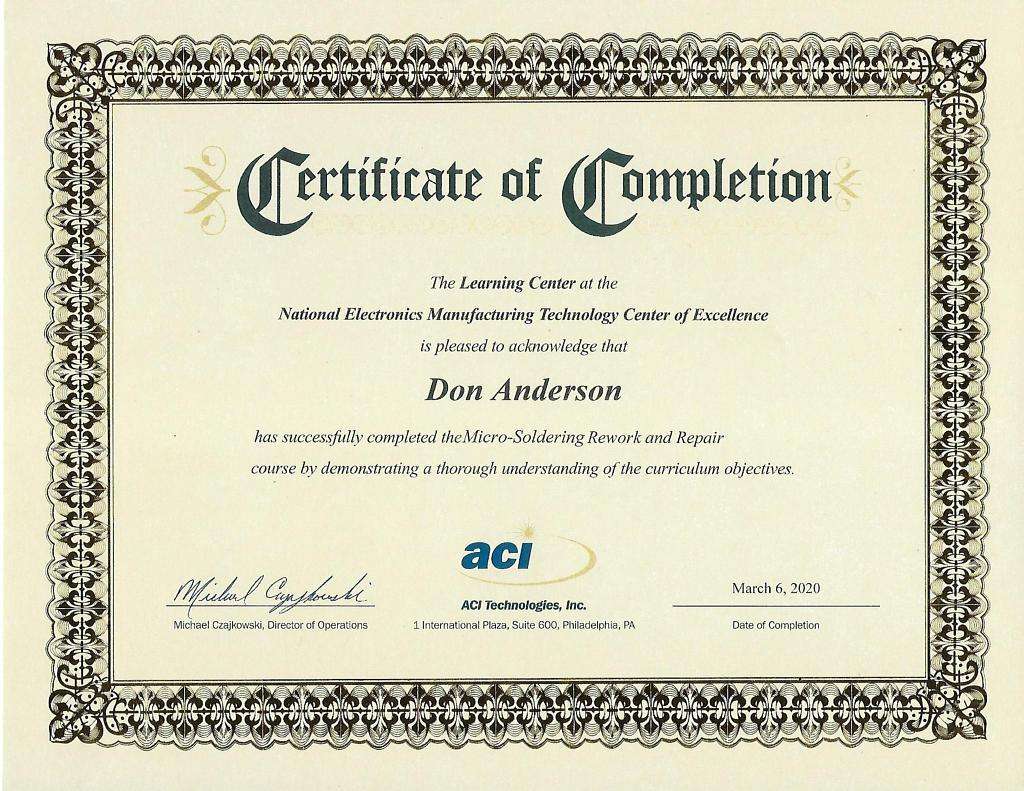
Our answer:Don Anderson performs every recovery, expert-certified on PC-3000 and DeepSpar and micro soldering certified through ACI Technologies in Philadelphia
WHICH ISO CLASS IS THE CLEAN ROOM, AND WHERE IS THE CERTIFICATE?
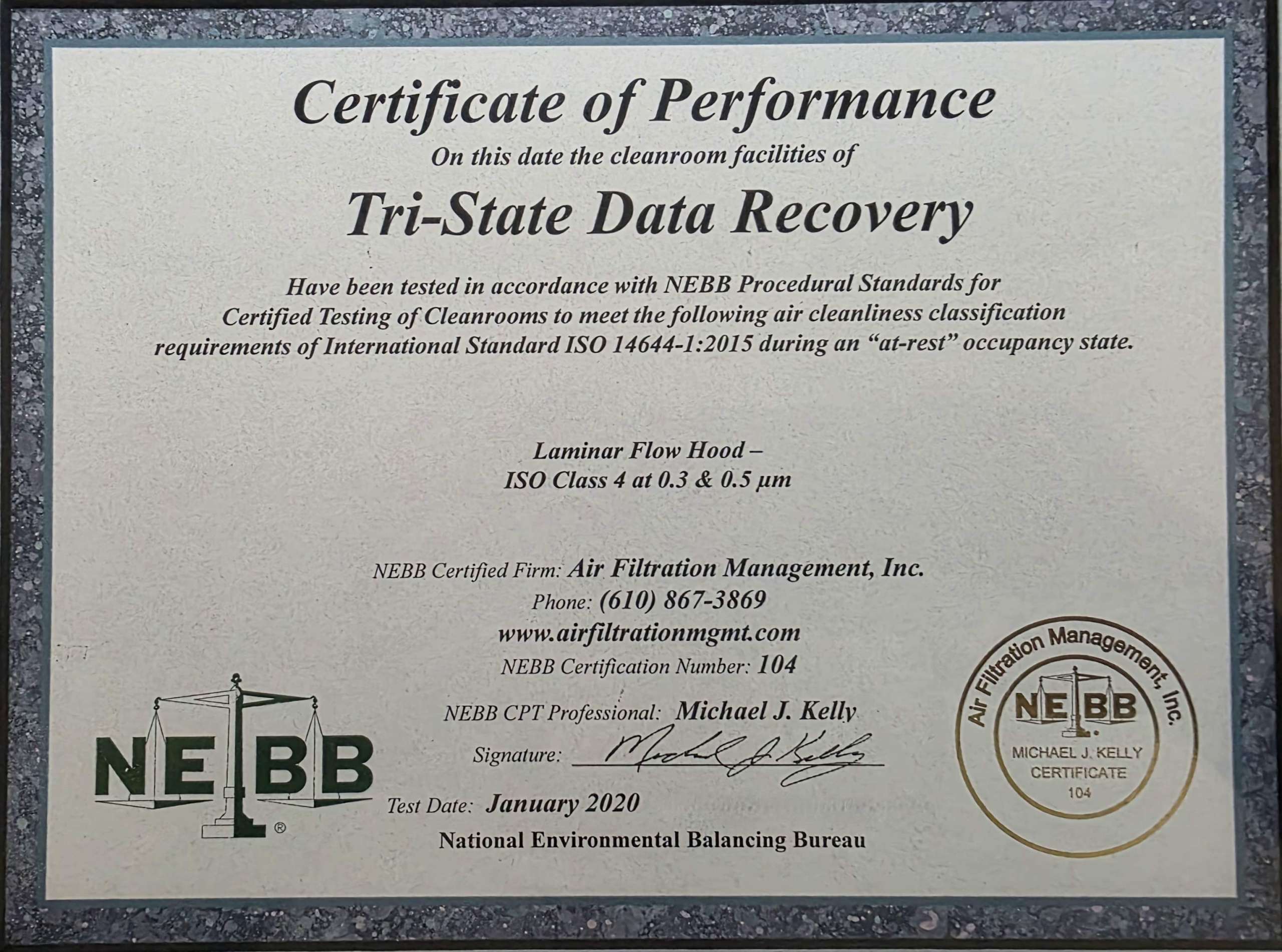
ISO 14644-1 runs 1 to 9, lower is cleaner, each step about ten times. “ISO-certified” with no number tells you nothing. Class 9 is roughly an ordinary office, and “Class 100” comes from a standard withdrawn in 2001 and is about equal to ISO Class 5, one step dirtier than the Class 4 this work is done to. Ask for the document naming the testing firm, the standard, the class, the date and the technician who signed it. This matters more than anything when the platters are exposed for hours during a multi-platter recovery procedure.
Our answer: ISO Class 4 under ISO 14644-1:2015, certificate viewable now
WHAT ACTUALLY HAPPENS TO A FAILING DRIVE
A Repair Counter and a Laboratory Are Different Rooms
A counter diagnoses a failing drive by reading it, because that is the only instrument on the counter. The software assumes a healthy drive with a logical fault, so it starts at the beginning and works through to the end, hammering the damaged areas hardest, on the one copy you have. A failing drive has a finite number of reads left in it, and that is how they get spent. Every minute of the attempt is spent out of the drive’s remaining life resulting in creating more bad sectors, a head crash or complete destruction of the drive. Local shops have been known to still charge a hefty price for returning only corrupted data.
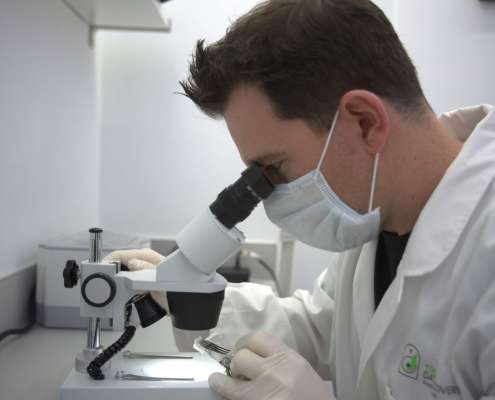
A laboratory uses professional hardware like the PC-3000 to test the drive, unlock its service area, back up and repair its firmware, create a head map and target the sectors relevant to your data. The file table is read first, so the imaging is aimed at the sectors your files actually occupy, with the weakest areas left for last, while also separating any damaged files so you know exactly what you are paying for. Consumer software has no such target: it attempts a full clone and spends the drive’s remaining reads on empty space. If heads have to be replaced, it is done with precision-matched donor parts inside a certified clean room, because a single particle on a platter surface is larger than the flying height of the head.
Modern hard drives add a further requirement. The circuit board carries a serial flash ROM holding adaptive data unique to that drive that needs modification to allow access to the service area, so modern data recovery means advanced micro soldering, chip replacement and reflow, and ROM programming and SED unlocking. It takes expert-level training to do any of that without destroying the board or the chip.
None of that equipment is something a repair counter owns. It costs more than the shop’s entire tool inventory and it takes years to use properly. What costs you the data is not the diagnosis, it is the attempt. If your drive has already been through it, say so on the first call. It changes the approach, and what can be done.
EXPERIENCE THE DIFFERENCE
A LABEL OUT OF STATE, OR AN HOUR DOWN THE TURNPIKE
WAREHOUSES, SHOP FLOORS AND BACK OFFICES
The Machine That Can’t Be Rebuilt From an Install Disc
The Valley runs on machines that were never meant to last this long and cannot be replaced casually. The PC on the shop floor driving a machine tool, the workstation holding twenty years of drawings, the box in the warehouse office running an inventory system whose vendor is gone. When one of those drives fails, the problem is rarely just the files. It is that the software cannot be reinstalled, the license cannot be reissued, and nobody left at the company set it up.
That changes what a recovery has to deliver. The target is often the whole working state of the machine rather than a folder of documents: the database and its configuration, the job history, the machine parameters, the license files sitting where the installer put them in 2009. Tell us on the first call what the machine does and what has to run again afterward, and tell us which files are needed first, because that decides the imaging order.
If production is stopped, say so. Most cases are completed within one week without paying for expedited services, and rush service on emergency cases is quoted per case, by the engineer, before the case is accepted, so you know the cost and what is possible before you commit. And if the failure is in an array, power it down: every member is repaired and imaged individually before we attempt to reconstruct the copies, and a rebuild attempted first is what usually ends the array.
WHAT WE RECOVER DATA FROM
LEHIGH VALLEY BUSINESSES, PRACTICES AND HOUSEHOLDS
Hard Drive Recovery
Hard Disk Drives from laptops or desktops that show up as unallocated space or have degraded from media damage or bad sectors and even dropped or banged and require recovery in our certified ISO Class 4 clean rooms.
SSD & NVMe Recovery
Solid-state storage degrades with use, and when it fails there’s no warning. Controller failure, corrupted firmware, degraded NAND, and drives that vanish from BIOS, recovered in-house with PC-3000 and DFL, including chip replacement and advanced cooling and reflow techniques. Certified in advanced micro-soldering through ACI Technologies in Philadelphia.
RAID, NAS & Server Recovery
Failed RAID 5 rebuilds, simultaneous drive failures, degraded arrays, virtual machines and business servers for Allentown corporations and medical practices. Performed in our Montgomery County lab in a fast and secure manner.
SHOP FLOOR & LEGACY SYSTEMS
Machine controllers, CAD and CAM archives, inventory and job-tracking systems on hardware nobody makes any more, including IDE, PATA and SCSI drives. Tell us what has to run again afterward, not just which folder you need.
Apple & Mac Devices
Macs and MacBooks with a removable SSD or hard drive, Fusion Drives, iMacs, Airport Time Capsule and LaCie external drives. On 2016 and 2017 MacBook Pro models we can read the onboard storage using Apple’s Customer Data Migration Tool. We don’t perform board repairs of any kind, so machines with a T2 chip or Apple Silicon are declined on the first call rather than after we have your machine.