Data Recovery
LANSDALE & HATFIELD, PA
NO
FALSE CLAIMS
96.7 PER CENT
Three Questions a Success Rate Can’t Survive
One of the companies advertising into this area publishes that figure. There is no auditor for data recovery success rates — no standard defining a success, no body collecting the numbers, nobody checking. So the figure is worth exactly as much as the three answers behind it.
What counts as a success?
A drive where everything came back is obvious. What about one where the folder structure returned but half the photographs were corrupt, or where the database opened but the last month of records was gone? Or the drive that comes in with scorn platters. Somebody decided which side of the line those fall on, and that somebody was the company publishing the figure.
What’s in the denominator?
Every drive that arrived, or only the ones accepted after a middle man screening? Turning away the complex cases before they become cases is the simplest way to raise a percentage, and it doesn’t require anyone to say a false word.
Who checked?
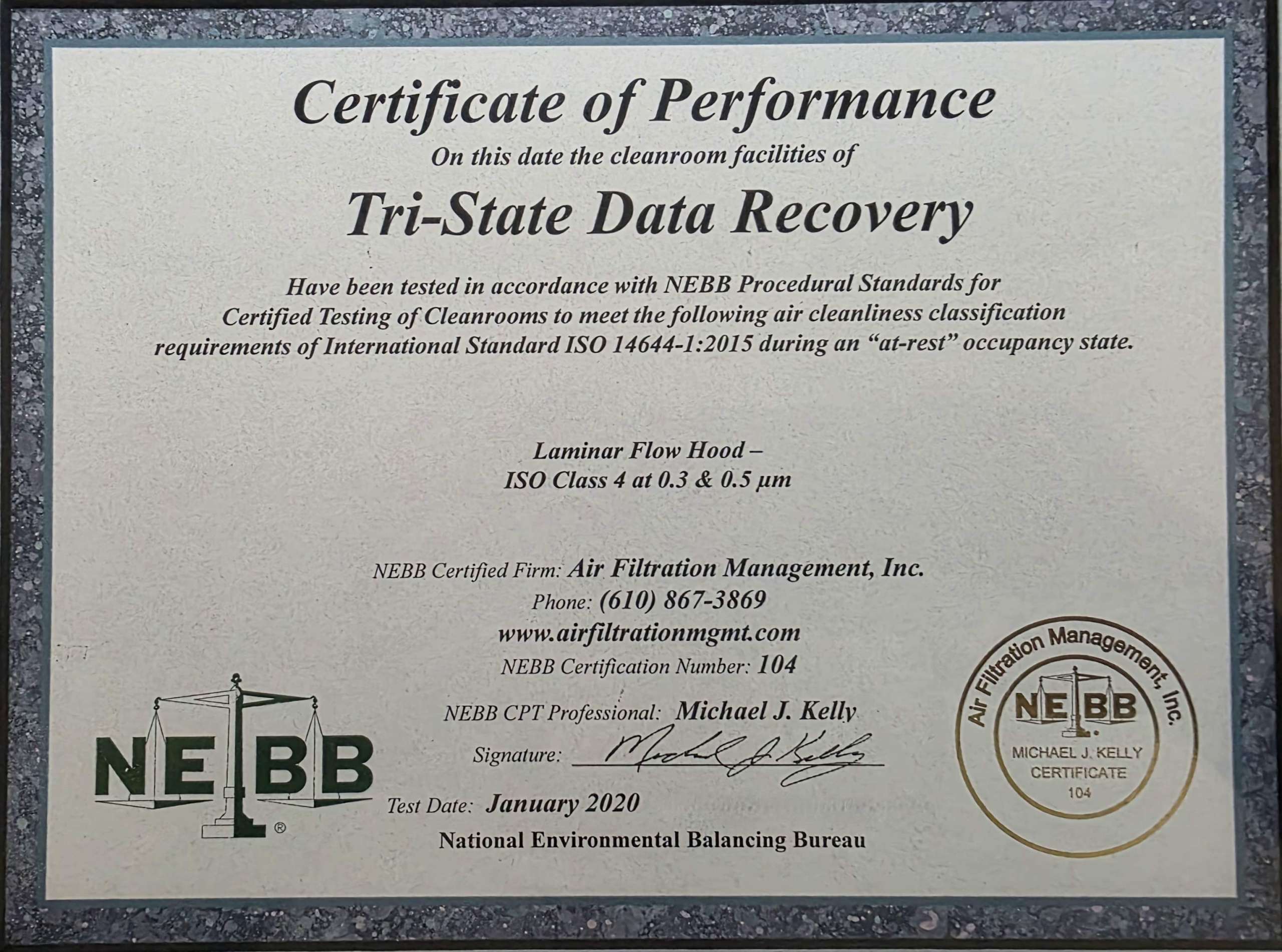
Nobody. A clean room certificate is different — issued by an outside testing firm, naming a standard and a class, signed by the technician who performed the test. That’s the difference between a claim and a document, and it’s why we publish no success rate: you couldn’t verify ours either.
THREE CHECKS, UNDER TWO MINUTES
What a Listing Can’t Fake
All three work on us as well as on anyone else. Run them before you hand a drive to anybody.
1. CHECK THE ADDRESS ON MAPS STREET VIEW
Most national companies use “fronts” – repair shops to share their address for a location on maps on arrangement. If you search the address you will find the company that actually resides there. Your drive is not opened or recovered there and the chain of custody will immediately be lost once it gets shipped out to a third party that you don’t even know, being exposed to many risks.
Our answer: The same address on all of our pages , where you meet with our engineer at our corporate office – 630 Freedom Dr Fl 3, King of Prussia, PA 19406
2. ASK WHICH ISO CLASS, AND FOR THE CERTIFICATE
ISO 14644-1 runs 1 to 9, lower is cleaner, each step about ten times. “ISO-certified” with no number tells you nothing — Class 9 is roughly an ordinary office, and “Class 100” comes from a standard withdrawn in 2001. Ask for the document naming the testing firm, the standard, the class, the date and the signatory.
Our answer: ISO Class 4 under ISO 14644-1:2015, certificate viewable today
3. ASK WHAT IT COSTS BEFORE YOU SEND ANYTHING
A published diagnostic fee and a published range can be compared before you commit. A free evaluation with the price set afterwards with middle man fees can’t — and by the time the number arrives, your only copy is already in somebody else’s building.
Our answer: Most single-drive physical recoveries from $400, published before you call.
EXPERIENCE THE DIFFERENCE
A Generated Page, or a Document
SAME COUNTY, TWENTY-FIVE MINUTES AWAY
Nothing Here Needs to Leave Montgomery County
Most of our location pages have to make an argument about distance. This one doesn’t. Lansdale, Hatfield and King of Prussia are all in Montgomery County, twenty-five to thirty minutes apart, and the laboratory that opens your drive is a Montgomery County facility. Your data does not cross a county line, let alone a state one.
That matters more than convenience for a lot of the work that comes out of the North Penn area. Pharmaceutical and manufacturing offices along the 309 corridor, medical and dental practices, and small firms holding regulated records all have to be able to say where a drive went and who handled it. We keep a documented chain of custody from intake to return, sign NDAs on request, execute a Business Associate Agreement where health data is involved, and securely erase recovered data two weeks after completion unless you arrange otherwise in writing.
And there is no partner facility anywhere in that process, which means the question “where did our data go and who has access to it” has a one-sentence answer with an address and name in it. If your procurement needs the paperwork — certifications, NDA, data handling and retention policy — ask on the first call and it comes as one packet rather than a piece at a time.
WHAT WE RECOVER
PRACTICES, PLANTS AND NORTH PENN HOUSEHOLDS
Hard Drive Recovery
Hard drives that are clicking, seized and beeping from a drop; head crashes, firmware faults and bad sectors caused from media damage. Weak or faulty head assemblies replaced with precision-matched donor parts inside our certified clean rooms.
SSD & NVMe Recovery
These devices degrade while in use and develop bad sectors , firmware corruption and some times require NAND-level recovery on solid-state drives that are no longer recognized. Degraded NVMe drives require specialized hardware, not a software license.
RAID, NAS & Servers
Failed rebuilds, simultaneous drive failures and degraded arrays. Drives bought together fail together, which is why the rebuild rather than the first failure usually ends an array. Power down and call before anyone rebuilds.
PLANT & PRODUCTION SYSTEMS
Machine controllers, production records and the back-office server running a small manufacturer along the 309 and 63 corridors. Say if production is stopped and that case goes to the front of the bench.
Apple & Mac Devices
Macs and MacBooks with a removable SSD or hard drive, Fusion Drives, iMacs, and the MacBook models that carry Apple’s data-recovery (“lifeboat”) connector. Also Airport Time Capsule and LaCie external drives. We don’t perform board repairs on current MacBooks with soldered storage — we’ll tell you that on the first call rather than after we have your machine.