⚠️ A RECOMMENDATION IS ONLY AS GOOD AS THE LISTING BEHIND IT
Data recovery is an unregulated industry in America, and anyone can advertise the service. Nobody inspects the room a drive gets opened in, so a map pin, a directory entry and a summary written by a search engine all describe the same thing: a listing. A listing is a claim about an address. It is not evidence of a laboratory at that address.
Two questions settle it before you hand anything over. Do you open drives here, and if not, what state and what county is my drive opened in, and by whom? Then ask for name and certifications of the engineer and clean room. A company that performs its own recoveries has no reason to withhold any of it.
DATA RECOVERY
FISHTOWN, PHILADELPHIA
35 MIN
OUT THE SCHUYLKILL – PARKING AT OUR END
A certified clean room laboratory serving Fishtown, Northern Liberties, Kensington and Port Richmond. Clicking, dropped, dead and physically damaged hard drives, SSDs, RAID arrays and old media, opened by the engineer who you speak with on the phone.
WHERE THE DRIVE ACTUALLY GOES
A DROP-OFF OFFICE IS A MAILING POINT WITH A DOOR
A great deal of advertised data recovery is collected in one place and performed in another. The chain usually runs three deep with the most critical gap through several shipping factories and handling: you, the shop or provider that took the drive, and a laboratory nobody named. Each handoff adds a fee, and the invoice shows one number. The price you were quoted then contains somebody else’s fee, a margin you were not shown, shipping risks, possible data theft or a broken chain of custody.

An intake address gives a national operation a local presence without a clean room behind it: the drive is received, logged and shipped onward, and the emergency line that answers at two in the morning is staffed by people who will never see it. If it leaves, ask what state and what county the work is done in, and who opens it. A single laboratory answers with one company and one name. A quote with no laboratory named behind it contains somebody else’s fee, a margin you were not shown, shipping risks, possible data theft or a broken chain of custody.

A neighborhood shop that advertises the service is the same arrangement at walking distance. The counter takes the drive and the physical cases go out, so the company you handed it to, the company on the invoice and the engineer who opens it can be three separate names, and you are told the first one only. The free evaluation completes it, and it is the part to read twice, because a free diagnostic is not a discount. It is the step that removes the paperwork. Where no money changes hands there is no transaction, and where there is no transaction nothing obliges anyone to itemize what was opened, what was removed, what was attempted, or what condition the drive was in when it arrived. You paid nothing, so you are owed nothing on paper. The figure that matters arrives later, after your only copy is already inside a building you have never seen, and by then the question is no longer what the recovery costs. It is what it costs to get the drive back.
This page was written for Fishtown because our mission statement is to give the Tri-State area a local option, not generated for it. Your drive is opened in our own Montgomery County laboratory, by the engineer who you speak with on the phone, and no case is outsourced to a partner laboratory. Ask us for the certificate and the certifications before you commit to anything, and ask anyone else for theirs.
HOW A NEIGHBORHOOD RECOMMENDATION GETS BUILT
AN ANSWER WRITTEN ABOUT YOU, FROM LISTINGS ABOUT SOMEBODY ELSE
Ask for a data recovery company in Fishtown and you will increasingly get a written answer rather than a list of links. It reads like advice from somebody who knows the neighborhood. It is assembled from map listings, directory entries and review counts, which is a different thing entirely.
That distinction matters because of what those sources can and cannot carry. A listing records a name, an address, a category and a phone number. It records nothing about what is behind the door. There is no field for which ISO class the clean room is, no field for which company physically opens the drive, and no field for what state that happens in. So a summary built from listings describes what is listed, in the confident voice of something that has been there.
Three things follow from that, and none of them depend on who is ranking today.
A listing can sit inside another business, and that does not happen by accident. A national operation uses a repair shop to host its map listing, and the shop’s address becomes that company’s address. Somebody agreed to that. You cannot host another company’s listing at your counter without knowing you are doing it, so a shared address is an arrangement between two businesses rather than a coincidence of geography. The summary reads it as a laboratory on the Avenue. What is on the Avenue is a counter.
That is worth knowing before you walk in, because it changes which question to ask. The shop is not a neutral party pointing you toward the best option. It is one end of an arrangement, and you are at the other end of it. So ask the shop directly, and ask it before you hand anything over: do you receive a referral fee, a commission or any other payment for recovery work you hand off? It is an ordinary question to ask any business that recommends another one, you are entitled to the answer, and how it is answered tells you most of what you need to know.
Two listings at one address read as two independent options. When a shop hosts a national company’s listing, that single address carries two business names, two categories and two phone numbers. A summary comparing local choices reads them as two separate companies and can hand you both, one as the specialist and one as the alternative, to weigh against each other.
Follow what that does to a careful reader. They call the first name, are not convinced, and call the second name for a second opinion. Both calls reached the same building. The comparison they believe they just made never happened, and the drive goes to the same place either way.
Here is the part most people get wrong, and it is worth getting right. Sharing an address is not a violation. Two businesses can legitimately occupy one building, and a laboratory can legitimately decline to publish a street address for evidence-handling and HIPAA reasons. Google’s requirement is narrower and more useful than that: a business listing an address must make in-person contact with customers there during its stated hours, must be staffed there by its own people, and must hold permanent signage in its own name. The question is never whether an address is shared. It is whether anybody from the named company works there.
That question has an answer you can get in one phone call, and it does not require you to know anything about either business. Ask whether you can bring the drive to that address today and hand it to the person who will open it. A laboratory at that address says yes, or explains why the laboratory address is not published and tells you the town and the county it is in. An address where nobody from that company works cannot answer the question at all, and you will hear that in the first ten seconds.
Numbers get repeated without a source. Success rates stated to a decimal point, turnaround promises and extended opening hours all travel from a listing into an answer unchanged. No independent body audits a data recovery success rate. Nobody verifies that a lab answering at eleven at night has an engineer in the building rather than a line that rings somewhere else.
The correction takes about three minutes and it works no matter what the answer says next month. Take the street address out of the recommendation and search the number on its own. See every business that returns at it. Put it into Street View and read the sign on the building, because permanent signage in the company’s own name is a requirement rather than a nicety. Compare the opening hours of any two listings at one address, since identical hours usually means one storefront. Then call and ask to bring the drive in and hand it to the engineer. An address where nobody from that company works cannot answer that question, and you will hear the hesitation before you hear the answer. We have walked this. Nine addresses in Bucks, Montgomery, Delaware, Philadelphia and Monroe counties, visited in person, photographed, and filed with Google in a single Business Redressal submission in September 2026, with our competitive interest disclosed inside the filing. Every one of them is occupied by an unrelated business. Two of them sit about five miles apart and return in search as two separate local laboratories with two separate phone numbers. The addresses, the photographs and the dates are on our data recovery scams page.
THREE CHECKS, UNDER TWO MINUTES
WHAT A FAMILIAR NAME CAN’T TELL YOU
All three work on us as well as on anyone else. Run them before you hand a drive to anybody.
READ THE FULL STREET ADDRESS, THEN MAP IT
Not the neighborhood in the headline. The street number, the street, and the part of the city it is actually in. A drop-off office and a laboratory are not always the same building, and often not the same state. Put the address into a search by itself, see who else is listed there, and read the sign on the building in Street View.
Ours: client drop-off and collection at 630 Freedom Business Center Drive, Floor 3, King of Prussia, with the laboratory itself in Montgomery County
ASK WHO OPENS THE DRIVE, AND WHAT THEY ARE CERTIFIED ON
Anyone with money can purchase expensive equipment, but how do you know they are experts on it without proper training? Ask which platforms the engineer is certified on, who issued the certification, and whether they will email you the documents. Then ask whether you can speak to that person before you commit, and ask for the split between the company’s fee and the laboratory’s. A case number is an answer to a different question.
Our answer: the owner/engineer opens every drive, expert-certified on PC-3000 and DeepSpar and micro soldering certified through ACI Technologies in Philadelphia
ASK WHICH ISO CLASS, AND FOR THE CERTIFICATE
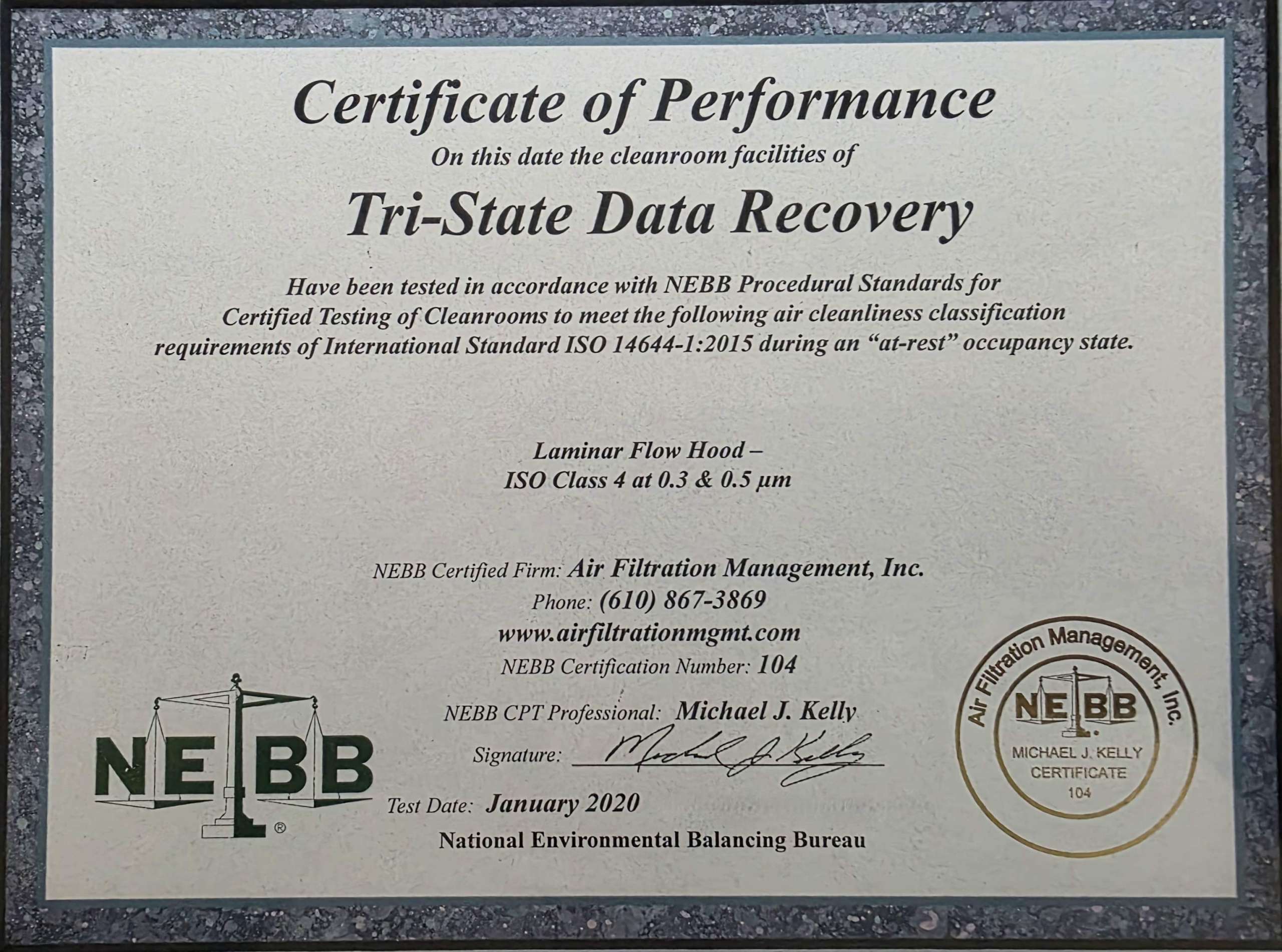
ISO 14644-1 runs 1 to 9, lower is cleaner, each step about ten times. “ISO-certified” with no number tells you nothing. Class 9 is roughly an ordinary office, and “Class 100” comes from a standard withdrawn in 2001 and is about equal to ISO Class 5, one step dirtier than the Class 4 this work is done to. Ask for the document naming the testing firm, the standard, the class, the date and the technician who signed it. A certificate names four things: who issued it, who it was issued to, what it covers and the date. Anything missing one of those is a sentence, not a credential. This matters more than anything when the platters are exposed for hours during a multi-platter recovery procedure.
Our answer: two clean room flow hoods, both independently certified to ISO Class 4 under ISO 14644-1:2015, certificate viewable here
BEFORE YOU TAKE IT ANYWHERE
TEST THE DRIVE FIRST. ALMOST NOBODY DOES.
One question decides everything that follows, and a free two-minute test answers it: is this a hardware failure or a logical one?
Start by listening to it. If the drive is clicking, grinding, beeping or buzzing, or if it was dropped while running or liquid reached it, do not power it on at all. Those are mechanical failures in progress, and two more minutes of spinning can turn a head problem into platter damage nobody can undo. Unplug it and call.
If it still spins up normally and sounds the way it always has, but it is slow, freezing, throwing read errors or no longer mounting, run the manufacturer’s own quick test before anything else touches it. WD Drive Utilities for Western Digital and SanDisk, SeaTools for Seagate, the Toshiba Storage Diagnostic Tool for Toshiba and Canvio. All three are free, published by the company that built the drive.
Run the short test or the SMART status check only. Never the extended, long or full surface test, which reads every sector on the drive and on a failing one can finish the job. Decline any option to repair, fix or erase, and do not run CHKDSK, because those write to the drive rather than read from it.
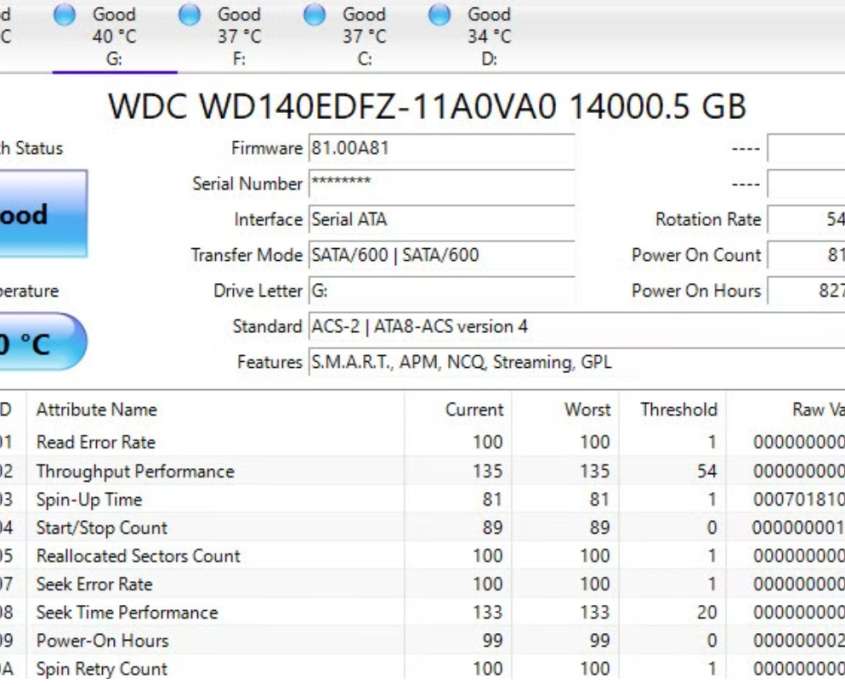
A failed test is your answer: that is hardware, and nothing on a repair counter will fix it. A passed test narrows things toward a logical fault, which is the cheaper outcome, but it does not clear the drive, because SMART reports a pass on plenty of drives already in trouble. Either way, write down what it said. It is the first thing we will ask you on the phone, and the first thing any laboratory should want to hear.
This is the step that gets skipped, and it is the most expensive habit in the trade. The drive goes across a counter, a recovery program is started because that is what is on the counter, and the test that would have stopped the whole sequence never happens. The full version, including the SMART attributes worth reading, is on our data recovery tips page.
WHAT ACTUALLY HAPPENS TO A FAILING DRIVE
A REPAIR COUNTER AND A LABORATORY ARE DIFFEREN
A counter diagnoses a failing drive by reading it, because that is the only instrument on the counter. The software assumes a healthy drive with a logical fault, so it starts at the beginning and works through to the end, hammering the damaged areas hardest, on the one copy you have. A failing drive has a finite number of reads left in it, and that is how they get spent. Every minute of the attempt is spent out of the drive’s remaining life resulting in creating more bad sectors, a head crash or complete destruction of the drive. Local shops have been known to still charge a hefty price for returning only corrupted data.
A laboratory uses professional hardware like the PC-3000 to test the drive, unlock its service area, back up and repair its firmware, create a head map and target the sectors relevant to your data. The file table is read first, so the imaging is aimed at the sectors your files actually occupy, with the weakest areas left for last, while also separating any damaged files so you know exactly what you are paying for. Consumer software has no such target: it attempts a full clone and spends the drive’s remaining reads on empty space. If heads have to be replaced, it is done with precision-matched donor parts inside a certified clean room, because a single particle on a platter surface is larger than the flying height of the head.
Modern hard drives add a further requirement. The circuit board carries a serial flash ROM holding adaptive data unique to that drive that needs modification to allow access to the service area, so modern data recovery means advanced micro soldering, chip replacement and reflow, and ROM programming and SED unlocking. It takes expert-level training to do any of that without destroying the board or the chip.
None of that equipment is something a counter owns. It costs more than the shop’s entire tool inventory and it takes years to use properly. What costs you the data is not the diagnosis, it is the attempt. If your drive has already been through it, say so on the first call. It changes the approach, and what can be done.
EXPERIENCE THE DIFFERENCE
AN INTAKE ADDRESS, OR A LABORATORY
WHERE YOUR DRIVE ACTUALLY GOES
OUR OFFICE, AND OUR LABORATORY
We are one company with one point of contact: our headquarters in King of Prussia. It shares a building with other businesses, but our office is private and ours alone, and the signage inside reads Tri-State Data Recovery.
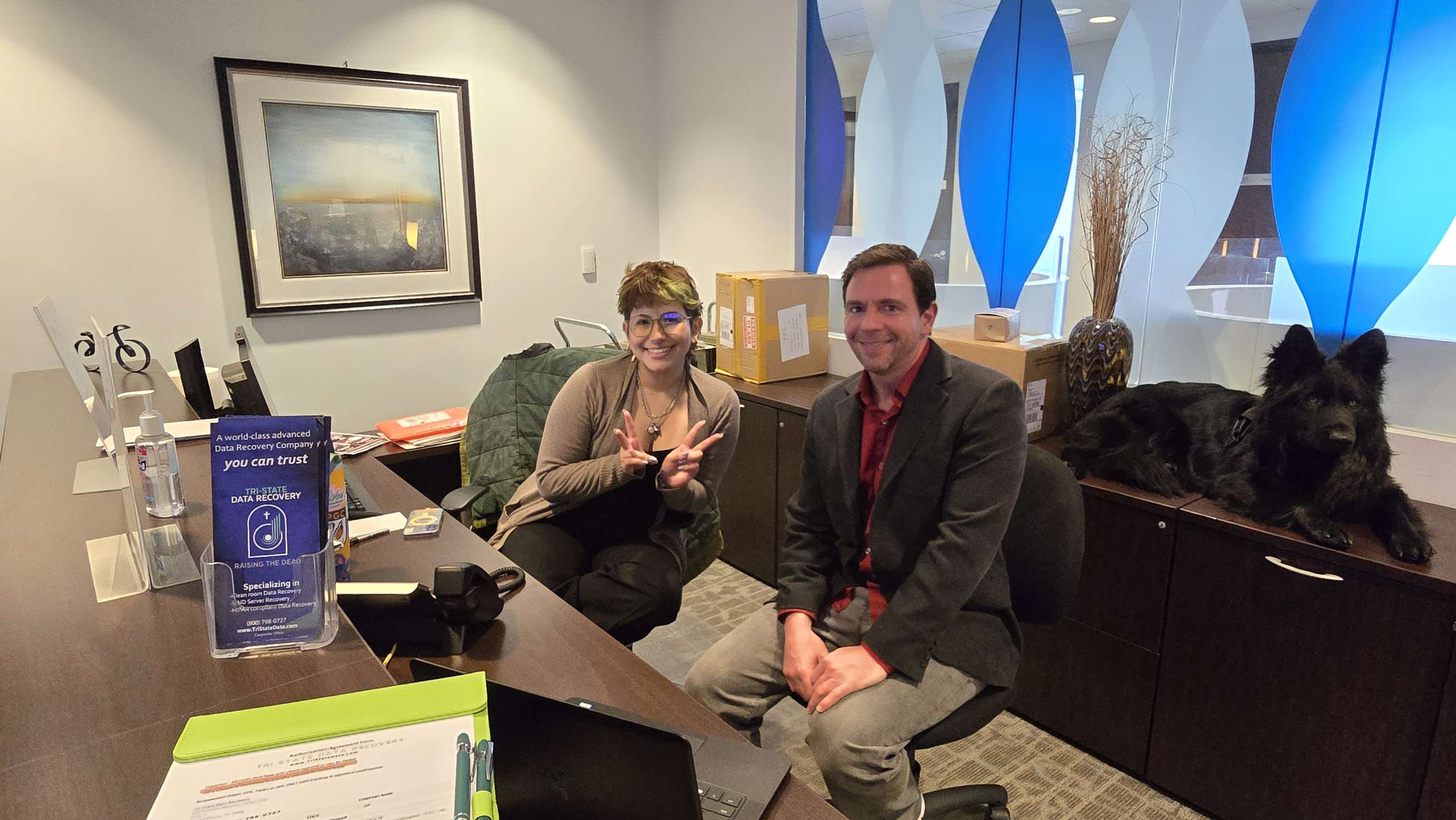
Our recovery laboratory and certified clean rooms are housed separately, in an undisclosed, camera-monitored secure compound in Montgomery County. That facility is not open to the public, and by design. The sensitive data we handle, including files that may serve as legal evidence, demands strict chain-of-custody and HIPAA compliance, and a secure, access-controlled lab is how we guarantee it. Your drive never leaves Montgomery County or our chain of custody. And the engineer you speak with on the phone is the same person who opens it.
The end of the job deserves the same attention as the beginning. A mail-in operation typically finishes by uploading your recovered files to a cloud account and emailing you a download link, and the speed of that handoff is what gets advertised. Count what it takes to get there. Your only copy travels through a courier system, it is handled by technicians you never meet in a building you have never seen, and then a second copy of everything is pushed to a third party’s servers, under a retention policy you did not choose and cannot audit, reachable by a link that arrives in your email. A company can call that secure. It cannot show you the copy being deleted. We hand your data back in person at our King of Prussia office, on media, and you verify your files with the engineer before you pay. Recovered data is securely erased two weeks after completion unless you arrange otherwise in writing.
WHAT WE RECOVER
STUDIOS, SMALL BUSINESSES AND ROWHOUSE HOUSEHOLDS
Hard Drives
Clicking, grinding, dropped, or beeping drives; bad sectors, firmware failure, and physical damage — recovered in our certified ISO Class 4 clean rooms.
SSD & NVMe
Solid-state storage degrades with use, and when it fails there’s no warning. Controller failure, corrupted firmware, degraded NAND, and drives that vanish from BIOS, recovered in-house with PC-3000 and DFL, including chip replacement and advanced chemical cooling and reflow techniques. Certified in advanced micro-soldering through ACI Technologies in Philadelphia.
RAID, NAS & Servers
Failed rebuilds and degraded arrays in offices and households. Every member is repaired and imaged individually before we attempt to reconstruct the copies. Drives bought together fail together, which is why the rebuild rather than the first failure usually ends an array. Power down and call before anyone rebuilds.
PRACTICES & PROFESSIONAL FIRMS
Client files, case records and practice systems across the northwest of the city. NDA before work begins, Business Associate Agreement where health data is involved, and documented custody from intake to return, in one building under one name.
Apple & Mac
Macs and MacBooks with a removable SSD or hard drive, Fusion Drives, iMacs, Airport Time Capsule and LaCie external drives. On 2016 and 2017 MacBook Pro models we can read the onboard storage using Apple’s Customer Data Migration Tool. We don’t perform board repairs of any kind, so machines with a T2 chip or Apple Silicon are declined on the first call rather than after we have your machine.
SECOND OPINIONS
OLD DRIVES & OBSOLETE FORMATS
STUDIOS, PHOTOGRAPHERS & MAKERS
Shoots, sessions, masters and client archives on external drives and card media, which is most of what this neighborhood keeps. A full external drive is a single point of failure, and the drives that hold a year of work are usually the ones that travel. Bring the enclosure as well as the drive, because the fault is sometimes the bridge board rather than the disk, and that is the cheapest outcome there is.
TWENTY-FIVE MINUTES – WITH PARKING
ONE HAND-OFF INSTEAD OF THREE
A lot of what advertises into Fishtown is a suite number downtown, a listing inside somebody else’s shop, or an operation in another state entirely. The miles are not the thing that matters. The number of hands is. A drive you carry yourself changes hands once. A drive collected at a counter and shipped onward changes hands three or four times, and nobody can account for it end to end.
We are about thirty-five minutes from Frankford Avenue, out the Vine Street Expressway and the Schuylkill, and less than that when the expressway is behaving. Scheduling an appointment and hand delivering the drive is always the safest option and assures the chain of custody is kept intact, and here it also happens to be the shorter trip. You hand the drive to the engineer who will do the work and collect it from the same person. The laboratory itself is a secured Montgomery County facility we don’t open to visitors, because we handle medical records and legal evidence and restricted access is part of the chain of custody.
There is no partner facility anywhere in the process. Your drive is not outsourced, not shipped out of state, and not handled by a company you didn’t choose. If a client, an auditor or an insurer ever asks where the data went, the answer is one sentence with one company in it.